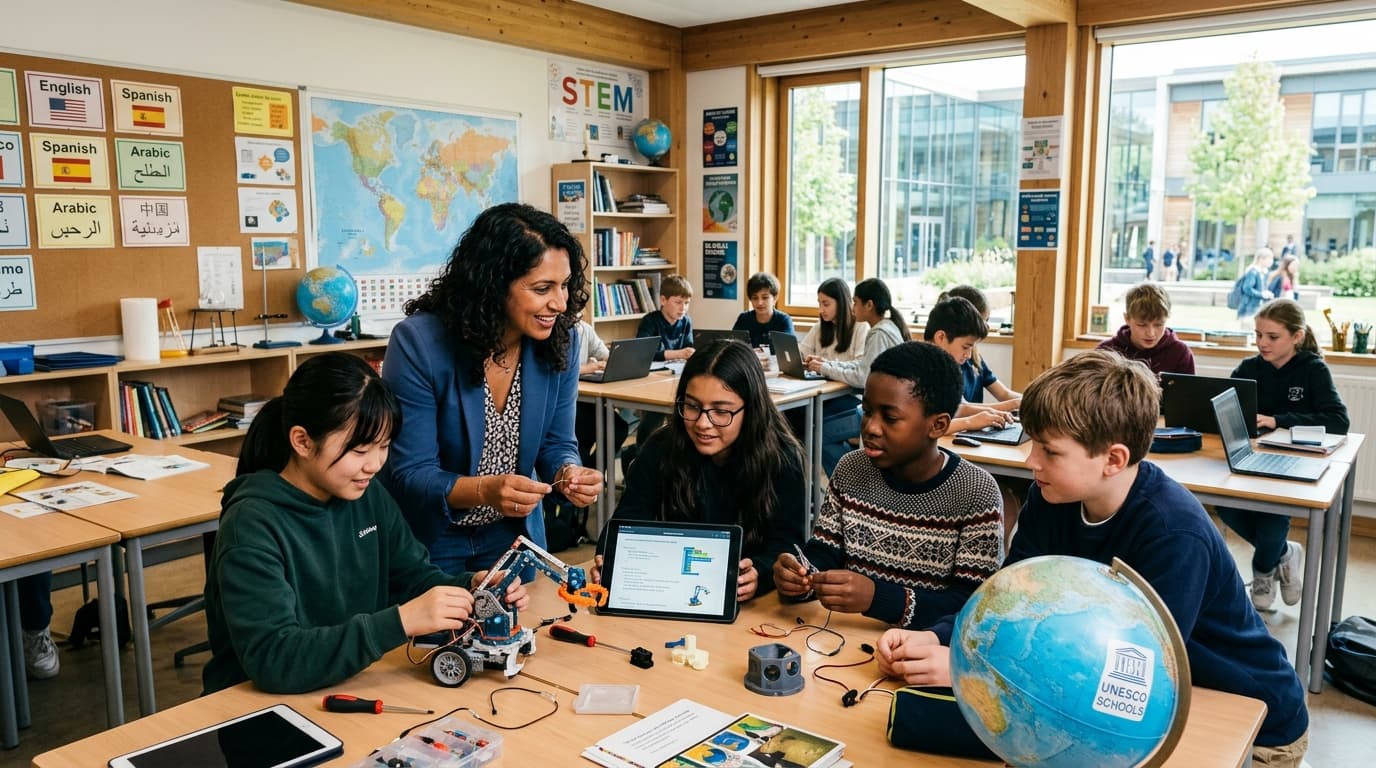
Introduction: The Global Shift Toward Additive Bilingualism
For decades, the dominant institutional paradigm across international education was unapologetically monolingual. English was positioned as the undisputed global lingua franca, while host-country languages, indigenous languages, and students' mother tongues were relegated to isolated "foreign language" electives or, worse, viewed as cognitive obstacles to English proficiency. Many elite international schools strictly enforced "English-Only" campus policies, penalizing students for conversing in Mandarin, Spanish, French, Korean, or Arabic in hallways and playgrounds.
This subtractive educational model is now recognized as cognitively and culturally obsolete. Decades of psycholinguistic research—spearheaded by scholars such as Jim Cummins, Ofelia García, and Colin Baker—demonstrate that forcing a child to suppress their home language diminishes cognitive flexibility, erodes emotional connection to family heritage, and actively hinders academic development.
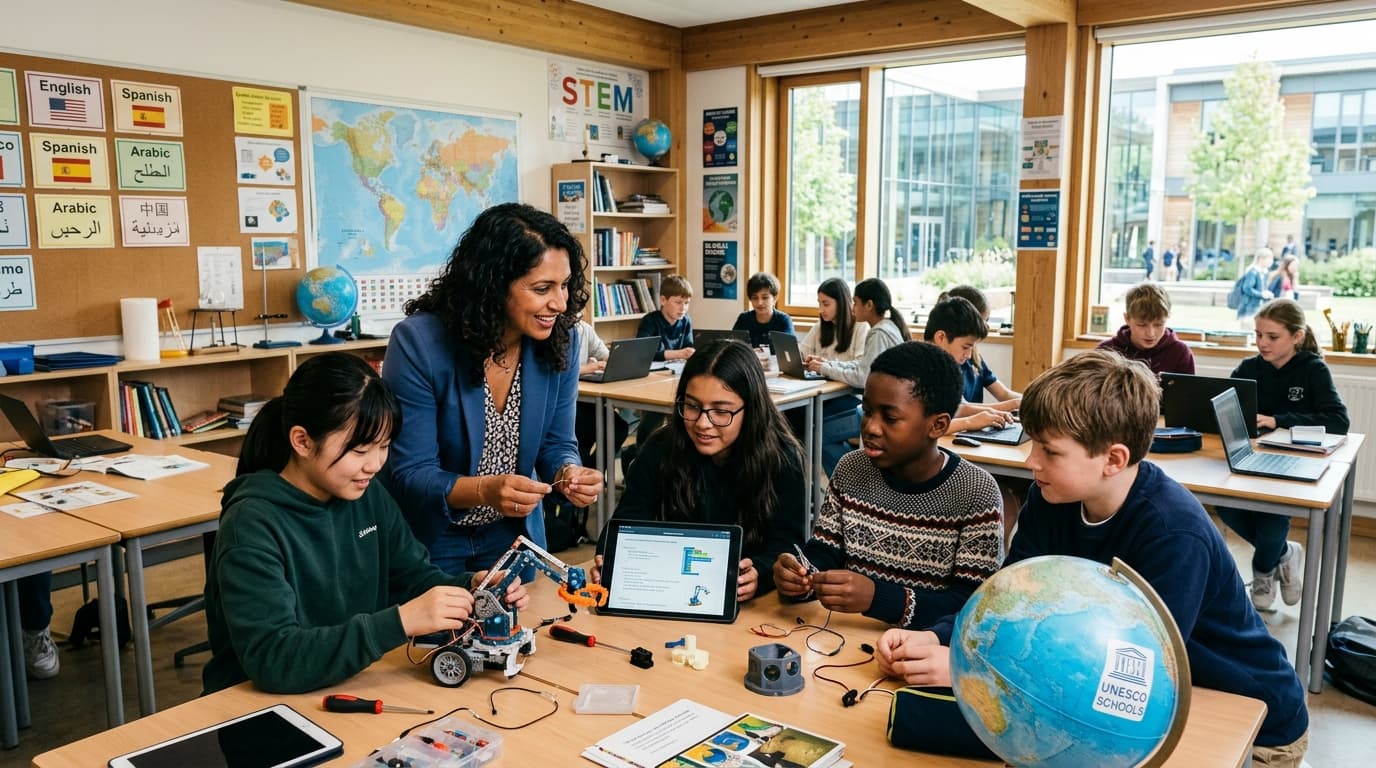
In contrast, Two-Way and One-Way Dual-Language Bilingual Immersion (DLBI) models represent the cutting edge of progressive international education. By delivering rigorous, standards-based academic instruction across two target languages—such as English and Mandarin, English and Spanish, English and French, or English and Arabic—dual-language schools cultivate additive bilingualism, biliteracy, and bicultural competence. In these classrooms, linguistic diversity is not treated as a deficit to be remediated, but as a cognitive superpower.
Yet designing and sustaining a high-performing bilingual immersion program is a complex institutional endeavor. It requires careful decisions regarding language allocation models, disciplined curricular articulation, dynamic translanguaging pedagogies, and equitable biliteracy assessment.
This master guide provides international school leaders, bilingual coordinators, and language specialists with an end-to-end framework for designing, implementing, and assessing dual-language immersion programs. From comparing 90/10 vs. 50/50 structural designs to managing cross-linguistic transfer and biliteracy rubrics, this guide equips schools to build thriving bilingual learning ecosystems.
The Neurobiology of Biliteracy: Interdependence and Cognitive Reserve
To lead an effective dual-language immersion school, educational leaders and faculty must first ground their practice in the cognitive science of bilingual language processing:
1. The Common Underlying Proficiency (CUP)
Jim Cummins' foundational Dual Iceberg Hypothesis reveals that although two languages appear separate on the surface (differing phonemes, syntax, and scripts), they are anchored in a single, shared mental reservoir: the Common Underlying Proficiency (CUP).
When a student learns how to formulate a scientific hypothesis, analyze historical causality, or deconstruct a mathematical word problem in Mandarin or Spanish, they do not need to re-learn those abstract intellectual skills when operating in English. The underlying cognitive architecture transfers fluidly across languages once the student acquires the surface linguistic labels.
2. Enhanced Executive Function and Cognitive Reserve
Neuroimaging studies consistently demonstrate that proficient bilinguals exhibit superior executive functioning compared to their monolingual peers. Because both languages remain active simultaneously in the bilingual brain, the prefrontal cortex must continuously recruit cognitive inhibition and working memory to suppress the non-target language. This lifelong neural workout enhances mental agility, abstract problem-solving stamina, and cognitive flexibility well into adulthood.
Comparing Language Allocation Models: 90/10 vs. 50/50 Architectures
The foundational structural decision for any dual-language school is selecting an appropriate Language Allocation Architecture:
Operationalizing the 50/50 Model in International Schools
For most international schools operating in multicultural gateway cities (Singapore, Hong Kong, Dubai, Geneva, São Paulo), the 50/50 Simultaneous Model provides the most viable operational framework. Schools typically organize 50/50 schedules using one of three structural options:
| Schedule Variation | Structural Mechanics | Advantages for Learning | Operational Challenges |
|---|---|---|---|
|
The Half-Day Switch
|
Morning taught in Target Language A (e.g., Spanish); afternoon taught in Target Language B (English).
|
Daily contact with both languages; prevents cognitive exhaustion; predictable daily routines.
|
Short instructional blocks; teachers must execute daily transitions smoothly.
|
|
The Alternate-Day Model
|
Monday/Wednesday/Friday in Language A; Tuesday/Thursday in Language B (reversing weekly).
|
Deeper, uninterrupted immersion; longer project-based learning blocks.
|
48-hour gap between language exposure can disrupt emerging speakers; requires diligent calendar tracking.
|
|
Subject-Disciplinary Split
|
Math and Science taught in Partner Language; Humanities and Arts taught in English (or vice versa).
|
Natural contextual academic vocabulary; clear institutional identity for each subject.
|
Risk of creating language hierarchy (e.g., "English is for creative arts, Chinese is for hard sciences").
|
Translanguaging Pedagogy: Moving from Rigid Separation to Fluid Asset
Historically, dual-language immersion adhered to rigid "language separation" dogmas. Teachers were instructed to strictly punish any student who code-switched or used their native tongue during the partner language block.
Contemporary sociolinguistics, led by Dr. Ofelia García, demonstrates that multilingual humans do not possess two separate linguistic brains; they possess a single, integrated linguistic repertoire. Translanguaging is the deliberate pedagogical practice of allowing students to draw strategically from their full linguistic toolkit to make meaning, solve problems, and deepen understanding.
Strategic Translanguaging vs. Chaos: Ground Rules for the Classroom
Translanguaging is not a free-for-all where students abandon the partner language. It is an intentional instructional scaffold with explicit boundaries:
- Language Spaces: Clearly designate instructional phases. During a designated "Immersion Output Phase," students must strive to produce work in the target language.
- Cognitive Scaffolding: Allow students to take initial research notes, construct concept maps, and conduct peer consultations in their strongest linguistic repertoire. Once conceptual clarity is achieved, guide them to express their final academic product in the target language.
- Cross-Linguistic Bridging (The Dictado / Contrastive Analysis): Dedicate 15 minutes weekly to explicit cross-linguistic analysis. Compare how punctuation, false cognates, syntax, and idioms work in Language A versus Language B (e.g., analyzing why Spanish capitalization rules differ from English, or examining how Mandarin tonal nuances compare to English intonation).
Curricular Articulation: Avoiding the "Duplicate Curriculum" Trap
A disastrous error in dual-language programming is the "duplicate curriculum"—teaching the exact same content twice. For example, having the English teacher spend Tuesday teaching photosynthesis, followed by the Spanish teacher spending Wednesday repeating the identical photosynthesis lesson in Spanish.
Lesson Planner
Generate comprehensive, CAPS-aligned lesson plans in seconds.
Duplicate instruction produces boredom, wastes precious instructional hours, and encourages students to simply "tune out" during the partner language class because they know the content will be re-explained in English.
The Unified Thematic Curriculum Model
High-performing dual-language schools design articulated, complementary curricular trajectories:
Authentic Biliteracy Assessment: Decoupling Testing from Monolingual Norms
Assessing bilingual students using monolingual standardized tests designed for native speakers in London or Chicago produces distorted, deficit-based diagnostic data. A bilingual child’s total vocabulary across both languages frequently matches or exceeds that of a monolingual peer, even if their vocabulary in each single language appears slightly lower when evaluated in isolation.
The Holistic Biliteracy Assessment Matrix
Dual-language schools must assess student growth using Holistic Biliteracy Portfolios:
The ACTFL and CEFR Biliteracy Progression Targets
Dual-language programs should establish transparent, multi-year proficiency targets aligned with internationally recognized standards:
| Grade Level | English Target (ACTFL / CEFR) | Partner Language Target (ACTFL / CEFR) | Expected Academic Literacy Milestone |
|---|---|---|---|
|
Kindergarten / Reception
|
Novice High / A1
|
Novice Mid / A1
|
Phonemic awareness, basic decodable texts, simple oral storytelling in both scripts.
|
|
Grade 2 / Year 3
|
Intermediate Low / A2
|
Novice High / A1-A2
|
Independent reading of early chapter books; functional paragraph writing with sentence frames.
|
|
Grade 5 / Year 6
|
Intermediate High / B1
|
Intermediate Mid / B1
|
Analytical reading across genres; multi-paragraph informational and narrative compositions.
|
|
Grade 8 / Year 9
|
Advanced Low / B2
|
Intermediate High / B1-B2
|
Academic argumentation, scientific lab reports, debate fluency, literary textual analysis.
|
|
Grade 12 / Year 13
|
Advanced Mid-High / C1
|
Advanced Mid / B2-C1
|
Capstone scholarly research paper, bilingual graduation diploma, university-level biliteracy.
|
Staffing, Co-Teaching, and Professional Development
The ultimate success of any dual-language immersion program rests upon the pedagogical skill and relational harmony of its teaching faculty. Two primary staffing configurations predominate:
1. The Two-Teacher Side-by-Side Model
Two co-equal educators share an identical cohort of students. Teacher A is a native or fully certified bilingual specialist instructing exclusively in the partner language; Teacher B instructs in English.
- The Golden Rule: Co-Planning Parity. Both teachers must be provided shared daily planning time. If Teacher A and Teacher B do not plan together, the curriculum quickly fractures into two disconnected, competing programs.
- Equal Status in the Classroom: The physical classroom environment must reflect absolute linguistic and cultural equity. Wall space, classroom library shelves, bulletin boards, and visual displays must be divided 50/50 between both languages.
2. The Single Bilingual Generalist Model
A fully bilingual educator teaches both languages to their own self-contained class, switching language modes according to the established schedule. While operationally simpler and cost-effective, this model requires educators with exceptional dual-native fluency and pedagogical mastery in both languages.
The Cross-Linguistic Transfer Protocol: "The Bridge" in Action
To ensure that learning in one language systematically enriches the other, dual-language educators utilize a structured routine known as "The Bridge" (developed by Karen Beeman and Cheryl Urow). The Bridge is the instructional moment when teachers guide students to transfer concepts learned in one language into the other, engaging in explicit contrastive analysis:
Exemplar 60-Minute Co-Taught Dual-Language Lesson
Below is an authentic lesson architecture illustrating how co-teachers execute a 50/50 bilingual session without language contamination or duplicate instruction:
- Minutes 0–15 (Mandarin Immersion - Teacher A): Teacher A introduces an environmental science inquiry on ecosystems. Students conduct hands-on soil testing, logging moisture and pH levels in Mandarin using guided observation logs.
- Minutes 15–35 (Collaborative Processing & Translanguaging): In small heterogeneous groups, students analyze soil quality. Students discuss in their preferred linguistic mix, clarifying technical terms before finalizing their Mandarin data tables.
- Minutes 35–45 (The Cross-Linguistic Bridge): Both Teachers A and B step forward. Together with students, they build an English-Mandarin scientific vocabulary bridge on the main interactive display, analyzing shared terms and distinct characters.
- Minutes 45–60 (English Application - Teacher B): Teacher B takes over. Students immediately apply their soil findings to write an English policy brief advocating for school garden composting, using the scientific data gathered in Mandarin.
School Leadership Implementation Audit Checklist
School heads and language coordinators can use this diagnostic checklist to ensure their dual-language immersion program is structurally sound:
| Strategic Domain | Implementation Milestone | Status |
|---|---|---|
|
Vision & Model
|
School community has explicitly selected, documented, and published its Language Allocation Model (90/10 or 50/50).
|
Verified [ ]
|
|
Curricular Articulation
|
Schemes of work are non-duplicative, thematic, and conceptually aligned to promote cross-linguistic transfer.
|
Verified [ ]
|
|
Translanguaging Policy
|
Faculty trained in structured translanguaging strategies, contrastive analysis, and intentional language spaces.
|
Verified [ ]
|
|
Library & Resources
|
Library budget allocated equitably; classroom libraries contain rich, high-quality, authentic literature in both languages.
|
Verified [ ]
|
|
Biliteracy Assessment
|
Assessment systems track holistic biliteracy growth rather than evaluating each language through monolingual tests.
|
Verified [ ]
|
|
Parent Education
|
Regular parent workshops demystify bilingual acquisition timelines, easing parental anxiety regarding early language mixing.
|
Verified [ ]
|
Conclusion: The Gift of Biliteracy for a Changing World
Establishing a world-class dual-language bilingual immersion program is one of the most visionary investments an international school can make. It demands intellectual discipline, cultural humility, collaborative teaching architectures, and an unwavering commitment to equity.
When we empower children to become truly biliterate, we do not merely give them two separate vocabularies; we expand their cognitive horizons and deepen their cultural empathy. In a complex, interconnected world, the ability to think, reason, create, and build bridges across multiple languages and cultures is among the greatest gifts an international education can bestow.