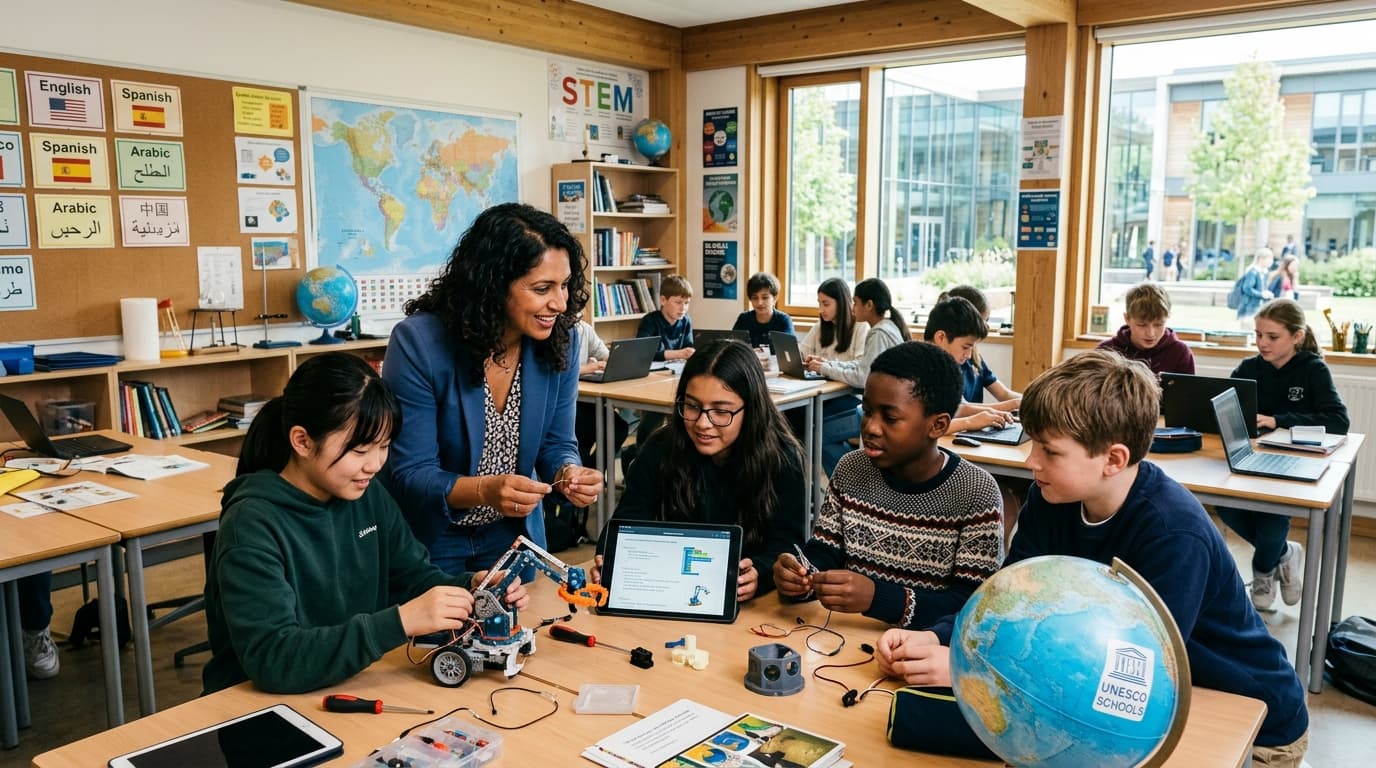
Executive Summary: Dismantling Monolingual Ideologies in Global Education
In international schools across Europe, Asia, the Middle East, Latin America, and Africa, the linguistic landscape is radically pluralistic. While the vast majority of these institutions operate under an English Medium of Instruction (EMI) banner, between 60% and 90% of their enrolled students speak languages other than English as their mother tongue. In any single Year 7 or Grade 9 classroom, an educator might teach students whose home languages include Mandarin, Arabic, Spanish, Russian, Korean, Hindi, and Portuguese.
For decades, international schools addressed this linguistic diversity through an assimilationist, monolingual paradigm: strict "English-Only" school rules, punishments for students heard speaking their native languages in corridors or lunchrooms, and withdrawal-based ESL support that viewed non-English mother tongues as a barrier to be eradicated. Applied linguistics and cognitive neuroscience have decisively proven that suppressing a student’s first language actively impairs their cognitive development, delays English language acquisition, and causes profound socio-emotional alienation.
| E ENGLISH- │ | │ ADDITIVE TRANSLANG |
|---|---|
|
EGIME │
|
│ ECOSYSTEM
|
|
Only" rules│ uage banned│ erspective │ nguage depts│ luency │ with CALP │
|
│ • Full unitary linguis repertoire leveraged │ • WIDA 2020 Standards │ • Disciplinary langua every subject area │ • Multimodal digital p
|
The contemporary international school standard is grounded in Additive Multilingualism and Translanguaging Pedagogy, operationalized through the WIDA English Language Development (ELD) Standards Framework (2020 Edition). This approach recognizes that multilingual individuals do not possess two or three separate linguistic brains; they possess a single, integrated, unitary linguistic repertoire. By strategically activating students’ complete linguistic repertoires, international teachers accelerate academic literacy, deepen conceptual comprehension, and affirm the cultural dignity of every learner.
This guide provides international educators, EAL specialists, and school leaders with an operational manual for deploying WIDA ELD standards, structuring translanguaging classrooms, and implementing multimodal language portfolios.
1. The WIDA English Language Development (ELD) Standards Framework (2020 Edition)
Adopted by hundreds of top-tier international schools worldwide, the WIDA ELD Framework provides an asset-based roadmap for language acquisition integrated directly with academic content.
| Standard 1: Social & Instructional | Multilingual learners communicate for Social and Instructional purposes within the school setting. |
|---|---|
|
Standard 2: Language of Language Arts
|
Multilingual learners communicate information, ideas, and concepts in Language Arts.
|
|
Standard 3: Language of Mathematics
|
Multilingual learners communicate information, ideas, and concepts in Mathematics.
|
|
Standard 4: Language of Science
|
Multilingual learners communicate information, ideas, and concepts in Science.
|
|
Standard 5: Language of Social Studies
|
Multilingual learners communicate information, ideas, and concepts in Social Studies.
|
The 4 Key Language Uses (KLUs)
WIDA compresses academic language across all disciplines into four overarching Key Language Uses:
- Narrate: Conveying experiences, fictional or real, through sequential character arcs and perspectives.
- Inform: Defining, describing, categorizing, and comparing phenomena using factual taxonomies.
- Explain: Illuminating how or why phenomena function, detailing causal mechanisms and consequences.
- Argue: Advancing claims, justifying stances with empirical evidence, and rebutting opposing perspectives.
2. The 6 WIDA Proficiency Levels: The Language Continuum
WIDA defines language acquisition across six developmental proficiency levels:
| Level 1: Entering | Understands simple commands, gestures, and pictorial cues; produces single words or chunks. |
|---|---|
|
Level 2: Emerging
|
Understands basic phrases; produces simple sentences; relies on high visual scaffolding.
|
|
Level 3: Developing
|
Conversational fluency established; comprehends main ideas; writes compound sentences with errors
|
|
Level 4: Expanding
|
Competent academic English; interprets complex syntax; writes organized multi-paragraph essays.
|
|
Level 5: Bridging
|
Advanced academic English; grasps abstract nuance and technical register; minor idiomatic gaps.
|
|
Level 6: Reaching
|
Fully proficient; matches native-speaking peers across all academic modalities and disciplines.
|
3. Translanguaging Pedagogy: Theory and Classroom Operationalisation
Pioneered by Cen Williams and advanced by Dr. Ofelia García and Dr. Li Wei, Translanguaging refers to the deployment of a speaker’s full linguistic repertoire without regard for political, national, or institutional language boundaries.
| DUAL VIEW │ te Boxes) │ | │ TRANSLANGUAGING REA │ (One Unified Syst |
|---|---|
|
rean ] │ vocabulary │ grammar │ │ glish ] │ vocabulary │ grammar │ segregated │ oom │ │ │
|
│ ┌──────────────────── │ │ CENTRAL COGNITIVE │ │ CONCEPTUAL STORAG │ │ (Mathematics, Scien │ │ Literacy, Metacogn │ └────────────┬─────── │ │ │ ┌───────┴─────── │ ▼ │ [Korean] [Eng │ (Surfacing Words & L
|
Strategic Translanguaging vs. "Random Chatter"
Translanguaging in the classroom is not an undisciplined free-for-all where students disconnect from English. It is a purposeful, planned pedagogical strategy consisting of three distinct phases:
┌────────────────────────────────────────────────────────────────────────┐
│                   THE 3-PHASE TRANSLANGUAGING LESSON ARC               │
└────────────────────────────────────────────────────────────────────────┘
                                   │
    ┌──────────────────────────────┼──────────────────────────────┐
    ▼                              ▼                              ▼
[ PHASE 1: INPUT / RESEARCH ]  ➔ [ PHASE 2: SENSE-MAKING ]  ➔ [ PHASE 3: OUTPUT / TARGET ]
  • Complex academic text in     • Collaborative discussion     • Formal academic product
    English (Target Language)    in home language (L1/L2)       written in Standard
  • Video with native subtitles  • Synthesizing concepts        Academic English
  • Unpacking Tier-3 concepts    • Comparing mental models      • Meets high-stakes criteria
4 High-Impact Translanguaging Classroom Techniques
- Multilingual Jigsaw Inquiry Groups:
- Students investigate a complex global issue (e.g., microplastic ocean pollution).
- In Expert Groups composed of students sharing a home language (e.g., three Korean speakers; four Arabic speakers), students read translated primary documents, analyze data, and debate concepts in their strongest shared language.
- Students then return to their Home Groups (diverse language mix) where all communication must occur in English. Because students deeply understand the concepts from their L1 discussion, their English academic output is articulate, confident, and sophisticated.
- Dual-Language Annotation Margins:
- When reading Shakespeare, a historical treaty, or an advanced biochemistry paper, encourage students to annotate the left margin with notes, diagrams, and reactions in their mother tongue, reserving the right margin for formal English definitions.
- Cross-Linguistic Morphological Hunting:
- Leverage cognates between English, Spanish, French, and Latin/Greek roots. When introducing the term circumnavigate, invite Romance language speakers to identify navegar or circunferência, creating peer bridges that celebrate linguistic assets.
- The Translanguaging Vocabulary Wall:
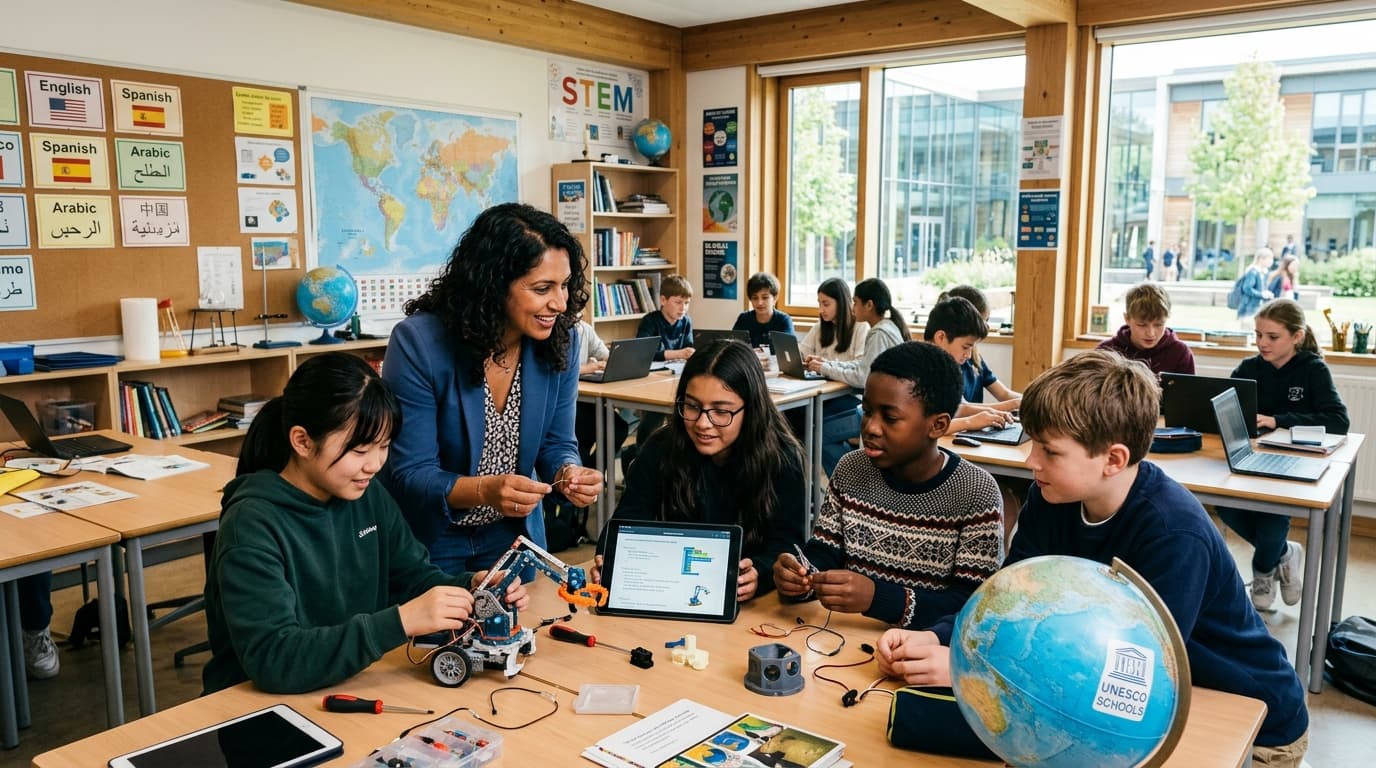
- The classroom vocabulary wall displays essential disciplinary terms translated into the six primary home languages of the cohort, validated by student scribes.
4. Cross-Linguistic Transfer: Comparative Syntax Pitfalls
Multilingual learners constantly map target English syntax against their primary language mental grammars. Understanding these systemic structural variances allows educators to diagnose errors accurately:
Lesson Planner
Generate comprehensive, CAPS-aligned lesson plans in seconds.
| Native Language | Structural Difference | Typical Student Error |
|---|---|---|
|
Mandarin / East Asian Languages
|
No verb conjugations or tense inflections; temporal adverbs used instead.
|
Omission of past tense -ed and 3rd person -s ("He walk to school yesterday").
|
|
Arabic / Semitic Languages
|
No present tense copul verb (to be); right- to-left writing.
|
│ Omission of auxiliary verbs ("The experiment very dangerous").
|
|
Spanish / Romance Languages
|
Pro-drop language: subject pronouns often omitted as verb inflec
|
Omission of subject pronouns ("Is obvious │ that temperature rose")
|
|
Slavic Languages (Russian, Polish)
|
No definite or indefinite articles (the, a, an).
|
Dropping articles ("We poured acid into beaker without lid").
|
Educators must recognise these patterns as logical cross-linguistic hypotheses, not cognitive deficits. Targeted mini-lessons addressing these contrastive grammar points accelerate student mastery rapidly.
5. A 60-Minute Translanguaging Science Lesson Blueprint
To observe translanguaging in authentic classroom practice, examine this complete 60-minute secondary biology lesson plan:
4. Scaffolding WIDA Key Language Uses Across the Disciplines
Mainstream subject teachers must scaffold the specific syntactic structures associated with WIDA Key Language Uses:
The Language of "Argue" in Secondary Social Studies
To write high-scoring arguments, multilingual learners must master Nominal Stances and Concessive Connectives:
| Level 1–2 (Emerging) | "I think X is bad because Y." Scaffold: Frame with visual prompt cards. |
|---|---|
|
Level 3 (Developing)
|
"Although some people support X, Y is dangerous because it harms the community."
|
|
Level 4–5 (Expanding / Bridging)
|
"While proponents argue that [Claim], empirical evidence demonstrates that [Counter-claim], thereby undermining the validity of [Premise]."
|
The Language of "Explain" in Secondary Sciences
Scientific explanations require causal chains and nominalized processes:
- The Causal Chain Organizer: Provide students with visual flowchart arrows requiring specific causal verbs: $$\text{[Solar Radiation]} \xrightarrow{\text{initiates}} \text{[Thermal Vaporisation]} \xrightarrow{\text{results in}} \text{[Condensation]} \xrightarrow{\text{precipitates}} \text{[Rainfall]}$$
- Once students map the process visually, they translate the arrows into formal causal connectives (subsequently, as a consequence of, leading to).
5. Dynamic Multimodal Language Portfolios
Traditional end-of-unit multiple-choice grammar tests fail to capture the true communicative growth of multilingual learners. International schools must transition to Dynamic Multimodal Language Portfolios.
| NING │ │ SPEA | ING │ │ WRIT |
|---|---|
|
rganizer │ │ • 60-secon from a │ reflection r lecture │ • Academic d bservation │ sample fro seminar │ fishbowl s
|
video │ │ • First dr on Seesaw │ iterated d bate audio │ • Self-corre Socratic │ coded gram minar │ revision l
|
Digital Portfolio Platforms (Seesaw, Toddle, Google Sites)
- Every student curates a digital language portfolio updated monthly.
- Crucially, portfolios capture Process over Perfection: students include audio recordings from September alongside audio recordings from May, listening back to their own pronunciation and sentence complexity to reflect on their linguistic journey.
6. Comprehensive WIDA-Aligned Formative Assessment Rubric
| Domain | Level 1–2 (Entering / Emerging) | Level 3–4 (Developing / Expanding) | Level 5–6 (Bridging / Reaching) |
|---|---|---|---|
|
Linguistic Complexity (Quantity & Variety)
|
Single words, memorized formulaic phrases, short simple clauses; relies heavily on gestures and visual prompts.
|
Compound sentences using coordinating conjunctions (and, but, so); emerging complex sentences with subordinate clauses (because, although).
|
Rich variety of complex sentence structures; fluid use of relative clauses, passive voice, and participial phrases; native-like syntactic flow.
|
|
Vocabulary Usage (Specificity & Tier)
|
High-frequency everyday social vocabulary (Tier 1); repetitive word choices; literal meanings only.
|
Expanding cross-disciplinary academic vocabulary (Tier 2) and basic subject terms (Tier 3); occasional misuse of register.
|
Precise technical discipline-specific vocabulary (Tier 3); sophisticated nominalization; idiomatic mastery; nuanced modal hedging.
|
|
Language Control (Accuracy & Mechanics)
|
Frequent grammatical and syntactic errors that impede communication; inconsistent verb tenses; basic mechanics.
|
Errors in complex structures do not obscure overall communication; consistent control of standard punctuation and basic tenses.
|
Minor mechanical or spelling slips that never obscure meaning; flawless command of academic conventions under exam pressure.
|
7. Whole-School WIDA & Multilingualism Implementation Audit
Use this operational checklist to evaluate whether your international school fosters an authentic, asset-based multilingual learning environment:
════════════════════════════════════════════════════════════════════════════════
By embracing additive multilingualism, operationalizing WIDA standards, and celebrating translanguaging in daily classroom inquiry, international schools transform linguistic diversity from a perceived challenge into their greatest intellectual superpower—cultivating global citizens who navigate world languages with fluency, cultural humility, and academic brilliance.