Executive Summary: Transforming Primary STEM Under ACARA Version 9.0
For decades, primary Science, Technology, Engineering, and Mathematics (STEM) instruction in Australian schools suffered from superficial implementation: one-off craft activities masquerading as engineering, isolated coding games disconnected from authentic utility, and prescriptive "cookbook" science experiments where learners followed step-by-step instructions toward predetermined outcomes. These surface-level activities delivered high engagement in the moment but produced minimal genuine conceptual transfer, critical thinking, or technological literacy.
With the release and nationwide implementation of the Australian Curriculum Version 9.0, primary STEM education has reached an inflection point. ACARA V9.0 establishes an explicit expectation that primary learners will engage with rigorous, cross-disciplinary design thinking. Within the Design and Technologies curriculum, students from Foundation through Year 6 must not merely consume digital artefacts or assemble pre-cut kits; they must investigate real-world problems, identify authentic user needs, produce working prototypes, and evaluate the environmental, economic, and social sustainability of their solutions.
| LUM CONVERGENCE │ | │ PEDAGOGICAL |
|---|---|
|
0 Design & Tech │ nquiry Skills │ cal Proficiencies │ ricular Priorities │
|
│ • Construction │ • Authentic Co │ • Gold Standar │ • Disciplined
|
|
THE 5-PHASE ENGIN k & Empathise ➔ Investiga
|
ERING DESIGN CYCLE e ➔ Ideate ➔ Prototype ➔
|
This guide presents an operational, comprehensive blueprint for primary educators, STEM coordinators, and curriculum leaders across Australia. It details how to design, execute, and assess authentic, research-backed Project-Based Learning (PBL) STEM units that honour the rigor of ACARA V9.0, embed First Nations engineering insights respectfully, manage classroom logistics effectively, and cultivate lifelong problem-solving competencies in young learners.
1. Theoretical Foundations: Why Project-Based STEM Works
Effective STEM instruction cannot be built on unstructured play or disjointed enthusiasm. It requires solid grounding in verified educational theory and cognitive science.
Constructionism and External Objects of Thought
Rooted in the work of Seymour Papert, Constructionism asserts that deep learning occurs most effectively when learners are actively engaged in constructing a public, tangible artefact—an "object to think with." In primary classrooms, whether this artefact is a solar-powered garden irrigation system, a biodegradable seed container, or an automated bushfire alarm wired to a BBC micro:bit, the physical or digital prototype forces students to test their mental models against the physical constraints of reality. When an axle jams or a moisture sensor fails to transmit data, students confront immediate cognitive dissonance that cannot be bypassed by memorised facts.
Authentic Learning and Situated Cognition
Jan Herrington’s framework of Authentic Learning identifies critical criteria that distinguish genuine project-based inquiry from artificial school exercises:
- Real-world relevance: Challenges must mirror actual community, environmental, or industrial problems rather than synthetic textbook contrivances.
- Ill-defined parameters: Tasks must not possess a single correct answer or a pre-set sequence of instructions.
- Sustained investigation: Projects must span days or weeks, requiring iterative troubleshooting rather than single-period resolution.
- Multiple perspectives and collaboration: Solutions must incorporate divergent viewpoints and interdisciplinary knowledge.
- Polished products and public exhibition: Learners present their solutions to real audiences—peers, parents, local councils, or industry professionals.
The Role of "Productive Struggle" and Disciplined Failure
In high-performing primary STEM classrooms, failure is reframed from an indicator of deficiency into the primary engine of intellectual progress. The engineering design cycle requires students to build prototypes that fail, diagnose the root cause of the failure using empirical data, and execute targeted iterations. This systematic habit of mind dismantles perfectionism and builds resilient metacognitive monitoring.
2. Unpacking ACARA V9.0: Curriculum Convergence
Executing rigorous primary STEM demands precise alignment across three distinct Australian Curriculum areas, reinforced by the Cross-Curriculum Priorities.
| Curriculum Area | ACARA V9.0 Core Strands & Strands Focus | Primary Classroom Manifestation |
|---|---|---|
|
Design and Technologies
|
•
Knowledge & Understanding: Technologies and society; Materials and technologies specialisations.
•
Processes & Production Skills: Investigating, Generating, Producing, Evaluating, Collaborating & Managing.
|
Students draft annotated blueprints, assess material properties (tensile strength, biodegradability), construct physical scale models, and write criteria for success.
|
|
Science
|
•
Science Understanding: Biological, Chemical, Earth & Space, Physical sciences.
•
Science as a Human Endeavour: Nature & development; Use & influence.
•
Science Inquiry: Questioning, predicting, planning, conducting, analysing, evaluating.
|
Students test soil pH, measure light absorption, record plant growth rates, run fair tests with controlled variables, and formulate evidence-based conclusions.
|
|
Mathematics
|
•
Mathematical Proficiencies: Understanding, Fluency, Problem Solving, and Reasoning.
•
Strands: Number, Algebra, Measurement, Space, Statistics, Probability.
|
Students calculate surface areas, plot sensor telemetry on line graphs, calculate component costs within strict budgets, and analyze statistical variance.
|
|
Cross-Curriculum Priorities
|
•
Aboriginal & Torres Strait Islander Histories & Cultures.
•
Sustainability.
|
Investigating Indigenous seasonal calendars, structural principles of traditional fish traps, closed-loop waste systems, and renewable energy circuits.
|
Resolving the Integration Dilemma
A common pitfall in primary schools is forcing artificial curriculum integrations—such as combining a history reading passage with an unstructured craft build and labelling it "STEM." Authentic cross-disciplinary STEM occurs when each discipline provides an indispensable cognitive tool required to solve the core design brief:
- Without Science, students cannot understand the physical or biological principles governing the system.
- Without Mathematics, students cannot model dimensions, quantify materials, measure performance, or analyze trial data.
- Without Design and Technologies, students lack the systematic process required to translate conceptual ideas into functional, evaluated artefacts.
3. The 5-Phase Engineering Design Process for Primary Learners
To provide structure without prescribing step-by-step answers, schools must adopt a shared, developmentally scaffolded Engineering Design Process (EDP).
┌────────────────────────────────────────────────────────────────────────┐
│                   THE PRIMARY ENGINEERING CYCLE                        │
└────────────────────────────────────────────────────────────────────────┘
                                   │
    ┌──────────────────────────────┼──────────────────────────────┐
    ▼                              ▼                              ▼
[ 1. ASK & EMPATHISE ]   ➔   [ 2. INVESTIGATE ]   ➔   [ 3. IDEATE & DESIGN ]
  • Who is the user?           • Material testing       • Divergent sketching
  • What are constraints?      • First Nations insight  • Annotated schematics
  • Criteria for success       • Scientific inquiry     • Decision matrices
                                                                  │
                                                                  ▼
[ 5. EVALUATE & SHARE ]  ◀─────────── [ 4. PROTOTYPE & ITERATE ] ─┘
  • Fair-test performance                 • Build working prototype
  • Stakeholder critique                  • Failure diagnostic logs
  • Public exhibition                     • Iterative refinement
Phase 1: Ask and Empathise (Framing the Authentic Brief)
Every unit begins with a human-centred or ecologically grounded design challenge presented through a client brief, community letter, or environmental scenario.
- Key Questions: What is the root problem? Who will benefit from this solution? What are our limitations (budget, materials, time, size)?
- Classroom Action: Students dissect the design brief, construct an "Empathy Map" of the intended end-user, and co-design a checklist of non-negotiable Success Criteria.
Phase 2: Investigate and Research (The Empirical Groundwork)
Before sketching or handling hot-glue guns, students conduct focused scientific inquiries and historical investigations.
- Key Questions: How have natural ecosystems or Indigenous engineering systems solved this problem? What are the physical properties of the available materials?
- Classroom Action: Students run controlled experiments (e.g., testing the thermal insulation of wool versus foil versus recycled paper; testing soil permeability; interviewing community Elders or local council arborists).
Phase 3: Ideate and Design (Divergent Thinking to Blueprinting)
Students brainstorm divergent solutions before selecting and refining their most viable concept.
- Key Questions: What are three completely different ways we could solve this? Which design best satisfies our success criteria within our constraints?
- Classroom Action: Every student produces at least three thumbnail sketches. Using a simplified weighted decision matrix, teams select one design and produce a formal, annotated blueprint with measurements, labelled components, and material callouts.
Phase 4: Prototype and Iterate (Disciplined Production)
Teams build their working models inside structured maker-sessions governed by material passports and safety protocols.
- Key Questions: Why did this joint snap? How can we reduce weight without compromising structural integrity? How does our code need to change to calibrate this sensor?
- Classroom Action: Students construct, test, log failures in their Design Folio, and execute at least two documented modification cycles.
Phase 5: Evaluate, Pitch, and Exhibit (The Authentic Culmination)
The project concludes with quantitative benchmarking and a public presentation to authentic stakeholders.
- Key Questions: Did our prototype meet the co-designed criteria for success? What trade-offs were made? What would we do differently in Version 2.0?
- Classroom Action: Students test prototypes under controlled conditions (e.g., placing water filters under turbid runoff, measuring structural load on a digital scale), graph results, and present their design pitch to visiting parents, engineers, or school administrators.
4. Four Curriculum-Aligned Primary STEM Units (F–Year 6)
The following four units illustrate how to implement this architecture across primary year levels, complete with curriculum codes, driving questions, and instructional sequences.
Unit 1 (Foundation to Year 2): Native Pollinator Sanctuaries & Micro-Beast Motels
Curriculum Mapping: AC9TDE2K01, AC9TDE2P01, AC9TDE2P02, AC9S1U01, AC9M1M02
Lesson Planner
Generate comprehensive, CAPS-aligned lesson plans in seconds.
4-Week Scope & Sequence
- Week 1 (Ask & Empathise): Students walk the school grounds with magnifying glasses, auditing insect biodiversity. They receive a letter from the school groundskeeper explaining that mowing and pesticide reduction have left beneficial solitary native bees (such as Blue-banded and Resin bees) without nesting hollows.
- Week 2 (Investigate & Research): Students test various nesting materials (hollow bamboo, paper straws, drilled wood blocks, pinecones, dried leaves). They test which materials absorb water and which stay dry when sprayed with a water bottle.
- Week 3 (Ideate, Design & Build): Students sketch a layered "hotel" structure with an overhanging roof to divert rainwater. Using recycled wooden milk crates or cardboard cylinders, they pack bundles of hollow stems, securing them with natural jute twine and clay mortar.
- Week 4 (Evaluate & Install): Students conduct a "Storm Test" using a watering can over their prototypes to ensure nesting tubes remain dry. Units are securely mounted in sheltered, north-facing garden beds. Students establish a weekly tally chart to monitor inhabitant uptake.
Unit 2 (Years 3 to 4): Passive Solar Irrigation & Catchment Systems
Curriculum Mapping: AC9TDE4K02, AC9TDE4P02, AC9TDE4P03, AC9S3U02, AC9M4M01
5-Week Scope & Sequence
- Week 1 (The Crisis Scenario): Students inspect the school kitchen garden after a long weekend and discover wilted seedlings. The driving problem: How can the garden survive a two-week school holiday without tap timers or municipal grid power?
- Week 2 (Material & Hydrodynamic Investigations): Students investigate capillary wicking using cotton ropes, polyester cords, and wool yarn submerged in water jars. They measure how many millilitres of water wick across a 20 cm distance over 24 hours. They study traditional subterranean terracotta olla pots used in ancient arid-zone agriculture.
- Week 3 (Engineering Blueprints): Teams design either a capillary-wicking subterranean bed or an elevated gravity-fed drip network using recycled plastic bottles, adjustable aquarium valves, and porous clay spikes. Each component has an assigned "STEM Dollar" cost; teams must keep their total prototype under a $25 budget.
- Week 4 (Fabrication & Calibration): Teams assemble their prototypes and connect them to test planter boxes. Over 72 hours, students use analog soil moisture meters to record moisture levels twice daily, logging data in their folios.
- Week 5 (Data Analysis & Optimization): Teams plot soil moisture curves on line graphs. They identify designs that caused root waterlogging versus those that maintained the optimal 40–60% moisture band. Teams present their data and recommendations to the school green team.
Unit 3 (Years 5 to 6): Bushfire & Flood Automated Early-Warning Towers
Curriculum Mapping: AC9TDE6K01, AC9TDE6P02, AC9TDE6P03, AC9TDI6P01, AC9S6U03, AC9M6SP01
6-Week Scope & Sequence
- Week 1 (Contextual Immersion): Students examine historical BOM (Bureau of Meteorology) datasets from the 2019–20 Black Summer bushfires and 2022 Northern Rivers floods. They explore how remote Australian communities face delays in emergency warnings due to downed telecommunication lines.
- Week 2 (Structural & Civil Engineering): Students study truss bridge and communications tower designs. Using timber balsa dowels, gussets, and PVA adhesive, teams engineer a 40 cm tall tower that must withstand the lateral shear force of an industrial box fan (simulating gale-force winds) while supporting a 500 g load at the apex.
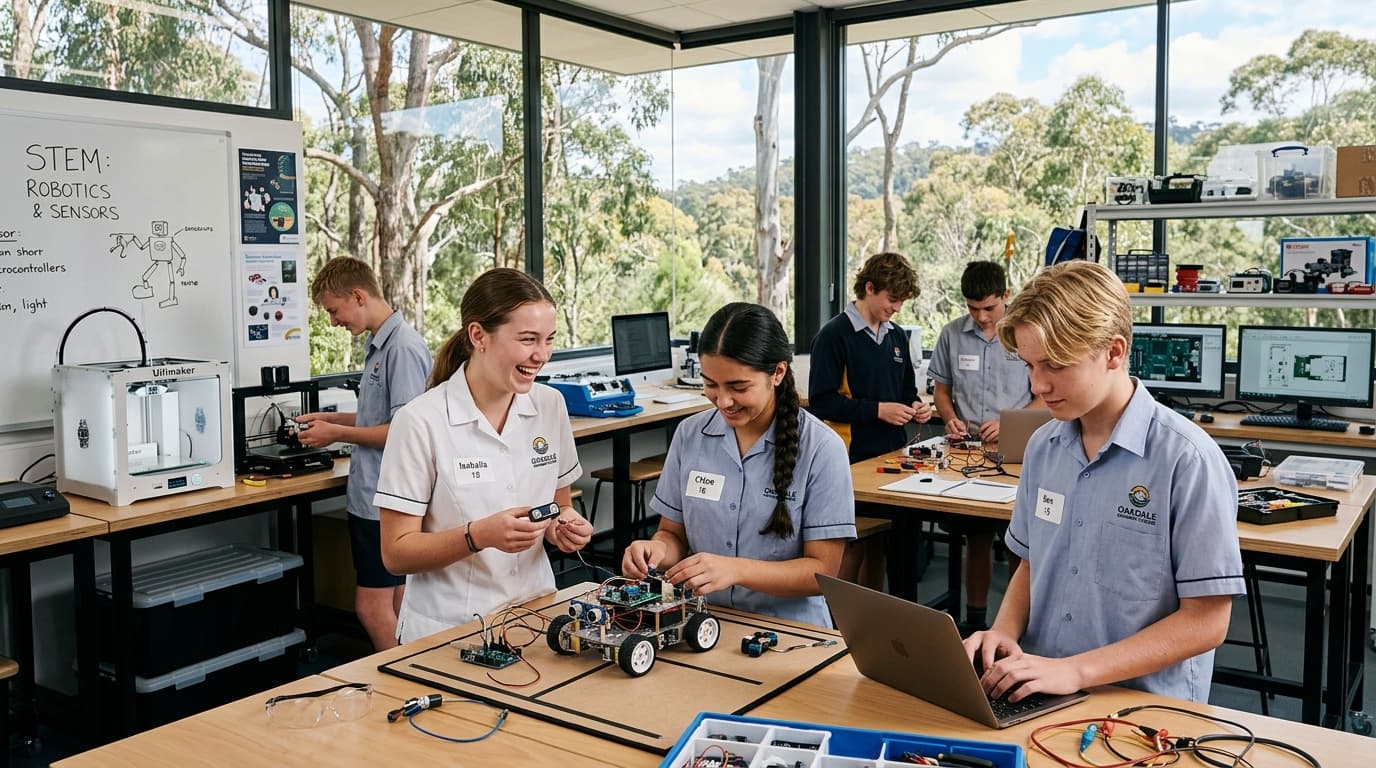
- Week 3 (Hardware Integration & Algorithmic Design): Students introduce the BBC micro:bit v2 or Raspberry Pi Pico connected to analogue environmental sensors: an ambient temperature/humidity sensor (DHT11/22) and an ultrasonic distance sensor (measuring rising water levels).
- Week 4 (Coding Autonomous Warning Triggers): In MakeCode (Blocks or Python), students code algorithms that poll sensor data continuously:
CLASSROOM STEM & ROBOTICS LAB
Pseudocode Logic for Autonomous Station
MicroPython 31 # Pseudocode Logic for Autonomous Station 2 700;">while True: 3 temperature = read_temp_sensor() 4 water_clearance = read_ultrasonic_distance() 5 6 700;">if temperature > 42.0: 7 display.show(Icon.FIRE) 8 radio.send_string("ALERT_EXTREME_HEAT") 9 sound.play(Sound.SIREN) 10 700;">elif water_clearance < 10.0: # Water within 10cm of sensor 11 display.show(Icon.FLOOD) 12 radio.send_string("ALERT_FLASH_FLOOD") 13 sound.play(Sound.SIREN) 14 700;">else: 15 display.show(Icon.HAPPY) 16 sleep(5000) - Week 5 (Enclosure Prototyping & Weatherproofing): Students design a 3D-printed or vacuum-formed protective enclosure that shields the microprocessor and sensors from precipitation while allowing free airflow and optical clearance for warning LEDs.
- Week 6 (The Stress Test Exhibition): Towers are deployed in a simulated environmental testing rig: placed in front of high-velocity airflow while a simulated water basin level is raised with pumps. Teams evaluate whether their electronic warning triggers activated within the required latency threshold.
Unit 4 (Years 5 to 6): The Circular Economy: Bio-Plastic Food Packaging
Curriculum Mapping: AC9TDE6K02, AC9TDE6P01, AC9TDE6P04, AC9S5U01, AC9M6M01
5-Week Scope & Sequence
- Week 1 (The Waste Audit): Students collect, weigh, and categorise all single-use packaging discarded by the school canteen over a five-day period. They calculate that the school generates over 18,000 single-use plastic wrap and polystyrene items annually, taking up to 400 years to decompose in landfill.
- Week 2 (Chemical Synthesis & Formulation): Working under strict laboratory safety protocols (safety glasses, heat-resistant gloves), students synthesize bioplastic polymers using cornstarch, water, white vinegar (acid catalyst), and vegetable glycerol (plasticiser). In controlled trials, teams vary the ratio of glycerol (0.5 mL, 1.5 mL, 3.0 mL) to determine its effect on flexibility versus rigidity.
- Week 3 (Material Strength & Barrier Testing): Students cut standardized 2 cm × 10 cm bioplastic strips and clamp them in a custom test rig. By adding incremental weights, they measure tensile strength until structural failure. In parallel, they test grease resistance by placing droplets of cooking oil on the surface and measuring bleed-through over 2 hours.
- Week 4 (Packaging Geometry & Die-Cutting): Using 2D net drawing skills, students draft geometric templates for a leak-proof sandwich clamshell box. They cast their optimised bioplastic polymer over reusable timber moulds or structural mesh formers.
- Week 5 (Compostability Trials & Canteen Presentation): Finished containers are tested with warm, moist food samples. Sub-samples are buried in the school’s hot-compost bin to establish decomposition rates over 21 days. Teams deliver a formal procurement proposal to the school principal and canteen committee, backed by life-cycle cost analysis and biodegradability data.
5. Engineering Folios: Scaffolding Student Thinking and Documentation
A primary STEM project without disciplined documentation quickly degenerates into an unreflective craft exercise. The Student Engineering Folio is the central artefact of learning, preserving the entire cognitive path from initial confusion to iterative breakthrough.
Structure of an ACARA-Aligned Primary Folio
Whether maintained in physical A3 spiral-bound format or digitally (via Book Creator, Seesaw, or Google Slides), every student folio must include six standard sections:
| Dimension / Category | Key Details & Guidance |
|---|---|
|
1. Problem Canvas
|
Dissected design brief, empathy notes, constraints
|
|
2. Science & Math
|
Data tables, controlled tests, material properties
|
|
3. Design Gallery
|
3 Divergent sketches with callout annotations
|
|
4. Working Plan
|
Scaled orthographic/isometric drawing + cut list
|
|
5. Failure Log
|
"What broke, why it broke, how we fixed it"
|
|
6. Final Audit
|
Quantitative test results vs initial success criter
|
The "Failure Diagnostic Log" Template
To normalize iterative improvement, students must complete a dedicated log entry every time their prototype fails to perform as planned:
| Attempt # | Intended Outcome | Observed Failure Mode | Probable Root Cause (Why?) | Engineering Modification Planned |
|---|---|---|---|---|
|
01
|
Support 500g load at apex
|
Tower twisted and sheared horizontally at 310g
|
Square joints lacked diagonal bracing; joints rotated
|
Add diagonal triangular gussets made from 3mm craft ply at all corners
|
|
02
|
Water sensor activates buzzer
|
Buzzer clicks once then silences; micro:bit resets
|
Current draw from buzzer exceeds micro:bit GPIO pin capacity
|
Rewire buzzer through external transistor circuit powered by 4.5V battery pack
|
6. Assessment and Evaluation Framework
Assessment in primary STEM must measure process, conceptual understanding, and metacognition—not merely the aesthetic polish of the final model.
Multi-Tiered Assessment Architecture
- Diagnostic Assessment (Pre-Project): Probe misconceptions regarding scientific concepts (e.g., confusing weight with mass, confusing voltage with current, believing plastic melts because it "dissolves").
- Formative Assessment ("Stand-Up Scrums"): Daily 3-minute team check-ins where each group articulates:
- What did we accomplish yesterday?
- What engineering hurdle is blocking our progress today?
- What scientific or mathematical data do we need next?
- Summative Assessment (The Holistic Rubric): Evaluated across four distinct dimensions.
Comprehensive Primary STEM Rubric (ACARA V9.0 Aligned)
| Assessment Dimension | Emerging (Working Towards) | Proficient (At Standard) | Advanced (Exceeding Standard) |
|---|---|---|---|
|
Investigating & Defining (Design & Tech / Science)
|
Identifies the basic topic but requires teacher guidance to isolate specific user needs, constraints, and success criteria.
|
Clearly articulates user needs, specifies material and budget constraints, and establishes measurable success criteria.
|
Formulates sophisticated, client-centred design parameters; anticipates environmental and systemic impacts; conducts rigorous secondary research.
|
|
Scientific & Mathematical Application
|
Gathers qualitative observations with gaps; measurement tools used inconsistently; struggles to explain underlying science.
|
Conducts fair tests with controlled variables; measures accurately with standard metric units; graphs data and uses findings to justify design choices.
|
Deeply integrates mathematical modelling (ratios, geometric nets, statistical ranges); explains physical/chemical mechanisms using precise terminology.
|
|
Generating & Iterating (The Engineering Process)
|
Produces a single design idea and resists modification; fixes errors ad-hoc without analysing root causes.
|
Generates multiple divergent design concepts; documents intentional modifications based on test failures in an Engineering Folio.
|
Synthesises creative, elegant solutions; maintains an exemplary Failure Diagnostic Log; tests multiple variables systematically to optimise performance.
|
|
Collaboration & Communication
|
Relies on one group member to lead; struggles to resolve technical disputes; final presentation lacks clear evidence.
|
Shares group roles equitably; resolves disagreements using evidence; communicates findings clearly using multimodal diagrams and spoken explanation.
|
Demonstrates exceptional collaborative management; facilitates peer critiques; presents compelling, data-backed technical pitches to authentic audiences.
|
7. Classroom Management, Resource Logistics, and Makerspace Safety
The most pedagogically sound STEM project will unravel if classroom logistics, safety protocols, and materials management are not systematically engineered.
| OOM │ │ MATER | ALS │ │ SAFETY P |
|---|---|
|
TURE │ │ MANAG
|
MENT │ │ & CREDE
|
|
ty Lab │ │ • "Banker"
|
job roles │ │ • Tool Dri
|
|
Coding Bay│ │ • Scrap sa on Zone │ │ • Consumab n Circle │ │ • Cardboar
|
vage bins │ │ • Low-temp e quotas │ │ • Eye prot joinery │ │ • 5-minute
|
The "Zoned" Classroom Layout
Transforming a standard primary classroom into a functional STEM studio requires clear zoning:
- Zone A: The Collaboration & Design Hub: Carpet area or clustered dry desks reserved exclusively for sketching, blue-printing, coding, and team planning. No glue, liquids, or cutting tools permitted.
- Zone B: The Fabrication Bay: Workbenches or tables covered in protective marine-ply or heavy cardboard. Equipped with cutting mats, Makedo cardboard saws, clamps, and low-temperature hot glue guns.
- Zone C: The Wet / Testing Station: Sinks, plastic tubs, waterproof testing tanks, sand trays, and fans. This zone contains cleanup equipment (sponges, squeegees, dustpans) accessible to students.
- Zone D: The Materials Depot: Centralized shelving organized by material type (Cardboard & Paper, Plastics & Polymers, Textiles & Twines, Fasteners & Adhesives, Electronics & Sensors).
High-Yield, Low-Cost Resource Acquisition
Sustainable primary STEM does not require expensive multi-thousand-dollar educational kits. In fact, proprietary single-purpose kits often limit authentic engineering because parts can only snap together in intended ways. Prioritize flexible, low-cost consumables and tools:
- Cardboard & Upcycled Materials: Run an ongoing school-wide donation drive for cereal boxes, corrugated shipping boxes, cardboard mailing tubes, plastic bottle caps, clean milk jugs, and timber pallets (for disassembling into clean slats).
- Specialised Cardboard Joinery: Invest in reusable plastic cardboard tooling systems (e.g., Makedo saws, scringes, and safe-screws). These enable primary students to cut and join rigid corrugated cardboard safely without box-cutters or utility knives.
- Adhesives & Joinery: Low-temperature glue guns (operating at 120°C rather than standard 190°C guns), masking tape, split pins, cable ties, paper clips, and PVA glue.
- Physical Computing Hardware: Class sets of BBC micro:bit v2 microcontrollers paired with break-out sensor boards (moisture, sonar, light, sound), alligator clip leads, servo motors, and AA battery packs.
Student Team Roles: Preventing the "Spectator Syndrome"
To prevent one dominant student from doing all the building while others disengage, assign functional engineering roles that rotate weekly:
- Project Lead: Reads and interprets the design brief; tracks timeline and keeps the team focused on success criteria.
- Lead Architect / Designer: Manages the Engineering Folio, records blueprints, and oversees precision measurement.
- Materials Engineer: The only student authorized to collect materials from the Materials Depot; monitors the team budget.
- Quality & Safety Officer: Inspects joints, runs testing protocols, checks adherence to tool safety, and manages the end-of-lesson workstation cleanup.
8. Differentiated Scaffolding: Universal Design for STEM Learning
STEM classrooms must be universally accessible, offering multiple entry points for diverse learners.
Supporting Neurodiverse Learners (ADHD and ASD)
- Visual Task Schedules: Break 60-minute building sessions into distinct 15-minute milestones:
- 0–10 min: Problem briefing and team goal setting.
- 10–35 min: Active fabrication and testing.
- 35–45 min: Folio logging and data capture.
- 45–55 min: Workstation pack-down.
- 55–60 min: Whole-class plenary reflection.
- Low-Arousal Testing Stations: Provide noise-dampening ear defenders in fabrication bays where power tools or high-noise testing occurs.
- Explicit Executive Function Supports: Provide pre-printed checklist templates inside folios so learners do not become overwhelmed by open-ended materials.
Scaffolding EAL/D Learners (English as an Additional Language)
- Bilingual STEM Glossaries: Pre-teach high-leverage technical vocabulary (absorb, repel, tensile, compressive, sensor, loop, conditional, iterate) accompanied by photographs and diagrams.
- Visual Blueprints: Allow EAL/D students to annotate designs using arrows, colour codes, and mathematical symbols before requiring extended prose.
- Video Design Pitching: Enable learners to record short video walkthroughs demonstrating their prototype on an iPad rather than demanding formal written essays.
Extending High-Potential and Gifted Learners
- Constraint Escalation: Once a high-potential group solves the core design brief, introduce real-world emergency constraints:
- "A global supply shortage has doubled the cost of plastic components—you must re-engineer your system using 80% natural cellulose materials."
- "Your sensor station must now operate inside a 30% smaller physical volume without losing structural stability."
- Algorithmic Complexity: Transition students from block-based programming to text-based MicroPython; challenge them to implement wireless radio communication mesh networks between multiple micro:bit sensor stations.
9. Integrating First Nations Engineering and Ecological Knowledge
Under ACARA Version 9.0, embedding the Aboriginal and Torres Strait Islander Histories and Cultures cross-curriculum priority within STEM is both a curriculum mandate and an intellectual enrichment. Indigenous Australians are the world's oldest continuous engineers, material scientists, and hydrologists.
| ULIC │ │ MATER | AL & │ │ ECOLO |
|---|---|
|
ERING │ │ THERMAL
|
CIENCE │ │ CALE
|
|
a Fish │ │ • Spinifex unnhu) │ │ thermopl ater-flow │ │ • Fire-har le catch │ │ • Natural s │ │ fibres a
|
resin │ │ • Multi-se stics │ │ tracking ening wood │ │ European tructural │ │ models d cordage │ │ • Environm
|
Exemplar Case Studies for Classroom Inquiry
- Hydraulic Engineering (The Brewarrina Fish Traps / Baiame’s Ngunnhu):
- Inquiry: How did Ngemba people use circular stone weirs across the Barwon River to alter water velocities, trap fish according to river heights, and allow breeding stock to escape?
- Classroom Challenge: Students build a scaled stream-table simulation. Using river rocks and pea gravel, they design permeable channel structures that redirect water flow and capture floating debris without causing bank erosion.
- Material Science (Spinifex Resin & Natural Adhesives):
- Inquiry: How did First Nations people extract, heat, and blend resin from spinifex grass with ochre and kangaroo dung to create an ultra-durable thermoplastic adhesive for hunting tools and vessels?
- Classroom Challenge: Students extract starches and natural tree resins to formulate non-toxic adhesives, comparing their shear strength against commercial craft glues.
- Thermal Science (Traditional Shelters & Aerodynamics):
- Inquiry: How were traditional gunyahs and wurlies designed with specific entry orientations, thatch densities, and earth mounding to maximise convective cooling in summer and thermal retention in winter?
- Classroom Challenge: Students build scaled shelter prototypes and use digital thermometer probes to log internal temperature changes when placed in direct sunlight versus shade.
Ethical Protocol: Always consult local Traditional Owners, Local Aboriginal Land Councils, or regional Department of Education First Nations advisory teams when incorporating local cultural practices. Ensure students understand that Indigenous knowledge is rigorous, empirical, and alive—not a historical curiosity.
10. Printable Teacher Implementation Checklist & Project Launch Canvas
Before introducing a new Project-Based STEM unit, use this operational checklist to ensure all pedagogical, curricular, and logistical safeguards are established.
════════════════════════════════════════════════════════════════════════════════
By systematically applying this curriculum-aligned, research-backed framework, Australian primary schools can move beyond superficial craft sessions to deliver rigorous, empowering STEM education. Primary learners become confident young engineers who do not simply observe modern technological challenges, but design, prototype, and build the sustainable solutions our world urgently requires.