How to Run High-Impact Primary Design and Technology (D&T): Mechanisms, Structures, Textiles, and Food Across KS1 and KS2
Design and Technology (D&T) is one of the most intellectually invigorating, creative, and practically empowering subjects in the National Curriculum for England. It invites children to step into the shoes of engineers, architects, fashion designers, roboticists, and culinary innovators. Through D&T, pupils solve real and relevant problems within a variety of contexts, considering their own and others' needs, wants, and values.
Yet, in many primary classrooms, Design and Technology is severely compromised. It is often conflated with decorative arts and crafts, diluted into flimsy cardboard models that collapse before reaching home, or reduced to novelty baking sessions lacking nutritional or culinary rigor. Furthermore, primary teachers frequently express legitimate concerns regarding health and safety, workshop equipment management, material cost constraints, and the complex logistical management of practical construction sessions with 30 children.
This masterclass equips primary classroom teachers, D&T subject leaders, and senior leadership teams with an evidence-informed pedagogical architecture for delivering an ambitious, rigorous, and safe Design and Technology curriculum from Key Stage 1 through Key Stage 2.
1. The Statutory Framework and the Iterative Design Process
The statutory National Curriculum programme of study for Design and Technology is built upon a fundamental conceptual pillar: the iterative design cycle. D&T is not a linear exercise where children follow a rigid step-by-step recipe to produce identical cloned products. It is an iterative, problem-solving journey comprising four interconnected phases:
The Three Core Types of D&T Activity
To deliver a high-quality D&T unit, the Design and Technology Association (DATA) recommends that every project incorporates three distinct forms of activity:
- Investigative and Evaluative Activities (IEAs): Pupils dissect, disassemble, test, and evaluate existing commercial products ("How does this garlic press mechanical lever work? Why is it made from cast aluminium instead of plastic?").
- Focused Practical Tasks (FPTs): Explicit direct instruction where pupils learn specific technical skills, measuring precision, joining methods, or tool safety ("Today we are all learning how to use a junior hacksaw and bench hook safely to cut wooden square dowel to a precise 100mm measurement").
- Design, Make and Evaluate Assignment (DMEA): The overarching project where pupils synthesise their technical knowledge to solve a genuine design brief for a real user ("Design and manufacture an accessible mechanical toy for a Reception class pupil who struggles with grip strength").
2. The Four Technical Strands of Primary D&T
The National Curriculum divides D&T into four core technical knowledge strands, alongside the separate statutory strand of Cooking and Nutrition:
3. Mechanisms Progression: From Sliders to Cams and Pneumatics
Mechanisms allow children to explore mechanical advantage and motion transformation: converting rotary motion into linear motion, reciprocating motion, or oscillating motion.
Deconstructing Lower KS2 Levers & Linkages
In Year 3, pupils move beyond single sliders to multi-bar linkage mechanisms using split pins (paper fasteners) and sturdy card strips:
- Fixed Pivot: The point where a lever is anchored immovably to the base card.
- Floating (Moving) Pivot: The joint where two moving lever arms are pinned together, transferring kinetic force across the mechanism.
- Linkage Types:
- Parallel Motion Linkage: Keeps the output arm moving in the exact same orientation as the input handle.
- Reverse Motion Linkage: Uses a central fixed pivot so that pulling the input handle to the left pushes the output pointer to the right.
Deconstructing Upper KS2 Cams Mechanisms
In Year 5, pupils construct wooden cam toys (automata). A rotating axle (camshaft) drives a shaped disk (cam), which pushes a vertical rod (follower) up and down:
- Cam Shapes:
- Circular (Eccentric) Cam: The axle hole is off-centre. Produces a smooth, gentle, continuous undulating vertical wave.
- Pear-Shaped Cam: Produces a long dwell period where the follower remains still, followed by a rapid rise and fall.
- Snail (Drop) Cam: The profile gradually increases in radius before dropping abruptly. Produces a slow lift and sudden snap fall (ideal for a mechanical jumping frog or crocodile bite).
4. Structures Progression: Freestanding to Triangulated Frames
Pupils must learn that structural integrity does not rely on dumping half a roll of sticky tape onto a joint. Structures depend on geometric physics: understanding tension, compression, and stability.
Lesson Planner
Generate comprehensive, CAPS-aligned lesson plans in seconds.
| Structural Concept | Key Stage 1 Focus | Key Stage 2 Focus |
|---|---|---|
|
Base Stability
|
- Widening the base of a tower. - Adding buttresses or outriggers.
|
- Lowering centre of gravity; ballast mass - Cantilever overhangs and counterweights.
|
|
Strengthening Flat Materials
|
- Folding paper into accordion Zs - Rolling flat card into tubes.
|
- Corrugation; lamination (gluing layers); - Ribbed reinforcement and flanges.
|
|
Frame Joints & Triangulation
|
- Card corner brackets glued to cereal box joints.
|
- Triangular gusset plates cut from card; - Diagonal cross-bracing across squares; - Cardboard strip triangulation.
|
The Power of Triangulation in KS2 Frame Structures
In Year 4 or 5, pupils construct load-bearing frame structures using square section wooden strip dowel (typically 8mm x 8mm pine or jelutong) and junior hacksaws.
- The Physics: A four-sided square frame is inherently unstable; push any corner and it shears into a parallelogram. A three-sided triangle is geometrically rigid; its shape cannot be altered without bending or breaking the physical sides.
- Triangulation in Practice: Pupils learn to add diagonal bracing struts across rectangular frames and reinforce every 90° corner with card gusset plates (triangles of 500-micron card glued to both faces of the joint).
5. Textiles Progression: Joining, 2D to 3D, and Fasteners
Textiles in D&T is distinct from expressive fabric collage in art. In D&T, textiles focuses on structural fabrication, durability, pattern drafting, and functionality.
| Year Group | Structural Project | Technical Skills & Tool Fluency |
|---|---|---|
|
Year 1
|
Puppet / Simple Pouch
|
- Joining felt with fabric glue or staples - Cutting felt with blunt-ended scissors
|
|
Year 2
|
Decorated Hand Puppet
|
- Threading large plastic/metal bodkin nee - Running stitch with embroidery thread - Attaching decorative buttons and trims
|
|
Year 3
|
Functional Cushion or Wallet
|
- Overstitch / Whip stitch for edge closur - Measuring seam allowances with chalk - Attaching hook-and-loop (Velcro) fastene
|
|
Year 4
|
Fabric Phone/Book Sleeve
|
- Backstitch for strong structural seams - Hemming raw fabric edges - Sewing on functional two-hole buttons
|
|
Year 5
|
3D Stuffed Mascot / Utility Belt
|
- Drafting 2D pattern paper templates - Pinning patterns with dressmaking pins - Blanket stitch and seam finishing
|
|
Year 6
|
Upcycled Garment / Backpack
|
- Combining synthetic and natural fabrics - Installing press-studs, toggles, buckles - Reverse engineering commercial garments
|
6. Electrical Systems and Computing Integration in KS2
In Key Stage 2, D&T builds upon National Curriculum science concepts of electrical circuits, transforming abstract circuits into functional automated systems.
Progression in Electrical & Digital Systems
- Year 4 (Simple Electrical Circuits): Designing products incorporating series circuits: torches, nightlights, alarmed security boxes. Pupils wire switches, buzzers, and bulbs into structural housings, designing ergonomic housings that allow access for battery replacement.
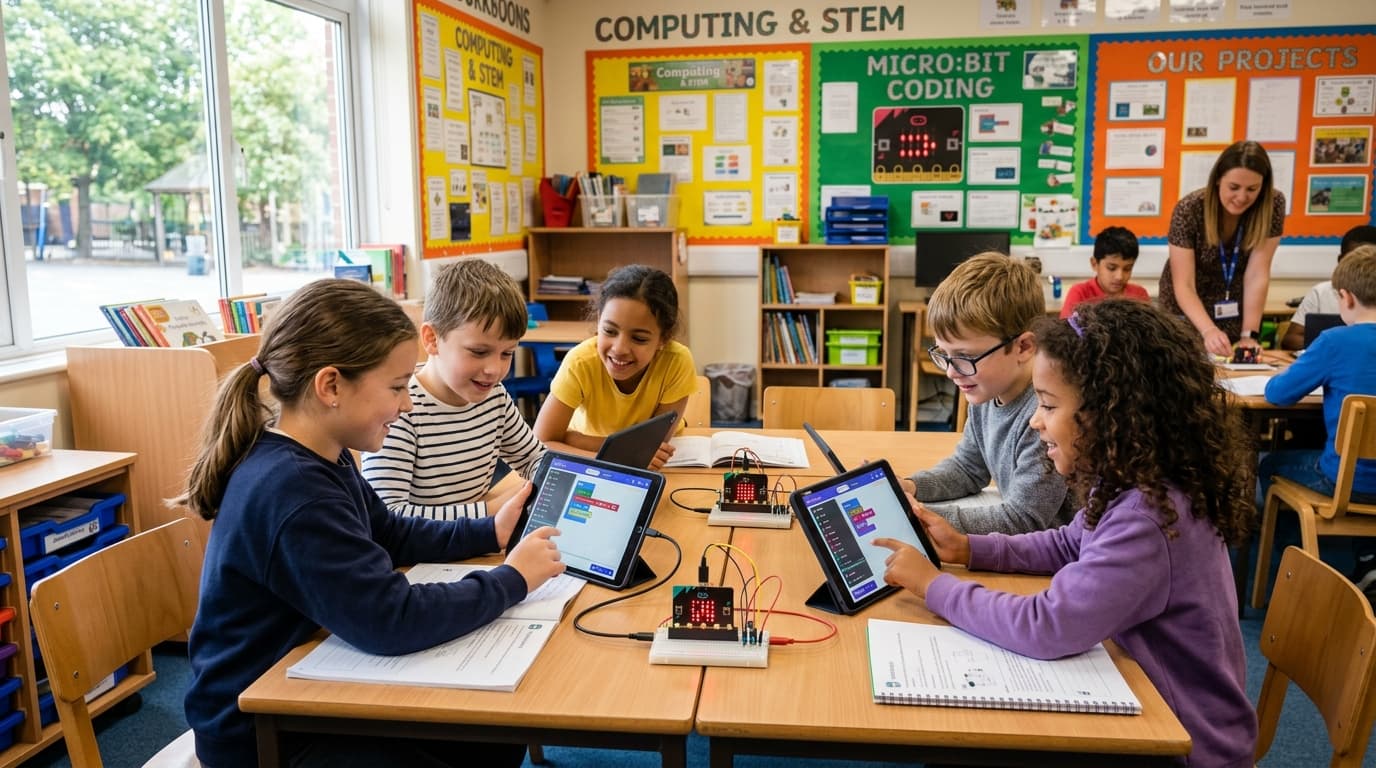
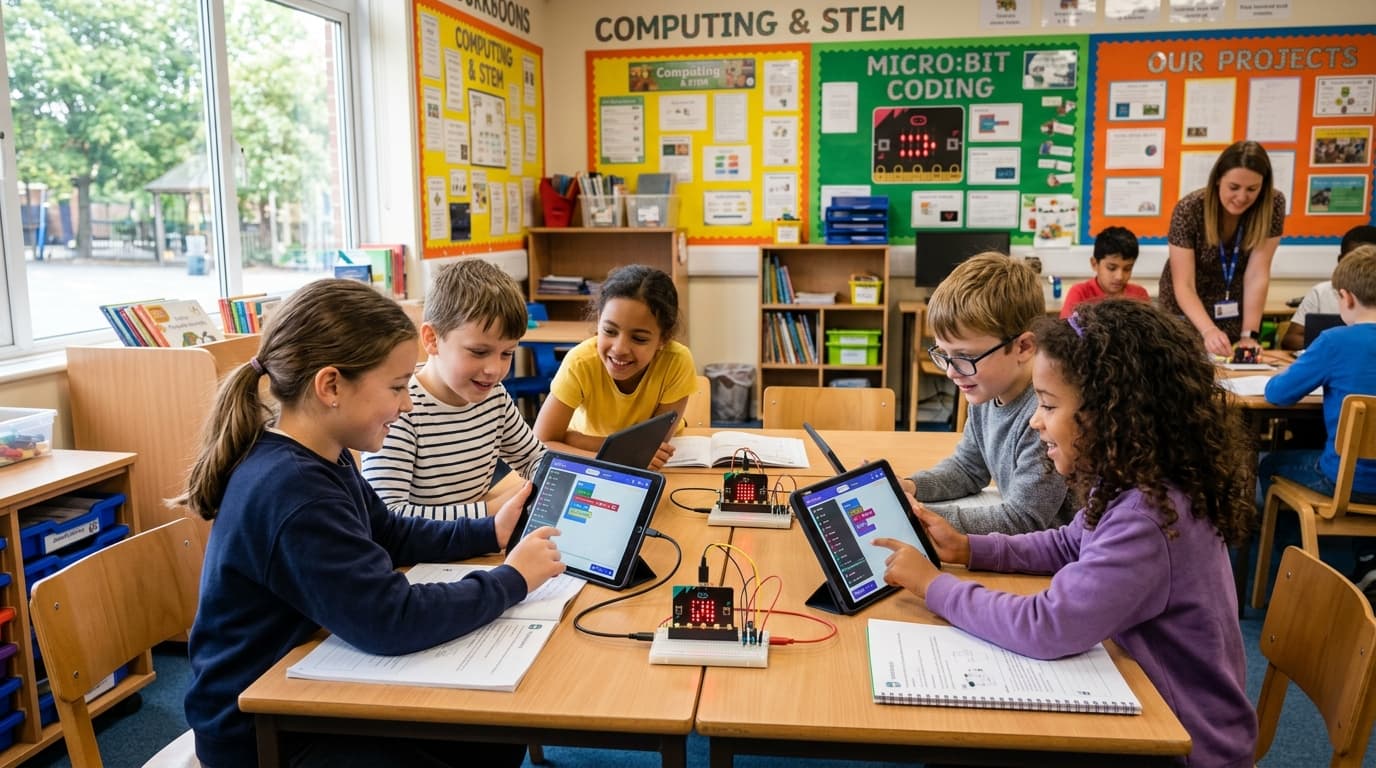
- Year 6 (Programmable Computing & Microcontrollers): Integrating microcontrollers (such as the BBC micro:bit or Crumble controller). Pupils write block algorithms to read external physical sensors (light sensors, tilt switches, push buttons) and control motors, servos, and RGB LEDs within a mechanical product (e.g., an automated fairground ride or a smart traffic barrier).
7. Cooking and Nutrition: Statutory Requirements and Kitchen Pedagogy
Cooking and nutrition is a statutory requirement for all primary pupils in England. It must not be treated as an occasional end-of-term treat or restricted to decorating pre-baked cupcakes with sugary icing. Under the National Curriculum, pupils must be taught how to cook, apply the principles of nutrition and healthy eating, and understand food provenance.
| Key Stage 1 (Years 1-2) | Key Stage 2 (Years 3-6) |
|---|---|
|
- Understand where food comes from (farming, fishing, harvest). - Use basic food preparation skills safely and hygienically: washing, peeling, slicing, grating, spreading, kneading.
|
- Understand and apply the principles of a healthy, varied diet using the Eatwell Guide. - Prepare and cook a variety of predominantly savoury dishes using a range of cooking techniques. - Know that different food is grown, reared, caught and processed across the UK and the wider world.
|
The Culinary Knife Skills Progression: Bridge Hold & Claw Grip
Safety during primary food sessions hinges on explicit modeling of ergonomic cutting grips:
8. Health, Safety, Tool Management, and Workshop Organization
Classroom management during practical D&T sessions can induce anxiety unless rigorous workshop protocols are established. Running a successful practical making session with 30 children requires strict organization.
The 5 Golden Rules of Primary D&T Workshop Safety
9. Assessment, Evaluation, and Ofsted Deep Dives in D&T
During an Ofsted subject deep dive in D&T, inspectors evaluate whether children are developing authentic disciplinary understanding of design, fabrication, and evaluation.
What Ofsted Inspectors Check During D&T Deep Dives
- User and Purpose Clarity: Can pupils articulate who their product was designed for and what problem it solves? (Inspectors will challenge projects where pupils simply make random craft toys with no user brief).
- Technical Vocabulary Fluency: Do pupils use precise technical language (triangulation, linkage, seam allowance, cam follower, reciprocating) or vague colloquial terms?
- Authentic Evaluation: Do pupils evaluate their work honestly against pre-established design criteria, or do they simply say "I loved it, it looks pretty"?
- Food Curriculum Substance: Does cooking include predominantly savoury, nutritious dishes, or is it confined to sugar-laden confectionery?
10. Frequently Asked Questions (Primary Teachers & D&T Coordinators)
How can a school on a tight budget afford materials for D&T?
- Curate Clean Recycled Materials: Establish a collection drive for clean, rigid cardboard packaging, cereal boxes, corrugated card, plastic bottle caps, and cardboard tubes.
- Standardize Raw Materials: Buy standardized materials in bulk: 8mm x 8mm jelutong strip wood, 500-micron card, split pins, and PVA glue. Standardized materials can be used across multiple year groups.
- Emphasize Cardboard Mock-ups: Have pupils build functional prototypes using corrugated card before committing to wooden or fabric fabrication.
What is the difference between Art and D&T?
While both involve creativity and making, their core intent is fundamentally distinct:
- Art: An expressive, aesthetic, or conceptual exploration. It does not need to solve an external problem or serve a utilitarian function.
- Design and Technology: An applied problem-solving discipline. Products are designed for an identified user to fulfil a specific, functional purpose. If a product does not work mechanically or fails its user criteria, it has not succeeded in D&T terms.
How do we fit D&T into a crowded primary timetable?
Many high-performing primary schools deliver D&T through blocked D&T Days or D&T Weeks (e.g., dedicating two full consecutive days to a D&T project every term). This allows sustained focus for setting up tools, iterative making, drying times, and in-depth evaluations without the disruptive stop-start friction of 45-minute weekly slots.