How to Plan KS2 Modern Foreign Languages (MFL): Building French and Spanish Oracy, Phonics, and Confidence in UK Primary Schools
Teaching a modern foreign language in the primary school is one of the most culturally enriching, cognitive-expanding dimensions of the Key Stage 2 curriculum. Under the statutory National Curriculum for England, learning a foreign language is compulsory for all pupils throughout Key Stage 2 (Years 3 to 6). The national curriculum aims to foster pupils' curiosity, deepen their understanding of the world, liberate them from insularity, and lay robust linguistic foundations for future study at Key Stage 3 and beyond.
Yet, Modern Foreign Languages (MFL)—predominantly French or Spanish in UK primary schools—is frequently cited by primary practitioners as the subject in which they feel least confident. Most primary class teachers are generalists without specialist language degrees. Many carry lingering anxieties about their own accent, pronunciation, and grammatical knowledge. Consequently, primary languages are too often reduced to disconnected vocabulary memorization: reciting lists of farm animals, fruit, or colours without ever teaching children how to construct a spontaneous sentence, unpick phonics sound-spelling correspondences, or sustain an authentic oral dialogue.
This masterclass equips primary classroom teachers, MFL subject leaders, and curriculum coordinators with an evidence-informed pedagogical architecture for teaching primary French and Spanish with passion, phonological precision, and infectious communicative confidence.
1. Statutory Foundations: The National Curriculum for Languages at KS2
The statutory programme of study for Key Stage 2 languages emphasizes practical communication. Teaching should focus on enabling pupils to make substantial progress in one language across four years, balancing oracy and literacy.
The 12 Statutory Attainment Targets (DfE)
By the end of Key Stage 2, pupils must be taught to:
- Listen attentively to spoken language and show understanding by joining in and responding.
- Explore the patterns and sounds of language through songs, rhymes, and poems.
- Engage in conversations: ask and answer questions; express opinions and respond to those of others.
- Speak in sentences, using familiar vocabulary, phrases, and basic language structures.
- Develop accurate pronunciation and intonation so that others understand when reading aloud or using familiar words.
- Present ideas and information orally to a range of audiences.
- Read carefully and show understanding of words, phrases, and simple writing.
- Appreciate stories, songs, poems, and rhymes in the language.
- Broaden vocabulary and develop the ability to understand new words (including using a dictionary).
- Write phrases from memory, and adapt these to create new sentences to express ideas clearly.
- Describe people, places, things, and actions orally and in writing.
- Understand basic grammar appropriate to the language being studied: feminine, masculine, and neuter gender; key features and patterns of the language; how to apply grammatical rules to build sentences.
2. Phonics First: The Sound-Spelling Correspondence (SSC) Pedagogy
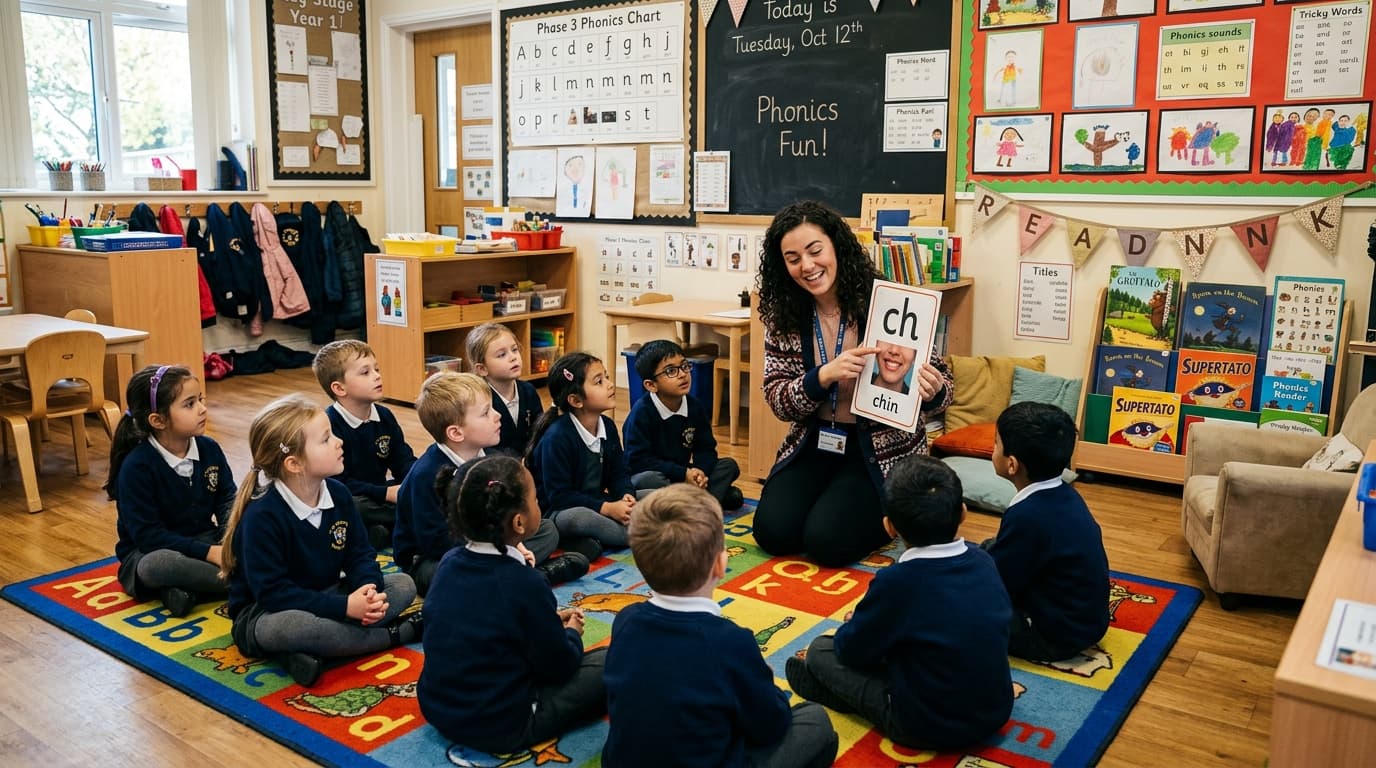
The most transformative breakthrough in modern language pedagogy—championed by the National Centre for Excellence for Language Pedagogy (NCELP) and prominent linguists—is the Phonics-First Methodology.
In English, children are taught Systematic Synthetic Phonics to decode letters into sounds. When children encounter French or Spanish, however, teachers frequently present written foreign words immediately without teaching foreign sound-spelling correspondences (SSCs). The child applies English decoding rules to French words, resulting in broken, anglicized pronunciation (e.g., pronouncing the French word comment as "com-ment" rather than [kɔ.mɑ̃], or Spanish llamo as "lamo" rather than [ˈʝa.mo]).
The 6 Key Sound-Spelling Patterns in Primary French
| Grapheme | Phonetic Sound | Gesture / Physical Action | Exemplar Classroom Words |
|---|---|---|---|
|
ou
|
[u] ("oo")
|
Push lips out like blowing
|
bonjour, rouge, sous, loup
|
|
on / om
|
[ɔ̃] (nasal "on")
|
| Tap index finger to nose
|
| cochon, marron, bonbon, lion
|
|
en / an
|
[ɑ̃] (nasal "ah")
|
| Flat hand across chest
|
| enfant, orange, dans, grand
|
|
oi
|
[wa] ("wah")
|
Circle hand like a clock
|
trois, noir, oiseau, moi
|
|
eau/au/o
|
[o] (pure "oh")
|
Shape mouth into circle
|
chapeau, jaune, auto, bateau
|
|
é / er
|
[e] ("ay")
|
Slice hand diagonally
|
écouter, danser, café, bébé
|
The 6 Key Sound-Spelling Patterns in Primary Spanish
| Grapheme | Phonetic Sound | Gesture / Physical Action | Exemplar Classroom Words |
|---|---|---|---|
|
j / ge
|
[x] (raspy "kh")
|
Gentle throat tap
|
naranja, rojo, conejo, gemelo
|
|
ll / y
|
[ʝ] ("yuh")
|
Open hand waving down
|
amarillo, me llamo, caballo, pollo
|
|
ñ
|
[ɲ] ("ny")
|
Two fingers tracing tilde
|
España, cumpleaños, piña, año
|
|
c (e, i)
|
[θ] ("th")
|
Tongue behind upper teeth
|
cinco, gracias, azul, doce
|
|
rr
|
[r] (rolled 'r')
|
Flutter lips or roll tongue
|
perro, marrón, guitarra, correr
|
|
h
|
SILENT
|
Finger to lips ("shh")
|
hola, hermano, hasta, hacer
|
By teaching sound-spelling correspondences explicitly with physical gestures (kinesthetic memory hooks) in Year 3, pupils gain the phonetic code to decode any new word they encounter with native-like phonological accuracy.
3. High-Frequency Sentence Builders vs. Isolated Vocabulary Lists
For decades, primary MFL instruction relied on the "Topic Vocabulary Trap": teaching 15 nouns per topic (15 zoo animals, 15 items of clothing, 15 vegetables). At the end of four years, pupils could name an elephant or a carrot, but could not say "I would like an apple because I am hungry" or "My brother does not like football."
Modern evidence-based language pedagogy—pioneered by Dr. Gianfranco Conti's Extensive Processing Instruction (EPI) framework—replaces isolated word lists with Sentence Builders. A sentence builder is a visual, chunked matrix that presents high-frequency grammatical structures, enabling pupils to generate hundreds of grammatically accurate, personalized sentences.
Exemplar Sentence Builder: Year 4 French (Expressing Opinions and Reasons)
| COLUMN 1: Opinion Stems | COLUMN 2: Activities | COLUMN 3: Connective | COLUMN 4: Reason Stems |
|---|---|---|---|
|
J'aime (I like) J'adore (I love) Je préfère (I prefer) Je n'aime pas (I don't like) Je déteste (I hate)
|
jouer au football (playing football) écouter de la musique (listening to music) manger des frites (eating chips) regarder la télévision (watching television) faire mes devoirs (doing my homework)
|
parce que (because) car (as / because)
|
c'est amusant. (it is fun.) c'est super. (it is great.) c'est délicieux. (it is delicious.) c'est ennuyeux. (it is boring.) c'est fatigant. (it is tiring.)
|
Using this single scaffold, any Year 4 child can assemble hundreds of unique, phonetically accurate sentences:
- "J'adore écouter de la musique parce que c'est super."
- "Je déteste faire mes devoirs car c'est ennuyeux."
Grammar is acquired implicitly through meaningful, prefabricated lexical chunks before being explicitly analyzed, drastically reducing cognitive overload.
4. Oracy Routines and Communicative Games
Children learn languages through their ears and mouths before their pens. Primary MFL lessons should be noisy, dynamic, and joyfully communicative.
Lesson Planner
Generate comprehensive, CAPS-aligned lesson plans in seconds.
High-Impact Low-Stakes Oracy Games
5. Deconstructing Primary Grammar: Gender, Agreement, and Word Order
Grammar in primary MFL should be taught conceptually and playfully, contrasting the target language against English structural conventions.
1. Noun Gender (The Blue & Red Concept)
English has no grammatical gender for inanimate objects; a table is an "it". In French (la table) and Spanish (la mesa), the table is grammatically feminine.
- Colour Coding & Dual-Coding: Consistently colour-code nouns in classroom displays and exercise books: Blue for masculine nouns (le chat / el gato); Red or Pink for feminine nouns (la souris / la gata).
- Physical Gestures: Pupils flex their muscles (biceps) when reciting masculine articles (un / le / el) and curtsy or place hands on hips when reciting feminine articles (une / la / la). Physical embodiment cements grammatical concepts in long-term memory.
2. Adjective Position and Agreement
- Position: In English, adjectives almost always precede the noun (the red car). In Spanish and French, colour and descriptive adjectives usually follow the noun (la voiture rouge / el coche rojo). Teach pupils the "Noun First, Detail Second" rule.
- Agreement: Teach adjectives as "chameleons" that change their physical endings to match the gender and number of the noun they describe (un crayon vert vs. une trousse verte; un perro blanco vs. dos perras blancas).
6. Comprehensive KS2 Primary Languages Progression Map (Years 3-6)
| Year | Phonics & Sound-Spelling (SSCs) | Vocabulary & Sentence Structure | Grammar & Mechanics | Reading & Writing |
|---|---|---|---|---|
|
Year 3
|
- Core vowel sounds & nasals - Silent final consonants - Phonics gestures introduced.
|
- Core greetings and feelings - Numbers 1-31; days, months - Colours and basic classroom.
|
- Definite & indefinite articles (le/la/un/une - el/la/un/una). - Concept of noun gender.
|
- Reading single words and short captions. - Copying accurate spelli
|
|
Year 4
|
- Diphthongs and blends - Decoding unfamiliar words using phonetic rules.
|
- Family members & pets - Likes, dislikes and hobbies - Food, drinks and cafe snacks.
|
- Adjective position (colours) - Making nouns plural (adding -s) - Negation (ne... pas / no...).
|
- Reading short 3-sentenc dialogues aloud. - Writing 1-2 sentences.
|
|
Year 5
|
- Intonation in interrogatives - Liaison in French speech - Stress accents in Spanish.
|
- School subjects & timetables - Town, directions & buildings - Telling the time (o'clock).
|
- High-frequency irregular verbs (avoir/être - tener/ser/estar). - Connectives (et, mais, parce qu
|
- Reading short narrative stories with audio. )| - Writing a paragraph.
|
|
Year 6
|
- Native-speed authentic audio - Fluent reading aloud with natural prosody.
|
- Daily routines & professions - Weather, seasons and geography - Planet Earth & healthy living.
|
- 1st and 3rd person singular verb endings in present tense. - Adjectival agreement mastery.
|
- Reading un-adapted text using a dictionary. - Independent composition
|
7. Assessment of Primary Languages: Low-Stakes, Oral, and Formative
Summative, stressful paper-and-pencil grammar tests destroy children's enthusiasm for languages. Assessment in primary MFL should be overwhelmingly formative, integrated dynamically into games and classroom routines.
High-Impact Assessment Techniques
- The 3-Finger Listening Check: Teacher says a sentence in the target language. Pupils show 1, 2, or 3 fingers on their chests to indicate whether the statement is true, false, or not mentioned. Instant, whole-class formative data in 5 seconds.
- Mini-Whiteboard Dictation (Phonics Tracking): Teacher dictates three pseudowords (made-up nonsense words obeying the target language's phonetic rules, e.g., French blaron or Spanish jupita). If pupils write down the correct sound-spelling correspondence, the teacher knows phonological decoding is secure.
- Recorded Speaking Portfolios: Pupils use school tablets once per term to record a 45-second audio video clip describing themselves, their family, or their hobbies. Comparing Year 3 clips with Year 6 clips provides incontrovertible, celebratory evidence of progress.
8. Inclusion, SEND, and EAL Adaptations in Primary MFL
Children with special educational needs or those learning English as an Additional Language (EAL) can thrive in modern foreign languages when pedagogy is multi-sensory and communicative.
Practical Pedagogical Adaptations
- Dyslexia and Phonological Processing: Traditional rote copying of French or Spanish text from a whiteboard is an ordeal for dyslexic learners. Emphasize multi-sensory phonics: pairing sounds with physical gestures, rhythm clapping, and colour-coded word cards. Allow dyslexic pupils to demonstrate understanding orally rather than via written spelling.
- EAL Learners as Language Experts: Children who already speak an additional language at home (e.g., Urdu, Polish, Somali) often possess superior metalinguistic awareness compared to monolingual peers. Celebrate their bilingualism. Ask them to compare how Spanish gender compares to grammatical gender in their home language.
- Speech and Language Needs (SLCN): Provide picture communication symbols (PECS) and dual-coded visual Sentence Builders. Scaffold sentence construction with physical colour-coded cards (Green for Opinion, Blue for Verb, Orange for Reason) that can be arranged on a desk like building blocks.
9. Preparing for an Ofsted Languages Subject Deep Dive
During an Ofsted subject deep dive into languages, inspectors examine curriculum ambition and progression. Common questions and high-impact responses include:
Question 1: *"Why do you teach French/Spanish, and how does your curriculum show progression?"*
Strategic Response: "We selected French/Spanish to align directly with our primary feeder secondary school, ensuring curriculum continuity at Key Stage 3. Our curriculum is sequenced systematically: Year 3 focuses on foundational sound-spelling correspondences and single nouns; Year 4 builds compound sentences with opinions; Year 5 introduces core verb conjugations; and by Year 6, pupils independently craft extended paragraphs with adjectival agreement."
Question 2: *"How do you support non-specialist primary teachers to deliver accurate pronunciation?"*
Strategic Response: "We use an evidence-based digital platform (such as Language Angels or Primary Languages Network) that embeds authentic native-speaker audio directly into classroom slide decks. Furthermore, every lesson begins with explicit sound-spelling phonics routines that staff rehearse during subject CPD."
Question 3: *"How do you know pupils are remembering the language over time?"*
Strategic Response: "We use spaced retrieval practice: every lesson begins with a 5-minute retrieval challenge revisiting vocabulary and structures from previous terms. In our recent pupil voice review, Year 6 pupils fluently recited sound-spelling gestures learned in Year 3 to decode new unfamiliar texts."
10. Frequently Asked Questions (Primary Teachers & MFL Leads)
Should we teach modern foreign languages in Key Stage 1?
While statutory MFL is only mandated for Key Stage 2, introducing playful songs, greetings, counting, and simple rhymes in Reception and Key Stage 1 fosters early linguistic enthusiasm and attunes children's ears to foreign phonemes. However, formal grammar and writing should be reserved for Key Stage 2.
What should we do if our local secondary school teaches German, but we teach French?
Engage in active transition dialogue with your secondary feeder schools. Even if the secondary school teaches a different language, the metalinguistic and phonological skills children master in primary French (understanding noun gender, adjectival agreement, verb conjugation, and sound-spelling decoding) are entirely transferable to German, Italian, or Mandarin.
How much time should be allocated to primary languages each week?
Research indicates that one 45-to-60-minute discrete lesson per week, supplemented by three 5-minute micro-retrieval sessions throughout the week (e.g., taking the register in French, singing a Spanish song before lunch, or answering maths questions in the target language), is far more effective than a single, isolated weekly block.