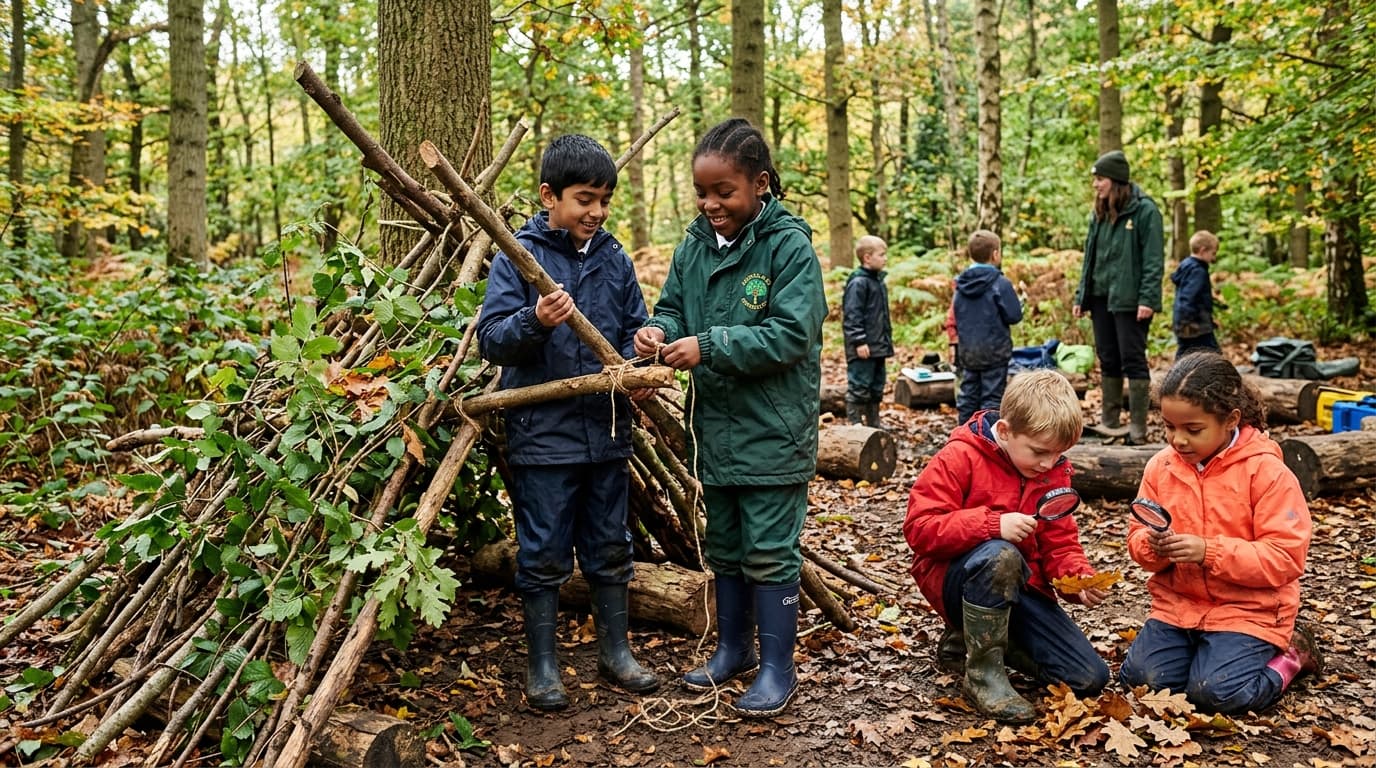
How to Establish Forest School and Outdoor Learning Routines in UK Primary Schools: Curriculum, Risk-Benefit, and Wellbeing
The natural outdoor environment is one of the most powerful, transformative, and underutilized learning spaces available to UK primary schools. Over the last decade, an overwhelming body of neuroscientific, psychological, and pedagogical research has confirmed what passionate educators have long observed: regular, immersive engagement with nature substantially accelerates emotional self-regulation, executive function, motor coordination, verbal communication, and ecological stewardship.
Yet, establishing an authentic, long-term Forest School and outdoor learning ethos across a primary school presents formidable challenges. Primary teachers often struggle to distinguish between structured curriculum outdoor learning and child-led Forest School principles. School leaders worry about liability, dynamic health and safety risk assessments, inclement British weather, budget constraints for waterproof clothing, and the maintenance of fragile school natural habitats.
This comprehensive masterclass provides primary classroom teachers, Forest School Level 3 leaders, science coordinators, and senior leadership teams with an evidence-informed roadmap for designing, managing, and sustaining world-class outdoor learning routines across the primary school.
1. Defining Forest School vs. Outdoor Learning: Conceptual Clarity
A common source of confusion in primary education is conflating Curriculum Outdoor Learning with Forest School. While both occur outdoors, their pedagogical intents, adult intervention models, and assessment criteria differ fundamentally:
| Dimension | Curriculum Outdoor Learning | Authentic Forest School |
|---|---|---|
|
Primary Driver
|
National Curriculum Objectives (Science, Geography, Maths, Art).
|
Holistic Child-Centred Growth (Resilience, Confidence, Independence).
|
|
Adult Role
|
Directs, scaffolds, and assesses specific academic concepts.
|
Facilitates, observes, and steps back to enable self-directed child inquiry.
|
|
Duration
|
Single lessons or topical units (e.g., 45-minute science habitat)
|
Regular, sustained, long-term sessions (weekly or bi-weekly over months/years).
|
|
Learning Outcomes
|
Measurable substantive knowledge (identifying deciduous trees).
|
Intrinsic personal development, emotional regulation, schema mastery, wellbeing.
|
|
Risk Management
|
Structured, adult-controlled experimental parameters.
|
Collaborative Risk-Benefit Assessment where pupils learn to self-manage risk.
|
The Six Core Principles of Forest School (Forest School Association - FSA)
To be recognized as authentic Forest School practice by the Forest School Association (FSA) UK, a programme must adhere to six statutory principles:
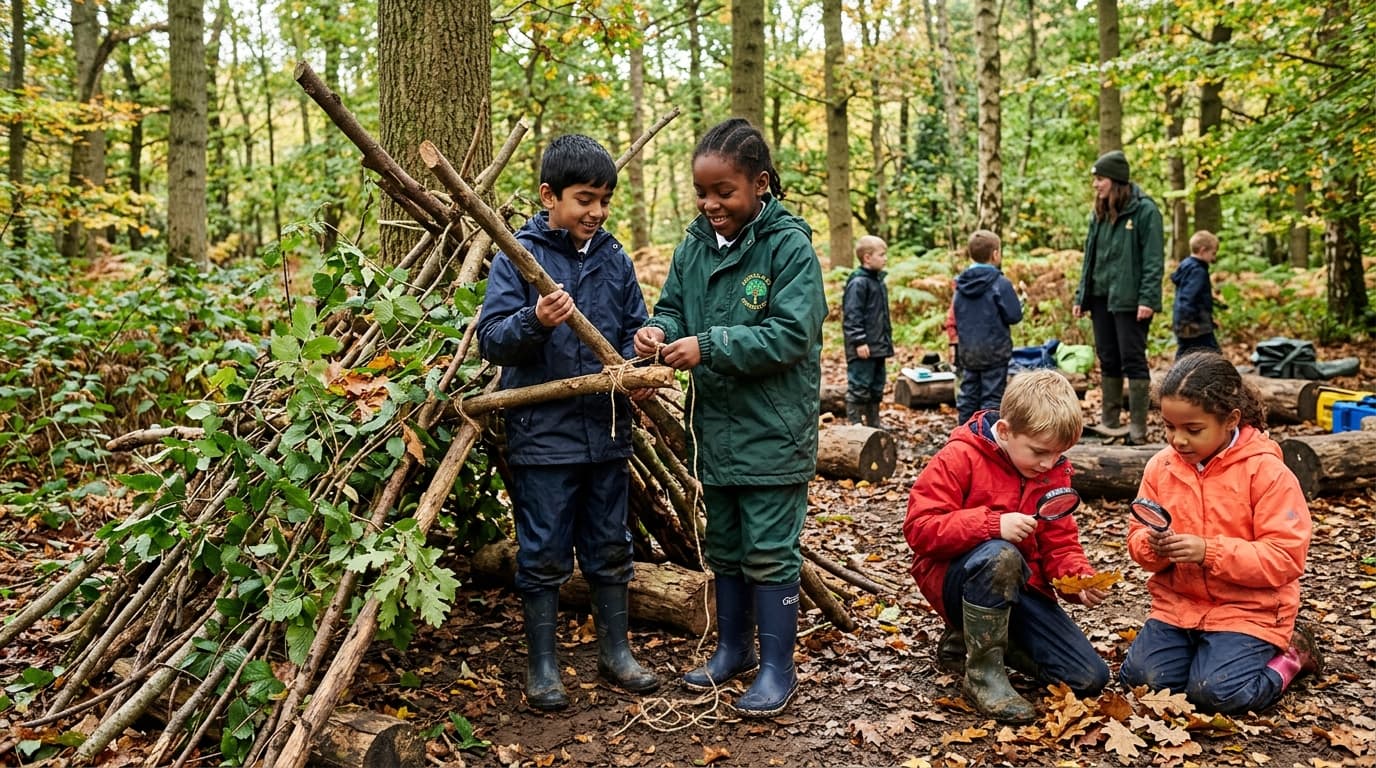
- Long-Term Process: Forest School is a long-term process of regular sessions, rather than a one-off or infrequent visit. Cycle through all four seasons to experience autumn leaf falls, winter frost, spring rebirth, and summer canopies.
- Woodland / Natural Setting: It takes place in a woodland or natural environment to support the development of a relationship between the learner and the natural world.
- Holistic Development: It aims to promote the holistic development of all those involved, fostering resilient, confident, independent, and creative learners.
- Supported Risk-Taking: It offers learners the opportunity to take supported risks appropriate to the environment and to themselves.
- Qualified Practitioner: It is led by a qualified Forest School Level 3 practitioner who continuously maintains and develops their professional practice.
- Learner-Centred Pedagogy: It utilizes a learner-centred pedagogical approach that is responsive to the needs and interests of the participants.
2. Risk-Benefit Assessment (RBA): Transforming the Health and Safety Culture
Traditional school health and safety often operates under a deficit model: identifying every conceivable hazard and attempting to eliminate it, resulting in sanitized playgrounds where children never encounter a mud patch, slippery log, or thorn bush.
Forest School replaces this with the Risk-Benefit Assessment (RBA) model, fully endorsed by the Health and Safety Executive (HSE) and the Outdoor Education Advisers' Panel (OEAP).
Writing a Living Risk-Benefit Assessment
A robust Risk-Benefit Assessment does not seek to wrap children in bubble wrap. It details three distinct columns:
| Activity / Hazard | Potential Harm | Developmental Benefit | Practical Control Measures |
|---|---|---|---|
|
Low Branch Tree Climbing
|
Fall from height; bruising, sprains, fractures; contact with deadwood branches.
|
- Proprioceptive and vestibular sensory integration. - Spatial risk assessment skills. - Physical grip, core body strength.
|
- Maximum climb height: | child's own head height - Ground audit: clear rocks/stumps from drop zone. No climbing when bark is icy or wet. - The "Three Points of Contact" golden rule.
|
3. Site Design, Habitat Management, and Sustainable Zoning
A primary school does not need an expansive ancient woodland to operate a transformative Forest School. Exceptional outdoor learning can be established within a modest corner of a school playing field, an overgrown boundary hedge, or a revitalised urban pocket copse.
The 4-Zone Sustainable Site Architecture
To prevent heavy footfall from eroding vegetation and churning soil into an uninhabitable swamp, divide the site into four functional zones:
The Three Golden Forest School Rules for Pupils
Keep rules memorable, positive, and non-negotiable:
- No Pick, No Lick: We never pick living growing plants without explicit permission, and nothing found in the woods ever goes into our mouths (berries, mushrooms, leaves).
- Look Up, Look Down, Look All Around: Before running, swinging, or carrying tools, look in all directions for tripping hazards, brambles, or branches.
- Respect the Circle: The inner perimeter of the fire circle is a calm, slow-walking zone. Never step across or jump over the log circle.
4. Practical Tool Use Progression: Whittling, Sawing, and Drills
Using authentic woodworking tools develops fine-motor dexterity, hand-eye coordination, focus, and maturity. Tool work must be scaffolded through a strict developmental progression:
Lesson Planner
Generate comprehensive, CAPS-aligned lesson plans in seconds.
The "Respect Bubble" (Blood Bubble) Protocol
Before any child touches a cutting tool, they must establish their Respect Bubble:
- The child holds the tool sheathed, stretches both arms out fully in a circle, and spins around 360°.
- If any other person or branch is within that physical circumference, the child cannot proceed.
- This creates an internalized, kinesthetic boundary of personal physical safety.
Ergonomic Tool Safety Positions
- The Respect Stance (The "One Knee Down" Position): When whittling with a fixed-blade knife or sawing with a bow saw, pupils place one knee on the ground with their elbow resting stably on the raised knee. This prevents the child from overbalancing forward and ensures the cutting stroke moves entirely away from the body toward the ground.
- The Glove Rule: When whittling, wear a cut-resistant safety glove on the non-working hand (the hand holding the piece of wood), while the dominant hand holding the knife blade remains bare for optimal tactile grip and blade control.
5. Campfire Management, Outdoor Cooking, and Fire Safety Protocols
The campfire is the ultimate community crucible. Sitting around a crackling wood fire creates an atmosphere of ancient human safety, lowering cortisol levels and inviting reticent children to speak openly. However, fire demands absolute procedural rigor.
The Fire Circle Safety Architecture
Simple, High-Impact Outdoor Cooking Recipes
- Damper Bread on Green Sticks: Mix self-raising flour, water, and a pinch of sugar into a stiff dough. Children wind a snake of dough around a clean hazel stick (bark peeled away) and hold it over hot glowing embers (not leaping smoke flames) until golden brown. Fill the hollow with honey or fruit jam.
- Campfire Apple Crumble: Core a cooking apple, stuff with rolled oats, cinnamon, and brown sugar, wrap in double-layered aluminium foil, and place in the warm embers for 15 minutes.
- Pine Needle & Mint Tea: Pupils forage fresh young Scots pine needles (packed with Vitamin C) and wild mint leaves, steep in boiling campfire water, and enjoy as a sensory tea ceremony.
6. Weather Management and Clothing Logistics: The British Climate Reality
There is no bad weather, only inappropriate clothing. In the UK climate, cold, wet, shivering children cannot learn; physical discomfort rapidly induces hypothermia, behavioral dysregulation, and misery.
The 3-Layer Clothing Principle for Primary Outdoor Learning
Building the School Waterproof Bank (Equitable Inclusion)
Disadvantaged pupils and low-income families cannot be expected to purchase £60 sets of specialized outdoor waterproofs and thermal boots. A high-performing school uses Pupil Premium funding or community donations to establish an all-weather Gear Bank: providing complete sets of labelled waterproof dungarees, jackets, and thermal boots for every single child in the school, guaranteeing complete parity of access.
7. Cross-Curricular Outdoor Learning: Science, Maths, and English
While Forest School focuses on holistic child-led development, structured outdoor learning harnesses the outdoor environment to teach rigorous National Curriculum objectives across core and foundation subjects.
| Subject Domain | Key Stage 1 Outdoor Application | Key Stage 2 Outdoor Application |
|---|---|---|
|
Science
|
- Seasonal changes and weather; - Identifying deciduous and evergreen trees and leaf types; - Micro-beast safari and homes.
|
- Classification keys for woodland fauna; - Micro-habitats, decomposition, fungi; - Shadow movement and sun angles; - Soil composition and water drainage.
|
|
Mathematics
|
- Natural loose parts counting; - Sorting sticks by length/mass; - 2D geometric shapes with sticks; - Tally charts of birds seen.
|
- Perimeter and area of natural clearings; - Estimating tree heights using clinometer triangles and shadows; - Angles in tree branching structures.
|
|
English (Oracy & Writing)
|
- Sensory descriptive adjectives (crunchy, squelchy, prickly); - Retelling traditional tales in outdoor natural mini-theatres.
|
- Immersive atmospheric creative writing in woodland habitats; - Authoring bushcraft survival manuals; - Environmental conservation debates.
|
|
Art & Design
|
- Ephemeral land art (Andy Goldsworthy natural mandalas); - Bark rubbings (frottage).
|
- Charcoal making from willow sticks; - Natural plant dye extractions; - Carving organic wooden totem sculptures.
|
8. Forest School as a Targeted Pastoral and Mental Health Intervention
Beyond whole-class provision, Forest School is a transformative targeted intervention for children with complex emotional needs, social anxiety, ADHD, autism, and traumatic backgrounds.
The Therapeutic Dynamics of the Natural Woodland
- Attention Restoration Theory (ART): Modern classroom environments demand intense, sustained directed attention, leading to cognitive mental fatigue. Natural environments engage soft fascination (rustling leaves, flickering flames, dappled sunlight), allowing the prefrontal cortex to rest, recharge, and restore executive function.
- Reduction of Cortisol and Stress Hormones: Immersion in green spaces has been proven in clinical studies to significantly reduce salivary cortisol levels and lower resting heart rates.
- De-Escalation of Behavioral Defensiveness: In the outdoors, physical acoustic volume is absorbed by the open air. Children who feel claustrophobic or over-stimulated in enclosed, buzzing classrooms feel an immediate physical release of spatial tension, resulting in dramatic reductions in disruptive incidents.
9. Inclusion, SEND Adaptations, and Neurodivergent Access
The outdoors is inherently sensory-rich. For some children with sensory processing differences, outdoor learning is liberating; for others, unexpected tactile textures (slimy mud, prickly pine needles) or weather changes can cause intense anxiety.
Tailoring Outdoor Provision for Diverse Needs
- Tactile Sensitivity: Never force a child with tactile defensiveness to touch wet mud or earth bare-handed. Provide gardening gloves, trowels, and long tweezers so they can engage with soil investigations at their own comfortable physical threshold.
- Mobility and Wheelchair Navigation: If woodland terrain is uneven, install compacted hoggin or boardwalk paths to key stations (the fire circle, the mud kitchen). Create raised wooden sensory planting beds at wheelchair lap height.
- Non-Verbal Communication & Visual Prompts: Provide waterproof, laminated pictorial communication cards (Makaton / PECS) attached to staff carabiners, depicting key safety instructions: "Drink water," "Sit on log," "Wash hands," "Put on coat."
- The "Quiet Den" Retreat: Establish a sheltered, covered canvas hammock or enclosed willow shelter away from the main camp where neurodivergent children can take a 10-minute sensory break when experiencing social or emotional fatigue.
10. Frequently Asked Questions (Primary Teachers & Outdoor Leaders)
Do I have to be a certified Level 3 Forest School leader to take children outdoors?
No. Any primary classroom teacher can and should take children outdoors for Curriculum Outdoor Learning (science investigations, outdoor maths, nature art). However, to run an authentic Forest School programme involving tool use (whittling, bow saws), open campfires, and learner-led woodland sessions, a practitioner must hold an accredited Level 3 Forest School Leader qualification and specialized outdoor paediatric first aid.
How do we manage bathroom breaks in the woods?
If your outdoor site is on school grounds, utilize standard school facilities (establishing a "boot-stripping" porch area to prevent mud from entering clean corridors). For off-site woodland excursions, erect a pop-up privacy tent with a specialized camping chemical toilet or biodegradable sawdust eco-toilet, equipped with hand-washing water dispensers and sanitizing soap.
What should we do in high winds or thunderstorms?
Establish a strict non-negotiable weather cancellation threshold. Check the Met Office forecast before every session. All woodland activities must be cancelled if wind speeds exceed 35mph (Beaufort Scale 6 - large branches in motion) due to the acute danger of falling deadwood and tree limb collapse. In the event of sudden thunder or lightning, immediately evacuate woodland canopies to the permanent school building.