How to Plan Next Generation Science Standards (NGSS) 3D Inquiry Lessons in Grades 3–5
For generations, elementary science instruction followed a formulaic, predictable routine: students read a chapter from a dense science textbook, highlighted vocabulary terms like precipitation or metamorphosis, and executed a "cookbook" science lab where every child followed pre-written steps to produce an identical, pre-determined result. While these activities kept children busy, they failed to teach authentic scientific reasoning.
The Next Generation Science Standards (NGSS) fundamentally transformed this paradigm. Adopted by or adapted in over 40 US states, the NGSS shifts elementary classrooms from "learning about" science to "figuring out" real-world natural phenomena.
Instead of memorizing definitions, elementary students act as scientists and engineers: they investigate puzzling real-world events, construct explanatory conceptual models, analyze empirical data, argue from evidence, and design solutions to engineering challenges.
This guide provides an exhaustive, practical framework for planning and teaching Three-Dimensional (3D) science inquiry lessons in upper elementary grades (Grades 3, 4, and 5).
Table of Contents
- 1. Deconstructing NGSS Three-Dimensional (3D) Learning
- 2. The Power of Anchoring Phenomena: Moving from Topics to Puzzles
- 3. Step-by-Step Guide: Designing a 3D Science Inquiry Lesson
- Step 1: Select an Intriguing, Observable Anchoring Phenomenon
- Step 2: Unpack the 3D Performance Expectation (PE) Matrix
- Step 3: Engineer the "Driving Question Board" (DQB) with Students
- Step 4: Facilitate the 5E Instructional Model (Engage, Explore, Explain, Elaborate, Evaluate)
- Step 5: Scaffold Student Modeling and Sense-Making Discourse
- Step 6: Assess with Claim-Evidence-Reasoning (CER) Frameworks
- 4. Complete Worked 5E Lesson Plan: 4th Grade Energy Transfer (4-PS3-2)
- 5. The Claim-Evidence-Reasoning (CER) Student Graphic Organizer
- 6. Science and Engineering Practices (SEPs) in Elementary Action
- 7. Crosscutting Concepts (CCCs): The Conceptual Lenses of Science
- 8. Overcoming Common Hurdles in Elementary Science Implementation
- 9. Digital Simulations, Sensors, and AI in Elementary Inquiry
- 10. Frequently Asked Questions (FAQ)
- 11. Action Plan for Elementary Science Educators
- 12. Scholarly References and National Science Frameworks
- 13. Related Teaching Resources and STEM Planning Tools
1. Deconstructing NGSS Three-Dimensional (3D) Learning
The central innovation of the NGSS is that learning must intertwine three distinct dimensions simultaneously:
If a lesson only teaches facts (DCI) without active investigation (SEP), it is not NGSS. If a lesson conducts a hands-on activity (SEP) without connecting to broad cross-cutting lenses like systems or cause-and-effect (CCC), it remains an isolated craft project. High-quality science occurs only when all three dimensions blend seamlessly.
2. The Power of Anchoring Phenomena: Moving from Topics to Puzzles
Traditional curricula organized units by broad abstract topics: "Unit 3: Weather" or "Unit 5: Plants." NGSS replaces abstract topics with Anchoring Phenomena—observable, real-world events that provoke genuine student curiosity and require scientific principles to explain:
- Instead of "Plants need sunlight" → Phenomenon: "Why did a potato stored in a dark kitchen pantry sprout long, pale, alien-like purple stems towards a small cabinet crack?"
- Instead of "Sound waves travel" → Phenomenon: "Why did the glass window in our classroom vibrate violently when a large delivery truck drove by outside?"
- Instead of "Fossils show history" → Phenomenon: "Why did geologists discover shark teeth and whale bones buried at the top of a desert mountain in Utah?"
A great phenomenon is observable, puzzling, grade-level appropriate, and cannot be explained with a simple Google search. It serves as the intellectual engine that sustains multi-week investigation.
3. Step-by-Step Guide: Designing a 3D Science Inquiry Lesson
Step 1: Select an Observable Anchoring Phenomenon
Identify a puzzling event relevant to students' lives. Use a 60-second video clip, an in-person live demonstration, or a real natural artifact.
Step 2: Unpack the Performance Expectation (PE)
Review the target NGSS standard code (e.g., 4-PS3-2):
- DCI: Energy can be transferred from place to place by sound, light, heat, and electric currents.
- SEP: Make observations to provide evidence that energy can be transferred.
- CCC: Energy can be transferred in various ways and between objects.
Step 3: Engineer the "Driving Question Board" (DQB)
After presenting the phenomenon, do not give explanations. Prompt students to write questions on sticky notes:
- "What do we notice?"
- "What does this make us wonder?" Post sticky notes onto a collaborative Driving Question Board (DQB) grouped into investigative categories. The DQB becomes the roadmap for the entire unit.
Step 4: Facilitate the 5E Instructional Model
Structure your lesson progression using the research-validated 5E Model:
Lesson Planner
Generate comprehensive, CAPS-aligned lesson plans in seconds.
- Engage (Day 1): Unveil the phenomenon; elicit initial student ideas and post driving questions.
- Explore (Day 2–3): Students conduct hands-on laboratory investigations, collect empirical data, and test variables.
- Explain (Day 4): Students share data patterns; teacher introduces formal scientific vocabulary to label the concepts students observed.
- Elaborate (Day 5): Students apply their new conceptual model to explain a novel, related real-world scenario.
- Evaluate (Day 6): Students construct an individualized Claim-Evidence-Reasoning (CER) scientific explanation.
Step 5: Scaffold Student Modeling and Sense-Making Discourse
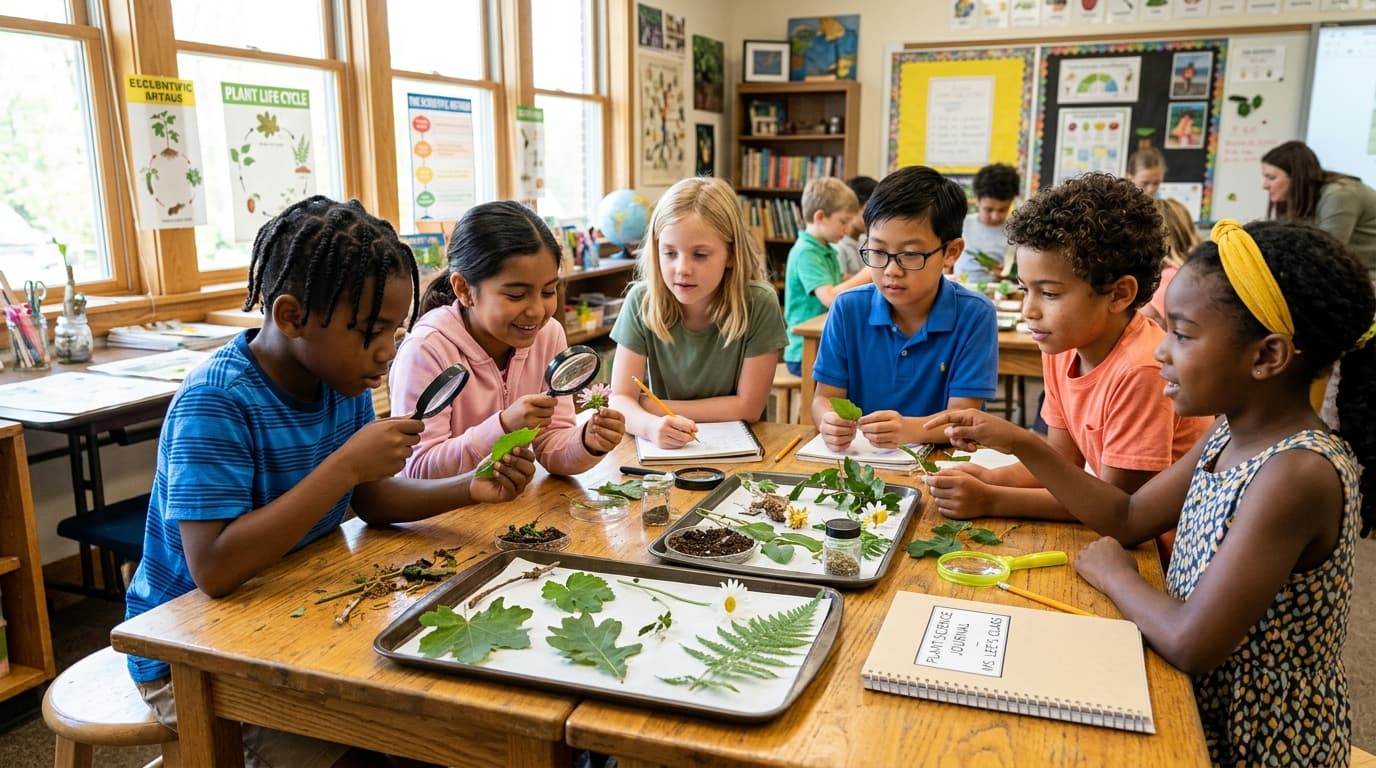
Scientists explain natural systems through visual models. Have students draw Initial Conceptual Models on day 1 with colored pencils:
- Use arrows to show unseen forces, motion, or energy flow.
- Add zoom-in bubbles showing what is happening at a microscopic or particle level.
- Revise models periodically as new empirical evidence is gathered.
Step 6: Assess with Claim-Evidence-Reasoning (CER)
Replace multiple-choice tests with the CER framework:
- Claim: A direct, one-sentence answer to the driving scientific question.
- Evidence: Specific quantitative or qualitative data collected during the investigation.
- Reasoning: Scientific principles connecting the evidence to the claim.
4. Complete Worked 5E Lesson Plan: 4th Grade Energy Transfer
Day 1: Engage & Phenomenon Observation
- Display two bowls of steaming soup. Place a metal spoon in Bowl A and a wooden spoon in Bowl B.
- Allow student volunteers to touch the handles after 3 minutes.
- Record initial student observations on chart paper. Students draw an initial diagram showing their theory of how heat moved from the soup to the handle.
Day 2–3: Explore & Data Collection Lab
- Materials per group: 1 cup of hot water, 1 metal ruler, 1 wooden ruler, 1 plastic ruler, 3 small beads attached to ruler tips with room-temperature butter.
- Students submerge ruler bottoms into hot water and time how many seconds until the butter melts and the bead drops.
- Data Collection Table:
- Metal: Bead drops in 42 seconds.
- Plastic: Bead drops in 3 minutes 15 seconds.
- Wood: Bead does not drop after 5 minutes.
Day 4: Explain & Scientific Discourse
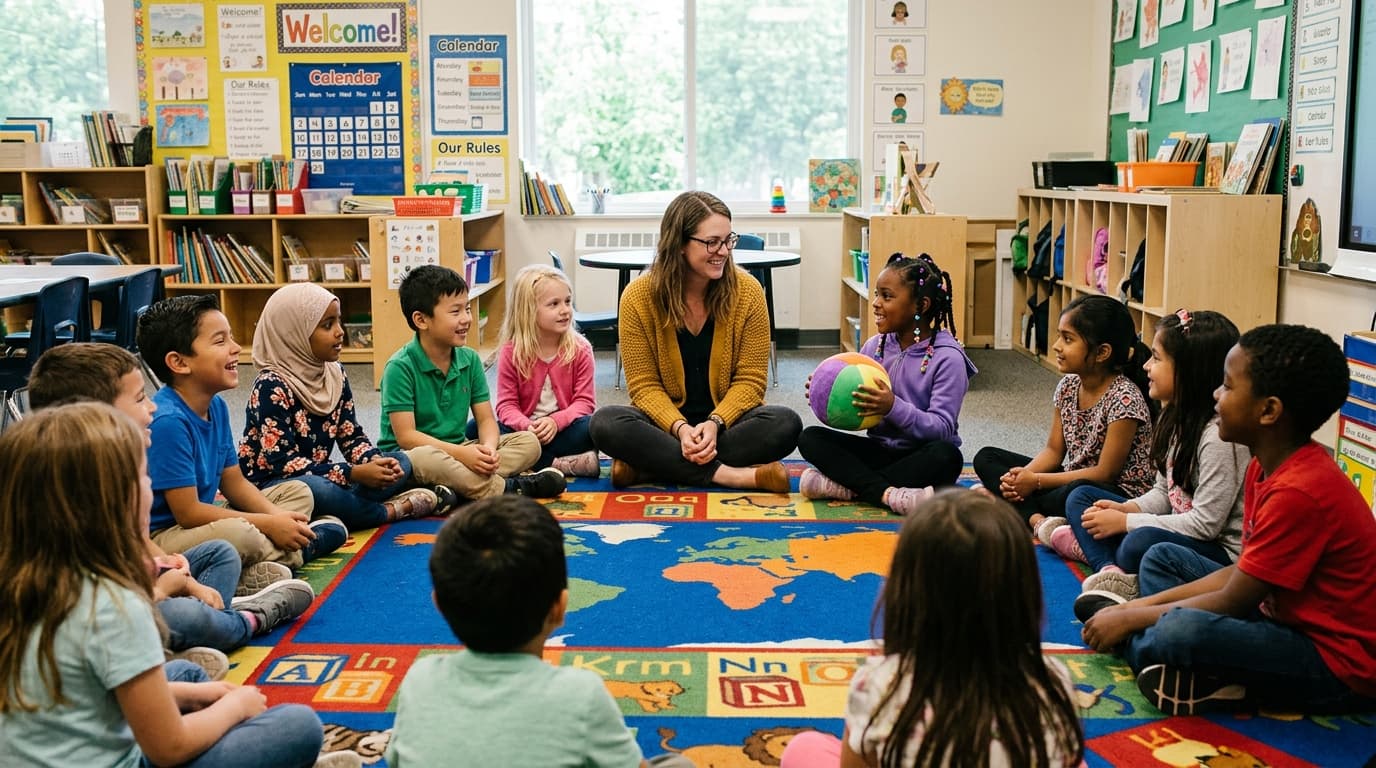
- Class convenes for a "Scientists' Circle" discussion on the rug.
- Students analyze data: "Why did the metal ruler drop its bead first?"
- Teacher introduces formal scientific vocabulary: Thermal Energy Transfer, Conduction, Conductors, Insulators.
- Students revise their initial Day 1 spoon models using color-coded arrows representing heat conduction.
Day 5: Elaborate & Evaluate (CER Assessment)
- Novel Challenge: "NASA is designing a new space rover. Which material should they use to shield sensitive electronics from scorching heat: metal or ceramic/wood? Construct a CER argument."
5. The Claim-Evidence-Reasoning (CER) Graphic Organizer
Provide elementary scientists with this structured scaffold:
6. Science and Engineering Practices (SEPs) in Action
The 8 NGSS SEPs represent authentic scientific behaviors:
- Asking questions and defining problems.
- Developing and using models.
- Planning and carrying out investigations.
- Analyzing and interpreting data.
- Using mathematics and computational thinking.
- Constructing explanations and designing solutions.
- Engaging in argument from evidence.
- Obtaining, evaluating, and communicating information.
Rotate focus across units so students master each practice systematically.
7. Crosscutting Concepts (CCCs): The Lenses of Science
Teach students to use the 7 Crosscutting Concepts as intellectual magnifying glasses:
- Patterns: What regularities do we see in our data?
- Cause and Effect: What caused this phenomenon to occur?
- Scale, Proportion, and Quantity: How does size or speed impact the outcome?
- Systems and System Models: What are the components, inputs, and outputs?
- Energy and Matter: How is energy flowing through this system?
- Structure and Function: How does the physical shape of a bird's beak support its feeding?
- Stability and Change: What conditions keep an ecosystem balanced?
8. Overcoming Common Hurdles in Elementary Science
9. Digital Simulations and AI in Elementary Inquiry
When real-world experiments are dangerous or cost-prohibitive, utilize free PhET Interactive Simulations (University of Colorado Boulder) for virtual circuit building, plate tectonics, and gravity investigations.
Additional Worked 3D Lesson Exemplars Across Science Domains
To illustrate three-dimensional inquiry across different scientific fields in upper elementary grades, examine these two complete lesson blueprints:
Exemplar 2: Life Science (5th Grade - 5-LS1-1)
- Engage (Day 1 - The Soil Mystery):
- Present the historical puzzle: "Where did the 164 pounds of wood come from if the tree didn't 'eat' the soil?"
- Students draw initial models showing tree roots absorbing soil versus leaves absorbing air.
- Explore (Day 2–3 - Controlled Seed Germination):
- Students grow radish seeds in three distinct environments: (A) Soil + Water + Air, (B) Moist Paper Towel + Water + Air (zero soil), and (C) Dry Soil (zero water).
- Students measure biomass growth daily over 5 days using digital kitchen scales.
- Explain (Day 4 - Carbon Dioxide & Photosynthesis):
- Students observe that seeds in wet paper towels sprout and gain weight without soil.
- Teacher guides discourse: carbon dioxide in the air ($CO_2$) provides the carbon atoms that form plant cellulose.
- Evaluate (Day 5 - CER Scientific Writing):
- Student writes: "Claim: Plants build their physical body chiefly from air and water, not soil. Evidence: Our radish seeds gained 14 grams of mass on wet paper towels without soil. Reasoning: Through photosynthesis, plant leaves absorb carbon dioxide molecules from the air and water from roots to synthesize glucose and plant matter."
Exemplar 3: Earth & Space Science (3rd Grade - 3-ESS2-1)
- Investigation Protocol: Students analyze authentic multi-city historical weather datasets (temperature, rainfall, snowfall) spanning 30 years from the National Oceanic and Atmospheric Administration (NOAA).
- Data Representation: Students create double-bar graphs and scatter plots comparing seasonal temperature swings across distinct US climate zones.
- Scientific Sense-Making: Students identify patterns (CCC) to predict whether an orchard could survive in southern Florida.
3D Science Formative Assessment Checklist
Use this observational matrix during student group investigations:
| Student Name | Asks Scientific Questions (SEP 1) | Gathers Empirical Data (SEP 3) | Draws Explanatory Models (SEP 2) | Identifies Cause & Effect (CCC 2) | Formulates Evidence-Based Claim (SEP 7) |
|---|---|---|---|---|---|
|
Marcus
|
High (poses testable hypotheses)
|
High (records accurate units)
|
Moderate (needs zoom-in prompt)
|
High (links variables)
|
High (clear CER paragraph)
|
|
Sophia
|
High
|
High
|
High (exceptional visual arrows)
|
High
|
High
|
|
Liam
|
Emerging (asks general questions)
|
Moderate
|
Developing (sketches pictures only)
|
Developing
|
Developing (needs sentence frame)
|
|
Elena
|
High
|
High
|
High
|
High
|
High
|
10. Frequently Asked Questions (FAQ)
Is NGSS too difficult for elementary students with reading deficits?
No! Because NGSS prioritizes hands-on sensory exploration, visual conceptual modeling, and physical experimentation, multilingual and struggling readers frequently thrive in science, experiencing profound academic success and confidence.
How do I grade student science notebooks?
Grade notebooks for evidence of scientific reasoning, model revision, and data accuracy rather than spelling or handwriting neatness.
11. Action Plan for Elementary Science Educators
- This Week: Replace one textbook chapter lesson with an observable phenomenon video clip.
- Next Week: Construct a physical Driving Question Board with student sticky notes.
- This Month: Assess student learning using a 3-part Claim-Evidence-Reasoning (CER) written prompt.
12. Scholarly References and National Science Frameworks
- National Research Council (NRC). (2012). A Framework for K-12 Science Education: Practices, Crosscutting Concepts, and Core Ideas. The National Academies Press.
- NGSS Lead States. (2013). Next Generation Science Standards: For States, By States. The National Academies Press.
- Bybee, R. W. (2015). The BSCS 5E Instructional Model: Creating Teachable Moments. NSTA Press.
- McNeill, K. L., & Krajcik, J. (2011). Supporting Grade 5-8 Students in Constructing Explanations in Science: The Claim, Evidence, and Reasoning Framework for Talk and Writing. Pearson.
13. Related Teaching Resources and STEM Planning Tools
- International Teaching Resources Hub — Explore our complete collection of global STEM and inquiry-based pedagogy guides.
- AI Lesson Planner — Generate standards-aligned 5E science inquiry lesson plans and investigation protocols.
- AI Worksheets Generator — Create customized CER graphic organizers and laboratory data collection sheets.