How to Integrate Visual Arts into Elementary STEM Units (STEAM)
In elementary schools across the United States, the acronym STEAM—adding the Arts to Science, Technology, Engineering, and Math—is widely celebrated on school district websites, painted across hallway murals, and promoted in grant applications.
Yet inside actual elementary classrooms, what frequently passes for "arts integration" is an intellectual compromise: after spending two weeks studying biological cell anatomy, students are asked to glue fruit loops and glitter onto a paper plate to make a cell model; or after studying geometric shapes, they color in a pre-printed coloring sheet.
These superficial activities, often critiqued by arts educators as "decorative crafts" or "refrigerator art", do not represent authentic arts integration. They do not teach artistic technique, visual spatial thinking, or creative problem-solving; they merely use craft supplies as an ornamental wrap around basic rote memorization.
Pioneered by the Rhode Island School of Design (RISD) under President John Maeda and reinforced by decades of cognitive neuroscience, authentic STEAM integration operates on a fundamentally different premise: art and science are twin modes of human inquiry.
Leonardo da Vinci did not separate his anatomical sketches from his mechanical engineering; Alexander Calder did not separate sculpture from kinetic physics; M.C. Escher did not separate printmaking from non-Euclidean tessellation geometry.
When visual arts are authentically integrated into elementary STEM curricula, art is not an afterthought decoration; art is the investigative methodology through which scientific observation, mathematical reasoning, and engineering design are executed.
This comprehensive guide delivers an evidence-based roadmap for implementing rigorous STEAM units across grades K–5, contrasting pseudo-crafts with authentic integration, detailing four complete standards-aligned units (bridge engineering, biomimicry sculptures, botanical watercolor observation, and tessellation architecture), and providing multi-dimensional STEAM assessment rubrics.
Table of Contents
- 1. Epistemological Foundations: Crafts vs. Authentic Arts Integration
- 2. Cognitive Synergy: How the Visual Arts Accelerate STEM Mastery
- 3. The 4 Dimensions of the Authentic STEAM Framework
- 4. Turnkey Unit 1: Structural Bridge Engineering & Watercolor Elevation Drafting (Grades 3-5)
- 5. Turnkey Unit 2: Mathematical Tessellations & Geometric Symmetry (Grades 2-4)
- 6. Turnkey Unit 3: Biomimicry Sculptures & Animal Adaptation Clay Engineering (Grades K-2)
- 7. Turnkey Unit 4: Botanical Cyanotypes & Solar Energy Printmaking (Grades 1-3)
- 8. Designing Balanced STEAM Assessment Rubrics
- 9. Sourcing Inexpensive Materials and Managing Studio Logistics
- 10. Overcoming Institutional Silos: Partnering with the School Art Specialist
- 11. The STEAM Studio Safety and Clean-Up Management System
1. Epistemological Foundations: Crafts vs. Authentic Arts Integration
To design authentic STEAM, educators must understand the boundary between decorative compliance crafts and rigorous arts inquiry:
In authentic STEAM, a lesson cannot be called integrated unless it assesses both an engineering/science/math standard AND a visual arts standard with equal rigor. If the visual arts portion can be stripped away without altering the learning, it is a craft; if removing the art fundamentally destroys the inquiry, it is authentic STEAM.
Lesson Planner
Generate comprehensive, CAPS-aligned lesson plans in seconds.
2. Cognitive Synergy: How the Visual Arts Accelerate STEM Mastery
Neuroimaging research reveals that artistic training enhances executive functioning, spatial visualization, and cognitive flexibility:
- Spatial Working Memory: When children learn observational drawing (rendering 3D objects onto 2D planes), their parietal lobes activate the identical neural networks required for advanced geometric transformations and mental rotation in engineering.
- Observational Acuity: Drawing forces sustained looking. A student casually looking at a plant leaf sees a generic green oval; a student required to draw the leaf with scientific botanical accuracy notices vein bifurcations, serrated margins, and stomata distribution. Drawing transforms looking into genuine observation.
- Tolerance for Ambiguity and Iterative Failure: In fine arts, the "happy accident" and creative experimentation normalize revision. In traditional STEM, failure is often penalized as a wrong answer; in STEAM, engineering prototypes and artistic drafts undergo continuous, joyful iterative refinement.
3. The 4 Dimensions of the Authentic STEAM Framework
When planning any STEAM unit, structure the inquiry across four interconnected cognitive pillars:
┌────────────────────────┐    ┌────────────────────────┐
│ 1. INVESTIGATE         │    │ 2. DESIGN & COMPOSE    │
│ Observe natural/formal │───►│ Apply artistic elements│
│ laws and STEM phenomena│    │ and engineering balance│
└────────────────────────┘    └────────────────────────┘
            ▲                              │
            │                              ▼
┌────────────────────────┐    ┌────────────────────────┐
│ 4. REFLECT & EXHIBIT   │    │ 3. CONSTRUCT & TEST    │
│ Defend design choices  │◄───│ Prototype, measure,    │
│ to public audience     │    │ calibrate, and iterate │
└────────────────────────┘    └────────────────────────┘
4. Turnkey Unit 1: Structural Bridge Engineering & Watercolor Elevation Drafting (Grades 3-5)
Integrated Standards:
- STEM: NGSS 3-5-ETS1-1 & ETS1-2 (Engineering Design: defining criteria and constraints; generating multiple solutions); CCSS.MATH.CONTENT.4.MD.A.3 (Perimeter and area formulas).
- Visual Art: National Core Arts Standards VA:Cr1.1.4a (Brainstorm multiple approaches to an art or design problem) & VA:Pr4.1.4a (Selecting work for exhibition).
Unit Walkthrough:
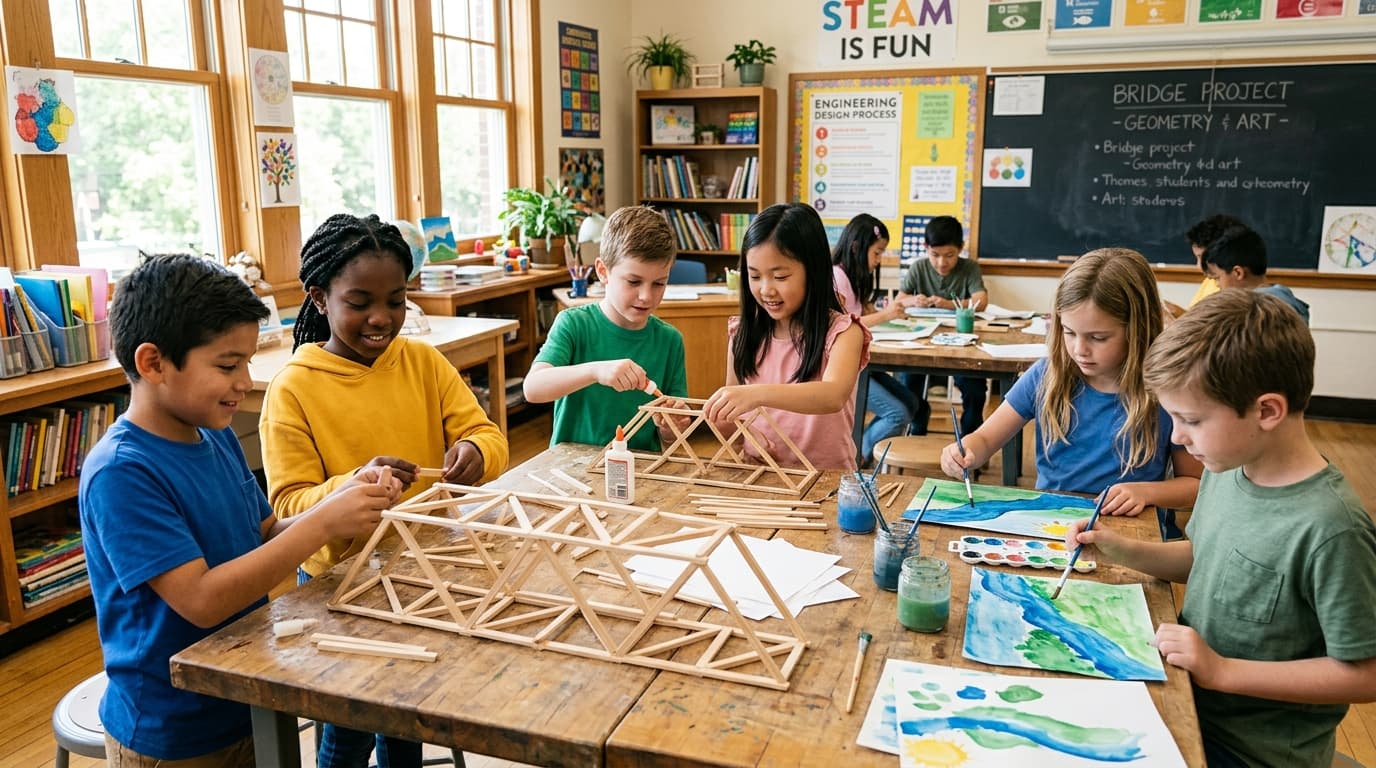
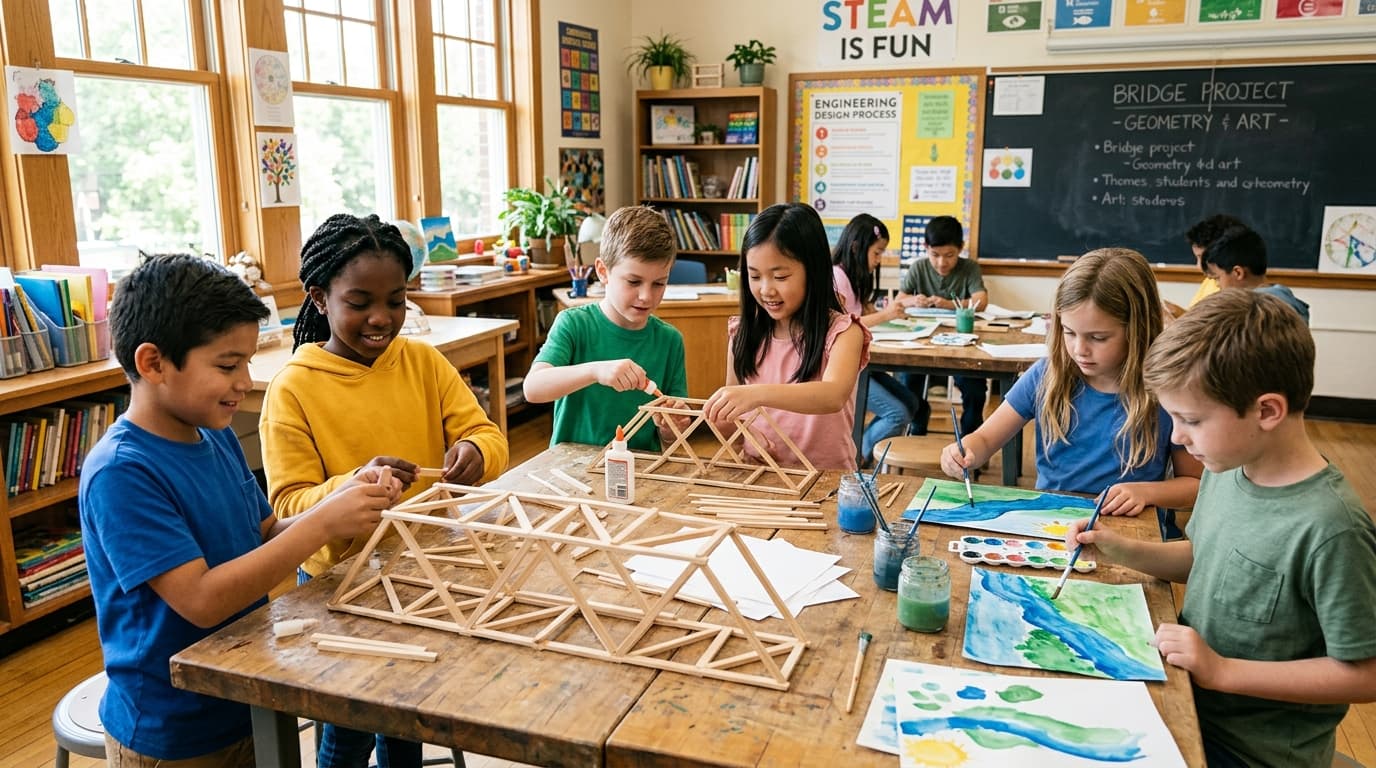
- Engineering Challenge: Student teams receive identical constraints: design a 14-inch truss bridge using wooden craft sticks and glue that can span an 11-inch ravine and support a minimum load of 15 pounds.
- Art Integration (Architectural Elevation Drafting & Watercolor): Before touching wood, students study the architectural blueprints of suspension and truss bridges designed by civil engineers.
- Students learn technical architectural drafting: drawing an orthogonal front elevation to 1:2 scale on grid paper using T-squares and triangles.
- Students learn watercolor wash techniques (wet-on-wet, wet-on-dry) to paint the environmental background landscape (river canyon, rock strata) behind their architectural blueprint.
- Construction & Load Testing: Teams build wooden trusses matching their architectural drawings with millimeter precision. On testing day, weights are incrementally suspended from the center of the span until structural failure occurs.
- Artistic Synthesis: Students display their painted architectural drafting elevations side-by-side with their load-tested physical bridges at the school STEAM Gala, writing an artist-engineer statement defending their structural choices.
5. Turnkey Unit 2: Mathematical Tessellations & Geometric Symmetry (Grades 2-4)
Integrated Standards:
- STEM: CCSS.MATH.CONTENT.3.G.A.1 (Categorizing geometric shapes by attributes); CCSS.MATH.CONTENT.4.G.A.3 (Line symmetry and rotational transformation).
- Visual Art: National Core Arts Standards VA:Cr2.1.3a (Create personally satisfying artwork using shape, pattern, and positive/negative space).
Unit Walkthrough:
- Mathematical Exploration: Students explore polygons that tile a plane without gaps or overlaps (triangles, squares, hexagons). They discover the internal angle sum theorem through hands-on pattern block tiling.
- Art Study (M.C. Escher & Islamic Geometric Tilework): The class analyzes M.C. Escher's woodcut prints (Metamorphosis, Sky and Water). Students observe how Escher transformed rigid geometric polygons into organic living forms (birds, fish, reptiles) using isometric translation, reflection, and rotation.
- The Translation Technique (Engineering the Nibble):
- Students cut a 3-inch by 3-inch square of rigid cardstock.
- On the top edge, they draw an organic cut line (e.g., the silhouette of an animal head) and cut it out cleanly.
- Following strict translational geometry, they slide the severed piece straight across to the bottom edge without rotating it, securing it with clear tape.
- They repeat the translation process from the left edge to the right edge.
- Visual Art Production: Students trace their custom tile repeatedly across a 12x18 sheet of watercolor paper, generating an interlocking tessellation pattern. They apply color theory (complementary color schemes or warm vs. cool contrast) using colored pencil blending to emphasize positive and negative space.
6. Turnkey Unit 3: Biomimicry Sculptures & Animal Adaptation Clay Engineering (Grades K-2)
Integrated Standards:
- STEM: NGSS 1-LS1-1 (Use materials to design a solution to a human problem by mimicking how plants/animals use external parts to survive).
- Visual Art: National Core Arts Standards VA:Cr1.2.1a (Use observation and investigation in making a work of art or design with 3D clay).
Unit Walkthrough:
- Scientific Inquiry: Students investigate how animals use physical anatomical adaptations for survival: bird beaks (spoonbill vs. hummingbird), beaver tails for structural propulsion, polar bear hollow fur for thermal insulation, burdock burrs (which inspired Velcro).
- The Engineering Dilemma: Students must design a wearable protective tool or grasping instrument for humans that mimics an observed animal adaptation.
- Ceramic & Polymer Clay Sculpting:
- Students learn authentic 3D sculpting techniques: rolling coils, creating pinch pots, scoring and slipping clay joints to ensure structural integrity during drying.
- Students sculpt an ergonomic tool handle inspired by an eagle talon, or a non-slip shoe tread pattern inspired by the microscopic lamellae of a gecko's foot.
- Functional Testing & Exhibition: Students test their clay tools picking up various objects (seeds, water drops, smooth marbles) and record scientific performance data in their STEAM design logs.
7. Turnkey Unit 4: Botanical Cyanotypes & Solar Energy Printmaking (Grades 1-3)
Integrated Standards:
- STEM: NGSS 1-PS4-3 (Plan and conduct an investigation to determine the effect of placing objects made with different materials in the path of a beam of light); 2-LS4-1 (Observe diversity of plant life in different habitats).
- Visual Art: National Core Arts Standards VA:Cr2.2.2a (Demonstrate safe procedures for using art materials in alternative photography printmaking).
Unit Walkthrough:
- Botanical Fieldwork: Students tour the school garden with magnifying glasses, collecting fallen leaves, seeds, ferns, and flower petals. They analyze leaf morphology: simple vs. compound leaves, venation patterns, and petal transparency.
- Chemical & Solar Physics: The teacher introduces cyanotype printmaking (sun-printing paper coated with light-sensitive iron salts). Students learn that ultraviolet (UV) solar radiation triggers a photochemical reaction, turning exposed paper Prussian blue, while opaque plant materials block the light.
- Artistic Composition: Students learn classical design principles: visual balance, radial symmetry, overlapping, and focal points. They arrange their botanical specimens in careful compositions across the dry cyanotype sheets.
- Solar Exposure & Water Development: Students carry their frames into bright sunlight, timing exact 2-minute exposures. They submerge the paper in cool water trays to wash away unreacted chemicals, witnessing the immediate emergence of high-contrast white botanical silhouettes against rich midnight blue backgrounds.
- Scientific Labeling: Students annotate their finished prints with botanical callout arrows identifying leaf margin structures and photosynthetic surface areas.
8. Designing Balanced STEAM Assessment Rubrics
A common pitfall is giving 100% of the grade for scientific data while ignoring artistic technique, or vice versa. A rigorous STEAM rubric assesses both disciplines with equal weight:
| Dimension | Exemplary (Score 4) | Proficient (Score 3) | Developing (Score 2) | Beginning (Score 1) |
|---|---|---|---|---|
|
Scientific / Mathematical Rigor (STEM)
|
Demonstrates deep conceptual understanding; calculations, load data, and biological adaptations are accurate and robust.
|
STEM concepts are applied accurately with minor calculation or labeling oversights.
|
Basic scientific understanding evident; requires teacher guidance to explain mechanics.
|
Scientific principles are misunderstood or omitted entirely from the design.
|
|
Artistic Craftsmanship & Technique (ART)
|
Masterful application of formal art elements (value, line, form, balance); precise material handling and clean craftsmanship.
|
Demonstrates competent artistic technique; intentional use of color and compositional balance.
|
Basic application of art media; sloppy execution, messy glue, or rushed brushwork.
|
Minimal effort in art execution; treats the visual component as a thoughtless craft.
|
|
Design Integration Synergy
|
The art component directly illuminates and advances the engineering solution; seamless conceptual fusion.
|
Art and STEM elements are connected clearly and support each other.
|
Art appears loosely connected to the STEM concept; feels somewhat decorative.
|
Complete disconnection between the science topic and the art product.
|
|
Iterative Defense & Reflection
|
Articulates how testing failures led to artistic and engineering design revisions; defends choices with empirical evidence.
|
Explains design choices and reflects on at least one iteration based on testing.
|
Describes the final product but cannot explain why specific design choices were made.
|
Refuses to reflect or cannot explain the design process.
|
9. Sourcing Inexpensive Materials and Managing Studio Logistics
Authentic STEAM does not require high-tech maker spaces or exorbitant budgets. The most transformative materials are everyday items organized with studio discipline:
Budget-Friendly STEAM Materials Matrix:
- Corrugated Cardboard & Pizza Boxes: Exceptional for architectural models, spatial scale, and structural load testing.
- Air-Dry Terracotta & Model Magic: Affordable alternatives to kiln-fired ceramic clay for tactile biomimicry sculptures.
- Sun-Print / Cyanotype Paper: Available in bulk packs for under $15 per classroom.
- Architectural Drafting Supplies: Sturdy wooden rulers, triangles, grid paper notebooks, and watercolor pan sets ($2.50 per student).
10. Overcoming Institutional Silos: Partnering with the School Art Specialist
In many elementary schools, the general education teacher and the specialist art teacher operate in complete isolation. Bridging this professional divide doubles instructional leverage:
The 3-Step Collaborative Planning Protocol:
- Quarterly Curriculum Sync: Share upcoming science and math units with the art specialist 4 weeks in advance (e.g., "In November, 4th grade is studying plate tectonics and rock strata").
- Reciprocal Instruction: The art specialist teaches landscape elevation, geologic strata textures, and clay relief techniques during 45-minute art specials, while the classroom teacher guides the physical lab testing and informational writing.
- Joint STEAM Exhibitions: Host a combined annual STEAM Night where parents experience student work celebrated through both scientific and artistic lenses.
11. The STEAM Studio Safety and Clean-Up Management System
Hands-on STEAM environments quickly dissolve into chaos without structured studio management routines.
The 4-Role Clean-Up Protocol:
- Role 1 (Water & Paint Master): Cleans water cups, rinses brushes with cold water, and shapes bristles flat to dry.
- Role 2 (Materials Inspector): Counts tools, returns rulers and scissors to labeled caddies, caps markers tightly.
- Role 3 (Surface Sanitizer): Wipes down desk mats with damp sponges and sweeps stray paper cuttings.
- Role 4 (Drying Rack Coordinator): Transports finished wet paintings or clay models carefully to the classroom drying rack.
12. The Student STEAM Design Journal: Daily Metacognitive Prompts
To cement cross-disciplinary synthesis, every student maintains an ongoing STEAM Design Journal throughout the project lifecycle. Before putting away materials each day, students complete one of four structured reflection prompts:
The 4 Core STEAM Reflection Stems:
- The Scientific-Artistic Connection: "How did understanding the scientific concept of [__] change the way I chose to paint, sculpt, or draw my design today?"
- The Engineering Failure Breakthrough: "What part of our physical prototype failed during testing today, and what artistic or structural adjustment did we make to solve the problem?"
- The Precision Math Check: "Where did mathematical measurement (angles, ratios, scale, perimeter) make the difference between a weak model and a strong, beautiful structure?"
- The Aesthetic & Functional Balance: "If I had to defend our design to an architect or gallery curator, how would I prove that it is both functionally effective and visually compelling?"
By embedding genuine artistic inquiry into elementary science and engineering, educators ignite cross-disciplinary brilliance—nurturing young thinkers who observe like scientists, calculate like mathematicians, and create like visionary artists.