How to Integrate Indigenous Ways of Knowing (FNMI) Across Canadian Classrooms: Reconciliation, Land-Based Learning, and Protocol
Integrating Indigenous perspectives, histories, and worldviews into K-12 education is not merely a curricular enhancement; it is a foundational legal, ethical, and pedagogical commitment across Canada. The 2015 Truth and Reconciliation Commission of Canada (TRC) explicitly outlined this responsibility in Calls to Action 62 and 63, directing federal, provincial, and territorial governments to integrate Indigenous knowledge, residential school histories, and treaty education into mandatory curricula for all students from Kindergarten through Grade 12.
Yet, many non-Indigenous educators feel immobilized by what scholar Dr. Susan Dion terms the "perfect stranger" phenomenon: an anxiety about causing offense, misrepresenting sacred cultural teachings, or perpetrating cultural appropriation. Fearful of "doing it wrong," teachers often default to superficial, tokenistic gestures: reading an Indigenous legend during November, crafting decorative dreamcatchers from paper plates, or reciting perfunctory Territorial Acknowledgments that sound like rote administrative disclaimers.
Meaningful integration of First Nations, Métis, and Inuit (FNMI) ways of knowing requires an ontological paradigm shift. It demands moving from learning about Indigenous peoples as static historical subjects to learning from Indigenous pedagogical frameworks—such as relationality, Land-based inquiry, oral storytelling, holistic balance, and deep intergenerational stewardship.
This masterclass equips Canadian educators, curriculum leads, and school administrators with a practical, respectful, and culturally grounded roadmap for embedding Indigenous ways of knowing across primary, intermediate, and secondary classrooms.
1. The Legal and Moral Imperative: TRC Calls to Action and Provincial Frameworks
Every educator practicing in Canada must understand the institutional foundations driving Indigenous education:
| Governance Level | Statutory / Policy Document | Key Directives & Pedagogical Mandates |
|---|---|---|
|
Federal / National
|
TRC Calls to Action (62 & 63)
|
- Mandatory age-appropriate K-12 curriculu on residential schools, Treaties, and contemporary Indigenous contributions. - Building student intercultural capacity.
|
|
United Nations
|
UNDRIP (United Nations Declaration on the Rights of Indigenous People (Enacted into Canadian law 2021)
|
- Article 14: Indigenous peoples' right to establish their educational systems; dignity and diversity of cultures in ed.
|
|
British Columbia
|
First Peoples Principles of Learning (FPPL - FNESC)
|
- Nine holistic principles underpinning the redesigned BC K-12 curriculum.
|
|
Ontario
|
Ministry First Nations, Métis and Inuit Education Policy Framework
|
- Mandatory integration across Social Studies, History, Science, and English.
|
|
Alberta
|
Professional Practice Standard 5 (TQS - Foundational Knowledge)
|
- Mandatory teacher competency: applying foundational knowledge of FNMI peoples.
|
The First Peoples Principles of Learning (FPPL)
Articulated by the First Nations Education Steering Committee (FNESC) in British Columbia, the First Peoples Principles of Learning provide a transformative framework applicable across all subjects and jurisdictions:
- Learning ultimately supports the well-being of the self, the family, the community, the land, the spirits, and the ancestors.
- Learning is holistic, reflexive, reflective, experiential, and relational (focused on connectedness, on reciprocal relationships, and a sense of place).
- Learning involves recognizing the consequences of one's actions.
- Learning involves generational roles and responsibilities.
- Learning recognizes the role of indigenous knowledge.
- Learning is embedded in memory, history, and story.
- Learning involves patience and time.
- Learning requires exploration of one's identity.
- Learning involves recognizing that some knowledge is sacred and only shared with permission and/or in certain situations.
2. Decolonization vs. Indigenization: Core Conceptual Clarity
Educators must distinguish between two complementary but distinct educational processes:
Decolonization
Decolonization is the critical work of unlearning and dismantling systemic colonial assumptions. It involves teaching the unvarnished truths of Canadian history: the Indian Act, the pass system, the Sixties Scoop, the residential school system, broken treaties, and ongoing environmental racism. It means auditing classroom bookshelves to remove outdated texts that depict Indigenous peoples through the "pioneer gaze" or noble savage stereotypes.
Indigenization
Indigenization is generative and affirmative. It centers Indigenous philosophies, epistemologies, and pedagogical structures. It validates oral storytelling as rigorous academic inquiry. It acknowledges the natural Land not as passive real estate or extractable resource, but as our first and greatest teacher.
3. Cultural Appreciation vs. Cultural Appropriation: Navigating the Boundaries
The most common anxiety for non-Indigenous educators is the fear of committing cultural appropriation. Understanding the boundary between respectful appreciation and extractive appropriation is essential for ethical practice:
| Dimension | Cultural Appreciation (Ethical) | Cultural Appropriation (Harmful) |
|---|---|---|
|
Voice & Authorship
|
Reading authentic stories written and published by Indigenous authors (e.g., Richard Wagamese).
|
Having students invent their own fictional "Indigenous legends" or make up spirit animal names.
|
|
Arts & Crafts
|
Studying the cultural meaning and geometry of Haida formline art, led by Indigenous artist videos.
|
Having children construct fake totem poles out of toilet paper rolls or make paper- plate dreamcatchers to take home.
|
|
Sacred Knowledge
|
Teaching about the significance of smudging, sweetgrass, and the sacred pipe with local Elder lead.
|
Attempting to conduct sacred ceremonies in class (e.g., non-Indigenous teacher staging a classroom sweat lodge or smudge)
|
|
Identity & Regalia
|
Inviting Indigenous dancers to perform and explain regalia.
|
Having students dress up in "Indian" costumes, feather headdresses, or fringe.
|
The Golden Rule: "Nothing About Us Without Us"
Non-Indigenous teachers should position themselves not as "experts" on Indigenous culture, but as humble facilitators and co-learners. Use authentic primary resources created by Indigenous authors, filmmakers, artists, and knowledge keepers. When introducing traditional cultural knowledge, explicitly name the nation, community, and source: "This teaching comes from Elder Muriel Cardinal of the Saddle Lake Cree Nation." Avoid homogenizing distinct cultures under a generic "Native" umbrella; recognize the rich distinctions between Anishinaabe, Haudenosaunee, Mi'kmaq, Cree, Blackfoot, Dene, Métis, and Inuit nations.
4. Land-Based Pedagogy: The Land as Primary Teacher
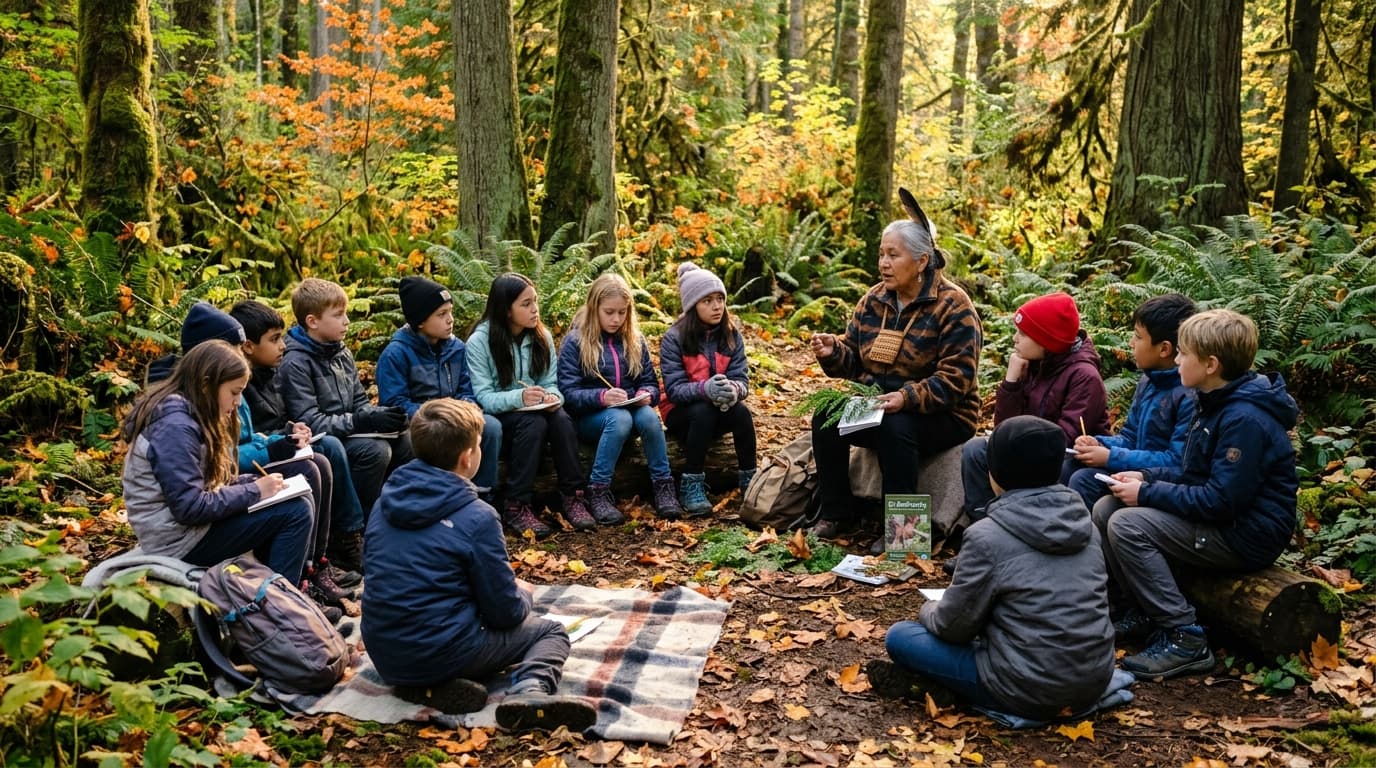
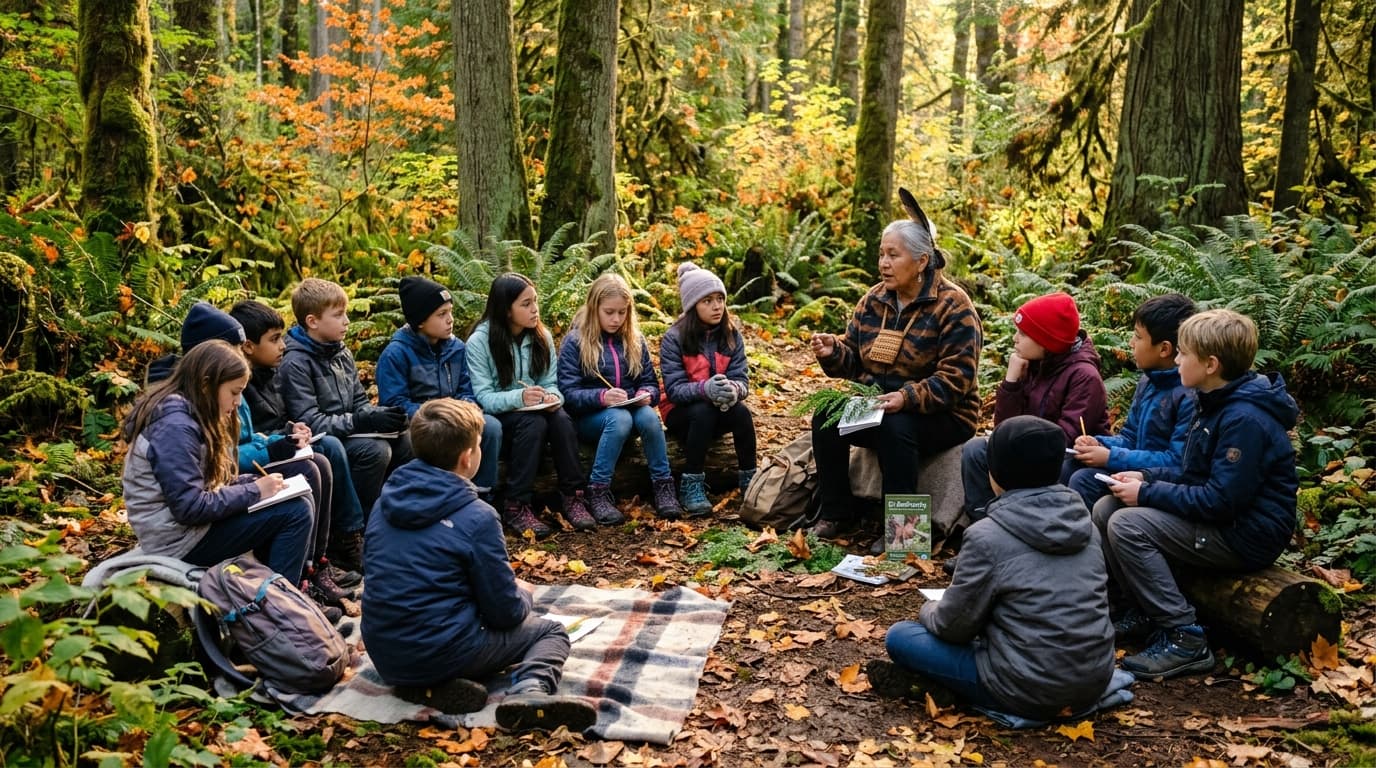
Land-based learning is the cornerstone of Indigenous pedagogy. It rests upon the understanding that human beings do not exist apart from nature; we are nature. The Land (including waters, soils, skies, plants, and animals) holds memory, history, and physical curriculum.
1. All My Relations (Relationality)
Known across nations by concepts like Mitákuye Oyás'in (Lakota) or Nii'kinaaganaa (Anishinaabe), this teaching emphasizes that all living things—four-legged, winged, swimming, rooted, and human—are interconnected kin.
Lesson Planner
Generate comprehensive, CAPS-aligned lesson plans in seconds.
- Classroom Translation: In biology and ecology, investigate food webs not as transactional predatory hierarchies, but as networks of mutual kinship and reciprocal balance.
2. Micro-Habitats and Seasonal Cycles
Indigenous knowledge systems track precise seasonal transitions based on ecological phenomena rather than rigid Roman calendar dates (e.g., The Sugar Moon marking maple sap run; The Frog Moon marking spring thawing).
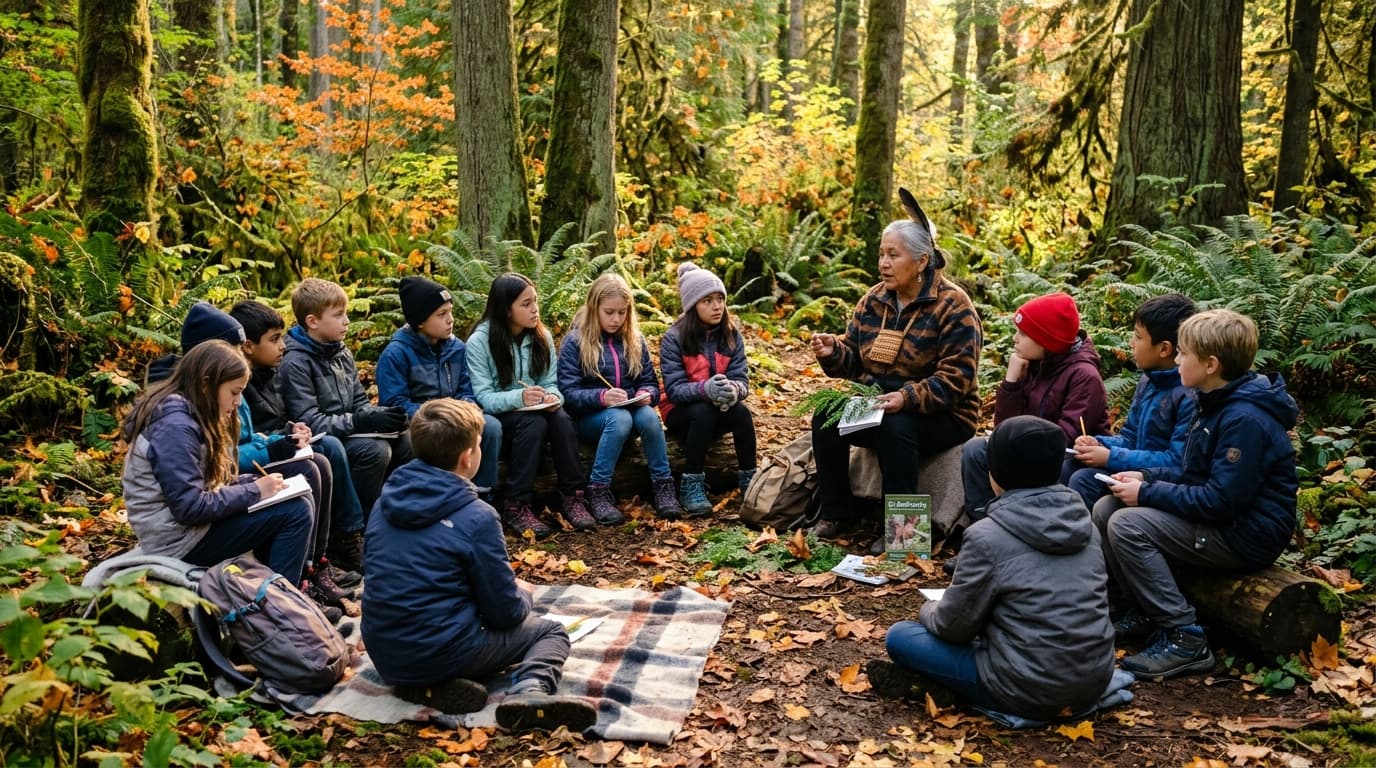
- Classroom Translation: Establish a year-long "Adopt a Tree / Adopt a Patch" routine. Students visit the same outdoor site once a week across all four seasons, recording phenological changes (budding, leaf senescence, insect activity, frost penetration) in observational field journals.
3. Reciprocity: Never Taking Without Giving Back
A core tenet of Indigenous land use is reciprocity. When harvesting traditional medicine or plants, one never takes the first plant found, never takes more than one-third of a patch, and always leaves an offering of gratitude (traditionally tobacco, or a respectful gift of clean water or song).
- Classroom Translation: When conducting outdoor science inquiries or collecting natural materials for art, teach students to take only fallen items, leave living branches intact, and perform a collective act of stewardship (such as cleaning litter or planting native wildflowers) before departing.
5. Engaging Elders and Knowledge Keepers: Protocol, Tobacco, and Honoraria
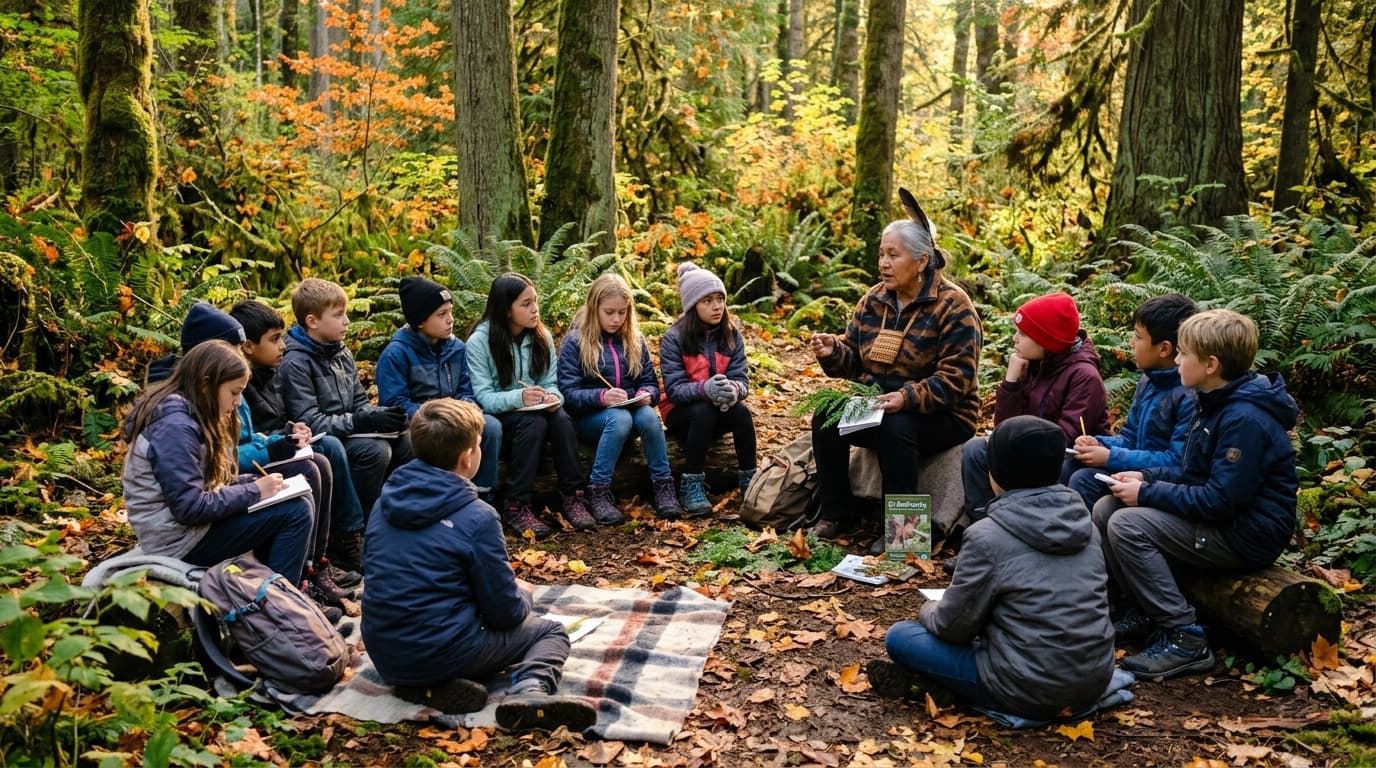
Inviting an Indigenous Elder, Knowledge Keeper, or Senator (Métis) into the school is one of the most enriching experiences for students. However, engaging an Elder requires strict adherence to cultural and administrative protocols.
6. Meaningful Land Acknowledgments: Moving Beyond Performance
Territorial or Land Acknowledgments have become commonplace across Canadian school assemblies, morning announcements, and staff meetings. Unfortunately, many have degraded into hollow, performative scripts rattled off in 15 seconds before the national anthem.
Deconstructing an Authentic Land Acknowledgment
To be meaningful, an acknowledgment must be personal, reflective, and linked to concrete action. Teach students the 3-Part Acknowledgment Framework:
Rotate the responsibility of authoring Land Acknowledgments among students. Have students research local Treaty maps (e.g., using native-land.ca), investigate the history of local waterways, and compose original spoken acknowledgments.
7. Subject-Specific Integration Matrix (K-12)
Indigenous ways of knowing should not be confined to Social Studies or History; they enrich every discipline across the curriculum:
| Subject | Primary (Grades K-3) | Intermediate (Grades 4-8) | Senior (Grades 9-12) |
|---|---|---|---|
|
English / Language Arts
|
- Indigenous oral storytelling traditions; circular narrative structures vs linear plots.
|
- Exploring Indigenous graphic novels (David A. Robertson) - The power of reclaiming names.
|
- Contemporary Indigenous literature (Eden Robinson, Cherie Dimaline, Thomas King). - Rhetoric of treaties; residential school testimonies.
|
|
Mathematics
|
- Beading patterns (AB, AABB) using traditional colour logic - Birchbark biting symmetry.
|
- Métis sash finger weaving: mathematical permutations and geometric transformations.
|
- Indigenous architecture: structural geometry of the Tipi (conical stability, wind aerodynamics); - Algorithmic thinking in traditional game theory.
|
|
Science & Environment
|
- Plant classification through sensory observation (touch, smell, seasonal appearance).
|
- Two-Eyed Seeing: water testing paired with Water Walkers; - Salmon life cycle & fishing.
|
- Sustainable resource management: traditional wildfire cultural burning practices vs wildfire suppression; - Arctic climate science through Inuit Qaujimajatuqangi
|
|
Visual Arts & Music
|
- Studying West Coast formline ovoid and U-shapes (artistic meaning, not imitation).
|
- Woodland Style painting (Norval Morrisseau); visual symbolism and spirit lines.
|
- Contemporary Indigenous resistance art (Kent Monkman, Christi Belcourt); traditional vs contemporary fusion music (Jeremy Dutcher, Snotty Nos
|
8. Navigating Residential School History with Age-Appropriate Sensitivity
Teaching the tragic history of the Indian Residential School system is mandatory under TRC Call to Action 62. However, introducing state-sponsored child abuse and genocide requires extreme pedagogical care to avoid traumatizing young children or inducing feelings of guilt and helplessness.
Self-Care and Trauma-Informed Debriefing
Whenever residential schools are discussed, remind Indigenous students that they are not obligated to speak for their culture or recount family trauma. Ensure school counseling staff are available, and provide the National Indian Residential School Crisis Line (1-866-925-4419) on all shared resources.
9. Frequently Asked Questions (Canadian Teachers & Curriculum Leaders)
Is it acceptable for a non-Indigenous teacher to teach Indigenous content?
Yes. In fact, TRC Call to Action 62 makes it the ethical responsibility of all Canadian teachers to educate their students on Indigenous histories and worldviews. However, non-Indigenous teachers must position themselves as facilitators, centering Indigenous-authored texts, documentaries, podcasts, and local guest speakers rather than speaking on behalf of Indigenous peoples.
How do we respond to pushback from parents who claim that learning about residential schools makes children feel guilty?
Explain clearly that the goal of reconciliation education is truth-telling, empathy, and collective responsibility, not personal settler guilt. Frame learning through the words of TRC Commissioner Murray Sinclair: "Education got us into this mess, and education will get us out." Children who understand historical truth grow into compassionate, informed citizens capable of building a just, united Canada.
What is the difference between First Nations, Métis, and Inuit?
Section 35 of the Constitution Act, 1982 recognizes three distinct Aboriginal peoples in Canada:
- First Nations: The original inhabitants of the land south of the Arctic tree line, comprising over 630 distinct nations with diverse languages, governance structures, and cultures.
- Inuit: The distinct Indigenous people of the Arctic circumpolar region (Inuit Nunangat), encompassing distinct language dialects (Inuktitut, Inuinnaqtun) and cultural traditions.
- Métis: A distinct Indigenous people whose culture emerged from historic unions between First Nations women and European fur traders in the Red River Valley and historic Northwest, with their own unique language (Michif), culture, and governance systems.