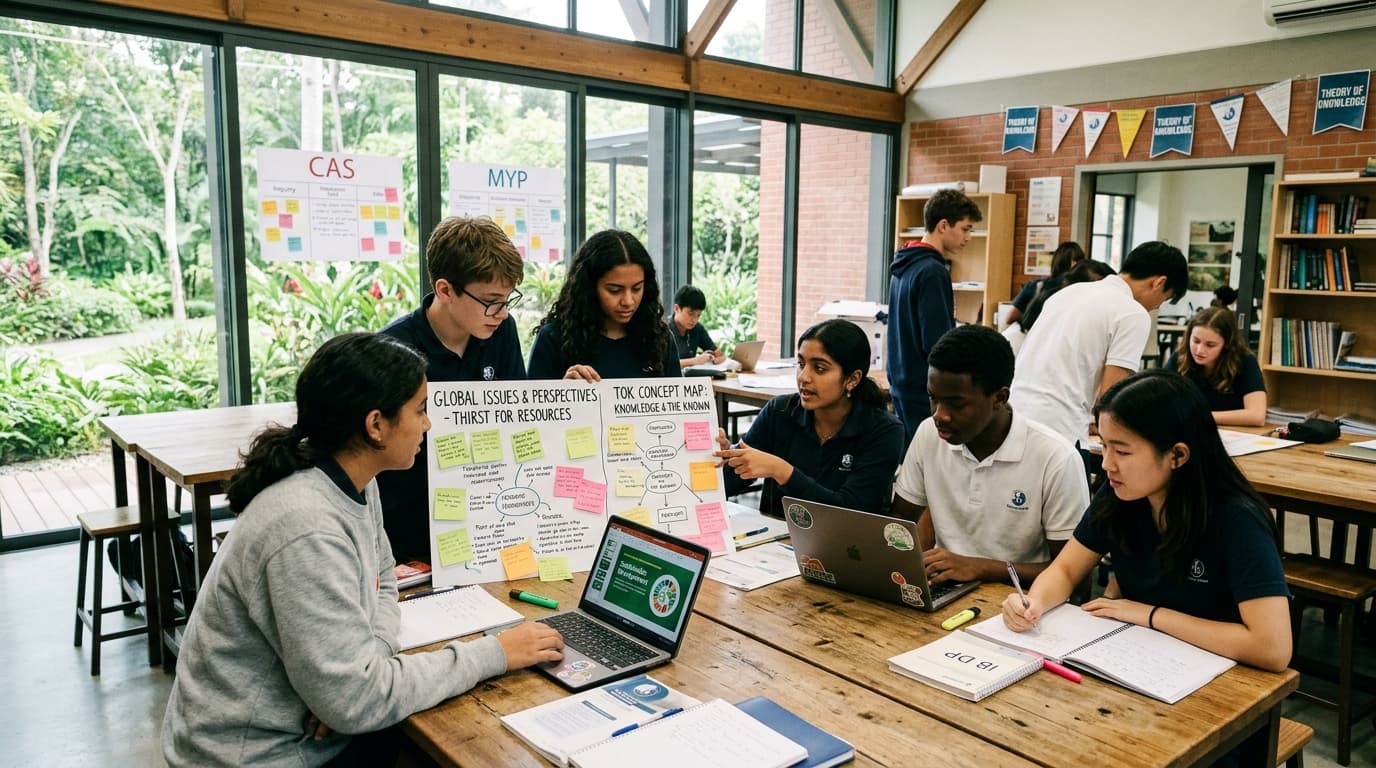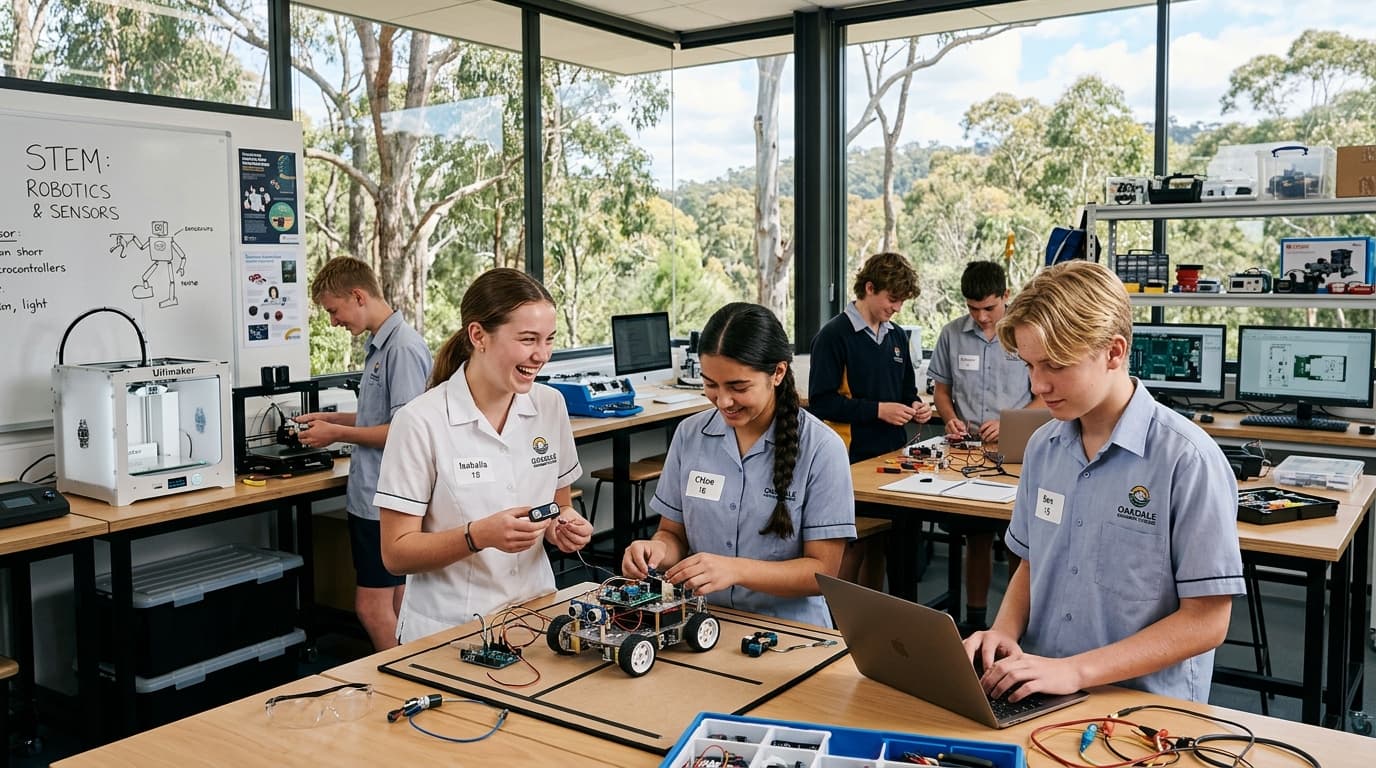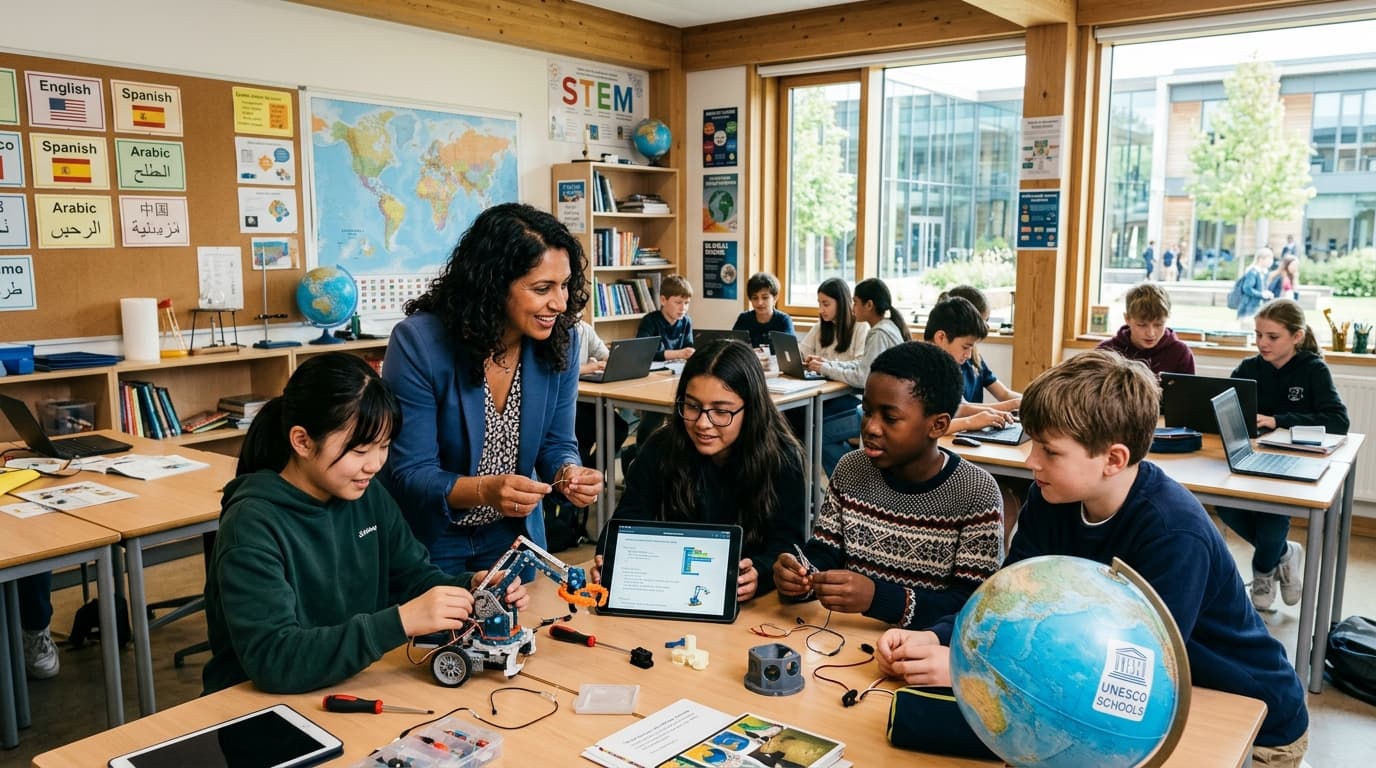
Executive Summary: Bridging Disciplinary Depths in the Middle Years
In secondary education worldwide, the early adolescent years (ages 11 to 16) represent a critical developmental crossroad. During this transition from primary generalist classrooms to specialized secondary subjects, young adolescents often experience learning as fragmented and disjointed. Students move through seven or eight discrete periods a day—switching from algebra to historical treaties to cell biology without ever encountering the profound connective tissues that unite human knowledge.
The International Baccalaureate Middle Years Programme (IB MYP) addresses this structural fragmentation. While the MYP respects disciplinary rigor across its eight distinct subject groups, its defining pedagogical innovation is Interdisciplinary Learning.
| Y GROUNDING│ + subjects)│ | │ INTERDISCIPLINARY SY │ (New, emergent unders |
|---|---|
|
concepts │ ──────────── concepts │ disciplinary│ gies │ grounding │ superficial│
|
│ • Solves real-world pr │ • Synthesises methods │ • Evaluates holistic │ • Assessed via IDU Cri │ (A: Grounding, B: Sy │ C: Communicating, D
|
The IB mandates that in every year of the MYP, schools must deliver at least one collaboratively planned Interdisciplinary Unit (IDU) that involves at least two subject groups. When executed effectively, an IDU demonstrates to students that complex global dilemmas—climate migration, infectious disease outbreaks, artificial intelligence ethics, or sustainable urban architecture—cannot be solved by a single discipline working in isolation.
This guide provides international secondary school educators, MYP coordinators, and heads of department with an operational manual for engineering, delivering, evaluating, and standardising MYP Interdisciplinary Units and culminating capstones.
1. The MYP Curriculum Architecture: Eight Subject Groups and Global Contexts
To design an effective interdisciplinary inquiry, teachers must understand how the MYP balances disciplinary depth with global relevance.
| Dimension / Category | Key Details & Guidance |
|---|---|
|
1. Language and Literature
|
2. Language Acquisition
|
|
3. Individuals and Societies
|
4. Sciences (Bio, Chem, Phys, Int)
|
|
5. Mathematics (Standard/Extended)
|
6. Arts (Visual and Performing)
|
|
7. Physical and Health Education
|
8. Design (Digital and Product)
|
The 6 Global Contexts: Providing Real-World Relevance
Every MYP unit—both disciplinary and interdisciplinary—is framed through one of the Six Global Contexts. These contexts answer the perennial student question: "Why does this matter to my life?"
| Dimension / Category | Key Details & Guidance |
|---|---|
|
1. Identities and Relationships
|
Who am I? Who are we? Human relationships, health, wellbeing, morals, and identity.
|
|
2. Orientation in Space and Time
|
Where and when? Personal histories, epochs, migrations, geography, turning points, landscapes
|
|
3. Personal and Cultural Express.
|
What is our creative expression? Art, craft, aesthetics, beauty, philosophy, and languages.
|
|
4. Scientific and Technical Innov.
|
How do we understand our world? Interplay between humans and nature, industrialisation, bioethics.
|
|
5. Globalisation & Sustainability
|
How is everything connected? Sustainable futures, markets, consumption, planetary ecosystems.
|
|
6. Fairness and Development
|
How do we share the planet? Rights, justice, law, equality, peace, conflict, and resource equity.
|
2. Concept-Based Curriculum: Statements of Inquiry
MYP learning is driven by concepts. A concept is a big idea that is timeless, universal, and abstract.
| Dimension / Category | Key Details & Guidance |
|---|---|
|
NCEPT │ │ RELATED cro-Lens) │ │ (Disciplin
|
CONCEPTS │ │ GLOBAL Micro-Lens│ │ (Real-Worl
|
|
Concepts │ │ • Subject- tems, │ │ • e.g., Po hips, │ │ Function ommunities │ │ Evidence
|
pecific │ │ • Grounded er, Bias, │ │ • e.g., Gl Energy, │ │ & Sustai Style │ │
|
|
│ STATEMENT OF │ (A meaningful, synthesi
|
INQUIRY (SoI) ed conceptual sentence)
|
The Formula for a Statement of Inquiry (SoI)
A rigorous Statement of Inquiry synthesises the conceptual triad into a single declarative sentence: $$\text{Key Concept} + \text{Related Concept(s)} + \text{Exploration of Global Context} = \text{Statement of Inquiry}$$
Examples of High-Yield Statements of Inquiry
- Science + Individuals and Societies IDU:
Key Concept: Systems. Related Concepts: Power and Energy. Global Context: Globalisation and Sustainability.
Statement of Inquiry: "The transformation of global energy systems depends on the balance of economic power and sustainable consumption." - Design + Mathematics IDU:
Key Concept: Form. Related Concepts: Model and Function. Global Context: Scientific and Technical Innovation.
Statement of Inquiry: "Optimizing the geometric form of a structural model maximizes its functional stability in extreme environments."
3. Designing the Interdisciplinary Unit (IDU)
An Interdisciplinary Unit is not a superficial theme day where students read a poem about water in English and calculate water volume in Maths. The IB defines interdisciplinary learning as:
"The process by which students come to understand bodies of knowledge and modes of thinking from two or more disciplines or established subject groups and integrate them to create a new, emergent understanding."
┌────────────────────────────────────────────────────────────────────────┐
│                   THE IDU INTEGRATION CONTINUUM                        │
└────────────────────────────────────────────────────────────────────────┘
                                   │
              ┌────────────────────┴────────────────────┐
              ▼                                         ▼
  [ MULTIDISCIPLINARY (WEAK) ]                [ INTERDISCIPLINARY (TRUE) ]
  • Parallel teaching of a topic             • Genuine integration
  • Disciplines remain isolated              • Neither subject could solve
  • No synthesis or dialogue                   the problem alone
  • Example: Reading about Rome in           • Example: Engineering an
    English while studying Roman               irrigation model (Maths) using
    roads in History                           ecological biology (Science)
Exemplar IDU Blueprint: Public Health and Epidemics (Sciences + Individuals & Societies)
- Year Level: MYP 4 (Grade 9 / Year 10).
- Participating Subjects: Biology (Sciences) and Geography/History (Individuals and Societies).
- The Authentic Problem Brief: How can an international megacity design a non-discriminatory pandemic containment policy that slows viral transmission while preventing economic and social collapse?
- Disciplinary Grounding:
- Sciences: Viral transmission mechanisms, R0 reproduction rates, vaccine biology, epidemiological tracking.
- Individuals and Societies: Human rights conventions, socio-economic spatial inequality, state surveillance, historical precedents (e.g., 1918 Influenza, 2020 COVID-19).
- The Interdisciplinary Synthesis Product: Teams draft a comprehensive "Municipal Pandemic Response Charter" and simulate a municipal council hearing. They defend their policy by reconciling epidemiological viral modelling with human rights protections.
4. Assessment in the IDU: The 4 Interdisciplinary Criteria
Interdisciplinary units are evaluated against four dedicated Interdisciplinary Assessment Criteria (graded on an 8-band scale, total 32 marks):
| Criterion A: Disciplinary Grounding | Students demonstrate relevant disciplinary knowledge, concepts, and skills from each participating subject group. (Max: 8) |
|---|---|
|
Criterion B: Synthesising
|
Students synthesize disciplinary knowledge to demonstrate a new, integrated understanding and create an authentic product or solution. (Max: 8)
|
|
Criterion C: Communicating
|
Students communicate interdisciplinary understandings clearly using appropriate media, formats, and disciplinary conventions. (Max: 8)
|
|
Criterion D: Reflecting
|
Students reflect on the development of their interdisciplinary understanding, evaluating the benefits and limitations of integration. (Max: 8)
|
Deconstructing Criterion D: The Metacognitive Reflection
Criterion D is unique to the IDU. It requires students to evaluate the nature of knowledge itself:
Lesson Planner
Generate comprehensive, CAPS-aligned lesson plans in seconds.
- What did Biology teach us about this crisis that Geography could never explain?
- What did Geography reveal about human behaviour that pure biological models failed to anticipate?
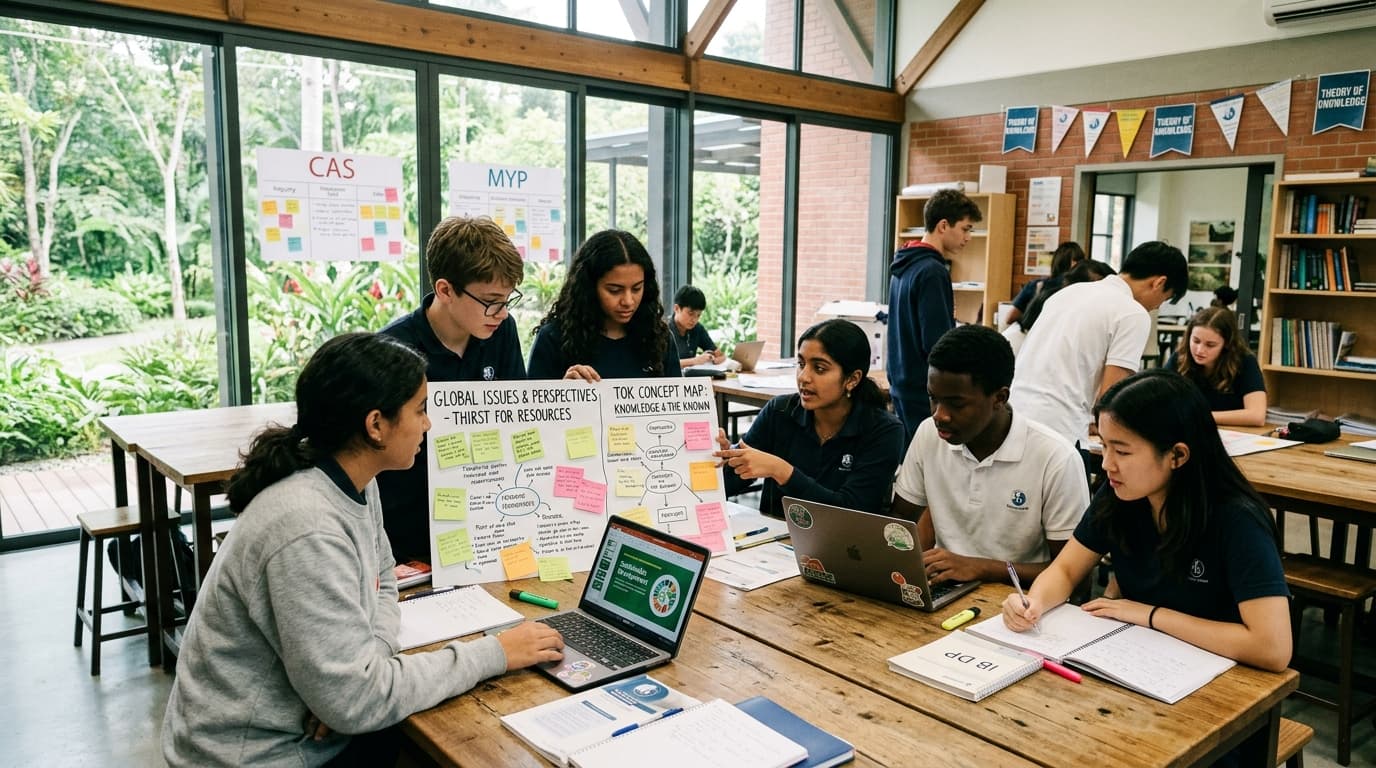
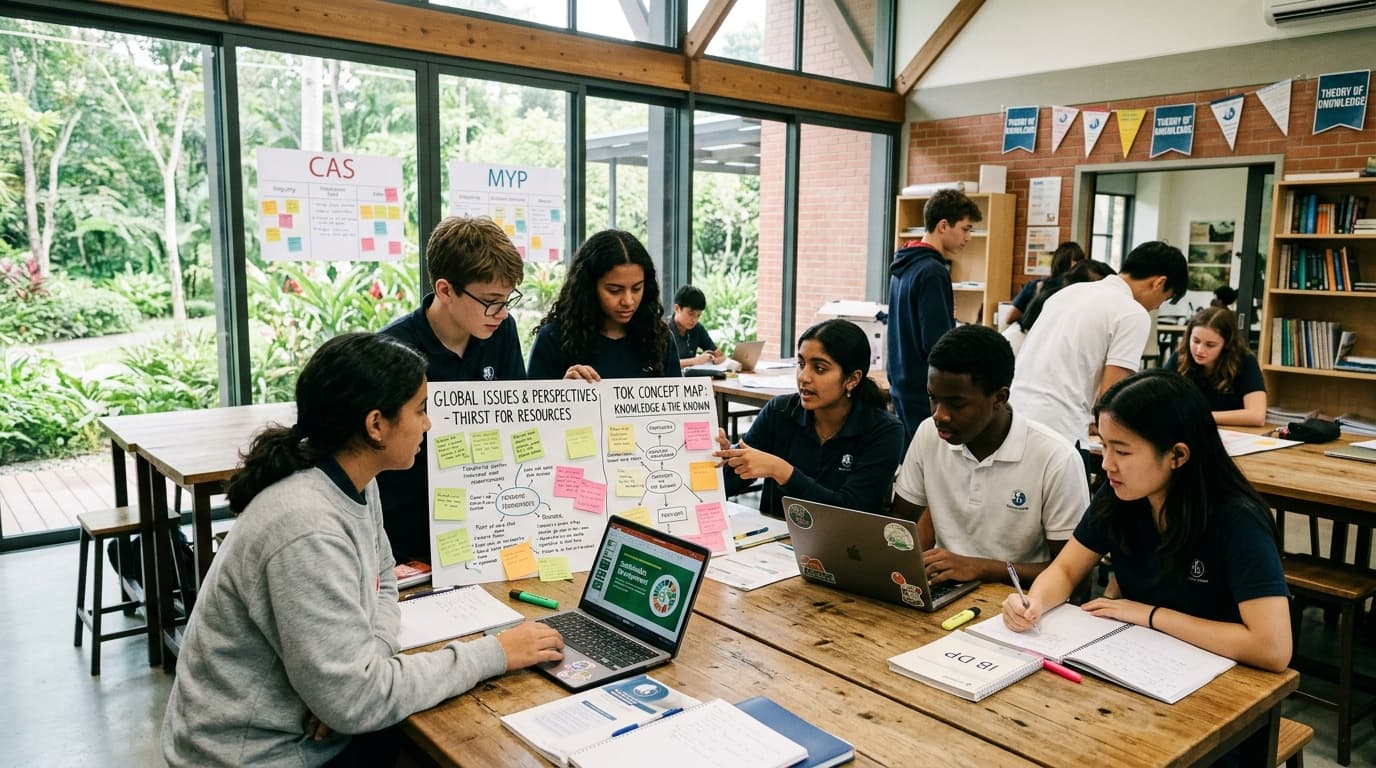
- What were the inevitable trade-offs when we forced these two worldviews together? This reflection forms the cognitive foundation for the IB Diploma’s Theory of Knowledge (TOK) course.
5. The Complete MYP Interdisciplinary Rubric Matrix (Criteria A–D)
To standardize marking across disparate departments, faculties must use the official IB MYP 8-band rubric descriptors:
| Level | Criterion A: Disciplinary Grounding (Max 8) | Criterion B: Synthesising (Max 8) | Criterion C: Communicating (Max 8) | Criterion D: Reflecting (Max 8) |
|---|---|---|---|---|
|
1–2
|
Demonstrates limited disciplinary grounding; uses few relevant concepts or skills; superficial factual recall.
|
Attempts to connect disciplines but connections are superficial or artificial; creates a rudimentary product with minimal integration.
|
Communicates interdisciplinary information in a confusing structure; lacks proper forms or conventions; frequent errors in citation.
|
Demonstrates superficial reflection; rarely identifies how disciplines interact; states personal opinions without analytical depth.
|
|
3–4
|
Demonstrates basic disciplinary grounding; applies basic concepts and skills from each subject group; occasional misconceptions.
|
Connects knowledge from disciplines in a straightforward manner; creates an adequate product showing emerging synthesis.
|
Communicates interdisciplinary understanding with adequate organization; uses some appropriate media; inconsistent referencing.
|
Outlines the benefits of using disciplines together; superficial recognition of limitations or disciplinary conflicts.
|
|
5–6
|
Demonstrates substantial disciplinary grounding; applies relevant concepts and skills accurately and effectively across both fields.
|
Synthesizes disciplinary knowledge to produce a coherent, integrated product; demonstrates clear emergent understanding.
|
Communicates interdisciplinary ideas in a well-structured, clear format; selects effective media; adheres to academic referencing conventions.
|
Explains the benefits and limitations of interdisciplinary synthesis; evaluates how combining worldviews deepened understanding.
|
|
7–8
|
Demonstrates sophisticated, comprehensive disciplinary grounding; applies nuanced concepts and advanced skills flawlessly.
|
Masterfully synthesizes disciplinary knowledge to create an insightful, innovative product demonstrating compelling emergent understanding.
|
Communicates complex interdisciplinary insights with exceptional structure, style, and flair; exemplary academic referencing.
|
Critically and insightfully evaluates the strengths and limitations of interdisciplinary learning; articulates profound metacognitive insights.
|
6. The Three Dimensions of Inquiry Questions: Factual, Conceptual, Debatable
In the MYP, teachers do not merely deliver content; they guide inquiry through a three-tiered questioning hierarchy derived from Lynn Erickson’s concept-based curriculum framework:
| Dimension / Category | Key Details & Guidance |
|---|---|
|
1. FACTUAL "What is...?"
|
Knowledge-based, content-driven, answers have definite correct responses. Anchored in facts.
|
|
2. CONCEPTUAL "How/Why...?"
|
Abstract, relational, analyses mechanisms across disciplines. Transcends specific unit examples.
|
|
3. DEBATABLE "To what extent?"
|
Provocative, multi-perspective, value-laden, promotes ethical argument and philosophical view.
|
Exemplar Inquiry Question Cascades Across Subject Pairings
Pairing 1: Sciences & Individuals and Societies (Public Health & Megacities)
- Factual: What are the primary modes of airborne viral transmission, and which municipal zones possess the highest population densities?
- Conceptual: How do spatial socio-economic inequalities accelerate transmission rates across urban infrastructure networks?
- Debatable: To what extent is a democratic government justified in suspending civil liberties and tracking citizens' digital movements during a catastrophic public health emergency?
Pairing 2: Language & Literature and Visual Arts (Propaganda & Rhetoric in Media)
- Factual: What specific rhetorical devices (logos, ethos, pathos) and color-contrast techniques were deployed in twentieth-century wartime posters?
- Conceptual: How do visual iconography and emotive linguistic framing manipulate public perception during socio-political crises?
- Debatable: Is objective journalism achievable in an algorithm-driven digital landscape designed to monetise emotional polarization?
Pairing 3: Mathematics and Design (Ergonomic, Sustainable Urban Architecture)
- Factual: What are the geometric equations required to calculate the surface-area-to-volume ratio of structural geodesic domes?
- Conceptual: How does mathematical optimization inform material efficiency and thermal retention in residential design?
- Debatable: Should municipal building codes mandate carbon neutrality even if it increases the cost of public housing in vulnerable communities?
7. Grade Boundaries and Criterion Aggregation
At the end of an MYP unit or reporting period, raw criterion levels are not averaged as percentages. The IB strictly forbids traditional percentage averaging because the four criteria assess qualitatively distinct intellectual domains.
| Total Points (A+B+C+D) | Final IB Grade Descriptor (1 to 7) |
|---|---|
|
1 – 5 points
|
Grade 1: Minimal performance across criteria
|
|
6 – 9 points
|
Grade 2: Very limited achievement
|
|
10 – 14 points
|
Grade 3: Limited understanding; emerging skills
|
|
15 – 18 points
|
Grade 4: General understanding (Passing standar
|
|
19 – 23 points
|
Grade 5: Substantial, competent achievement
|
|
24 – 27 points
|
Grade 6: High quality; sophisticated synthesis
|
|
28 – 32 points
|
Grade 7: Exceptional, exemplary mastery
|
Teachers sum the final criterion levels (out of 8 each, giving a total out of 32) and map the aggregate score directly to the internationally standardized 1 to 7 Grade Boundary Table. This ensures absolute consistency across diverse international school cohorts worldwide.
5. Capstone Projects: The Community Project and the Personal Project
The MYP culminates in two major independent student capstones that evaluate self-management, research, and communication:
| TY PROJECT │ | │ THE PERSONAL PROJE |
|---|---|
|
Grade 8) │
|
│ (MYP 5 / Grade 1
|
|
tive (1–3) │ s Action │ local need│ oral │ ion │ teamwork │
|
│ • Strictly Individual │ • Independent passion │ • Spans 6 months (25+ │ • Process Journal docu │ • Formal 15-page acade │ report + verified pr
|
The Personal Project (MYP 5 / Grade 10)
The Personal Project is an externally moderated, high-stakes capstone:
- The Goal & Global Context: Students set a challenging personal learning goal grounded in a Global Context (e.g., Learning Goal: Master traditional Japanese joinery; Product: A hand-crafted cedar tea table built without metal nails; Global Context: Personal and Cultural Expression).
- The Process Journal: Students maintain an active, dated journal logging brainstorming, research notes, interviews with craftspeople, failures, and design iterations.
- The Final Report: A structured academic report (maximum 15 pages or 3,500 words) evaluated against three criteria:
- Criterion A: Planning (clear goal, criteria for success, detailed action plan).
- Criterion B: Applying Skills (critical thinking, ATL skills, achieving the product).
- Criterion C: Reflecting (evaluating product against criteria, personal growth as an IB learner).
6. Approaches to Learning (ATL): Explicit Skill Scaffolding
The MYP recognizes that knowledge becomes obsolete, but the ability to learn remains lifelong. The Approaches to Learning (ATL) framework organizes skills into five broad categories:
| Dimension / Category | Key Details & Guidance |
|---|---|
|
1. Communication
|
Exchanging thoughts, messages, and information; reading, writing, and digital media literacy.
|
|
2. Social
|
Collaborative teamwork, conflict resolution, distributed leadership, listening to peers.
|
|
3. Self-Management
|
Organization (time, materials), affective states (resilience, mindfulness), reflection (growth).
|
|
4. Research
|
Information literacy (finding, verifying data), media literacy (detecting bias, ethical citing).
|
|
5. Thinking
|
Critical thinking, creative synthesis, transfer of skills into unfamiliar contexts.
|
Operationalizing ATL Skills in the Classroom
ATL skills must be explicitly taught, not assumed:
- Ineffective Teaching: Telling students: "Form a group and collaborate."
- Explicit ATL Instruction: Conducting a 15-minute workshop on Collaborative Conflict Resolution: teaching students how to use the "I-Statement" protocol when a team member fails to complete their assigned research milestone, logging agreements in a shared charter.
7. The IB MYP eAssessment (Year 5 Digital Examinations)
In MYP Year 5, students can undertake IB MYP eAssessment, leading to the prestigious IB MYP Certificate:
- On-Screen Examinations: State-of-the-art 2-hour digital multimedia examinations in Language & Literature, Individuals & Societies, Sciences, Mathematics, and Interdisciplinary Learning.
- Interactive Exam Features: Students do not merely write text; they manipulate interactive digital simulations, plot live data points on dynamic coordinate grids, watch video stimulus extracts, and design digital experiments in simulated virtual laboratories.
- The Interdisciplinary eAssessment: An innovative on-screen exam where students are provided with a pre-released interdisciplinary topic (e.g., Urban Water Systems), requiring them to synthesize unseen stimulus documents under exam conditions.
8. Whole-School MYP Interdisciplinary Unit Implementation Audit
Use this operational checklist to evaluate the fidelity, conceptuality, and integration depth of your MYP units:
════════════════════════════════════════════════════════════════════════════════
By connecting academic disciplines through authentic global contexts, concept-based inquiry, and rigorous interdisciplinary assessment, the IB Middle Years Programme transforms early adolescents into agile, critical thinkers prepared for the rigors of the Diploma Programme and the complexities of our interconnected world.