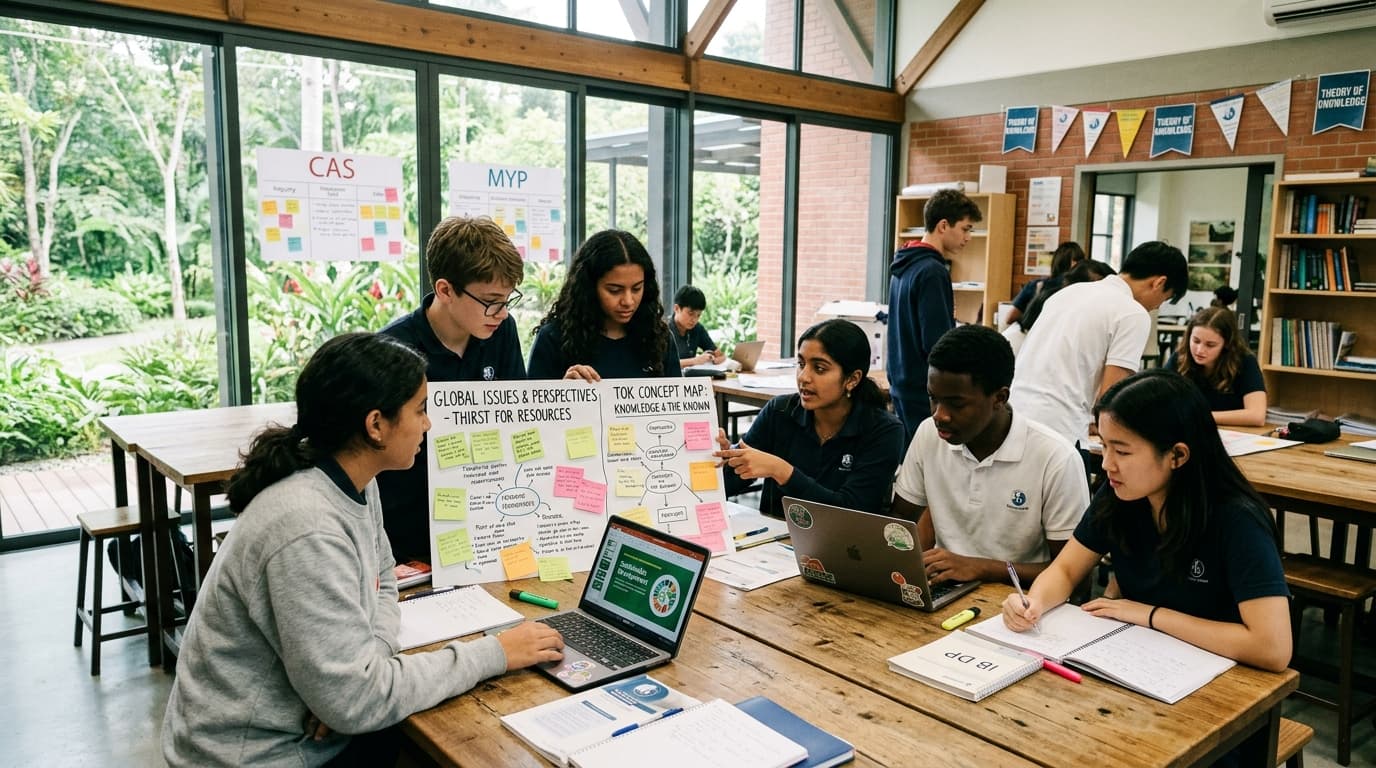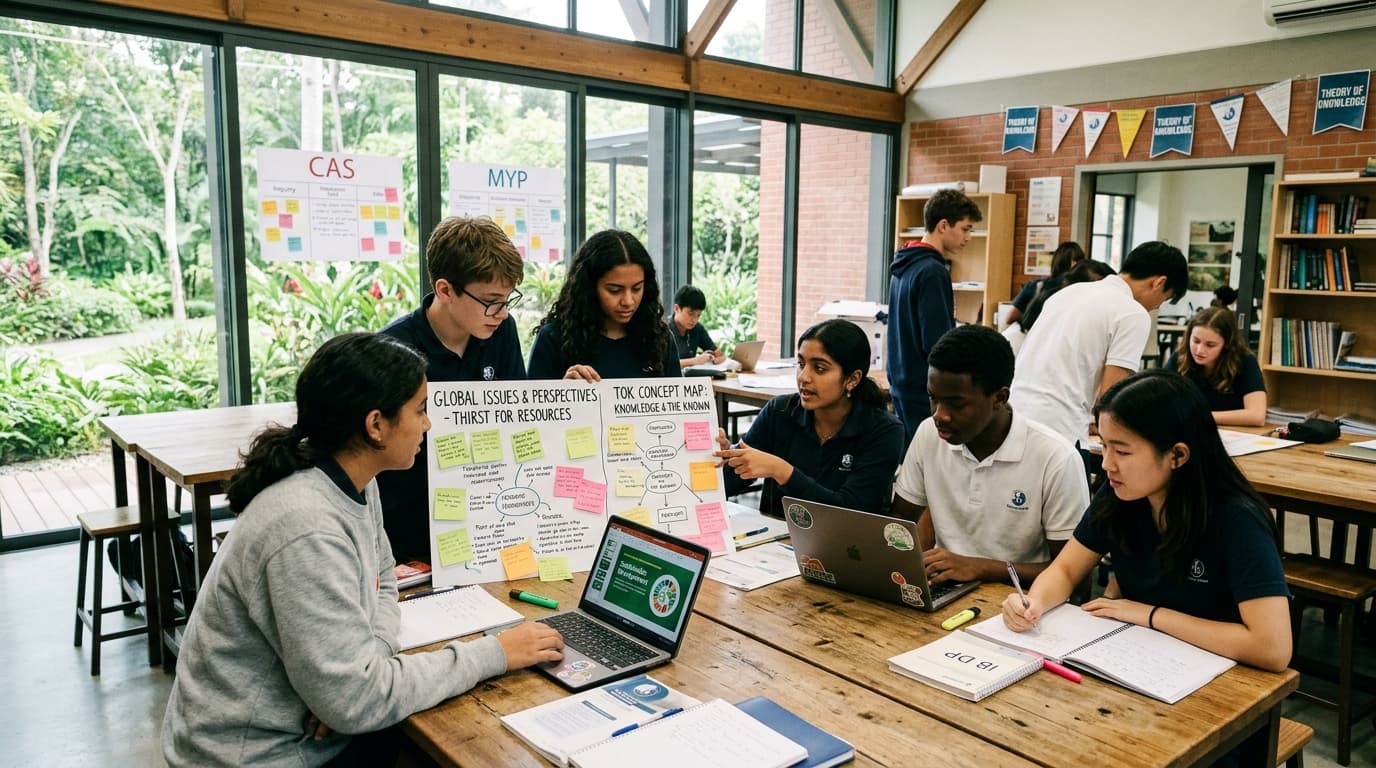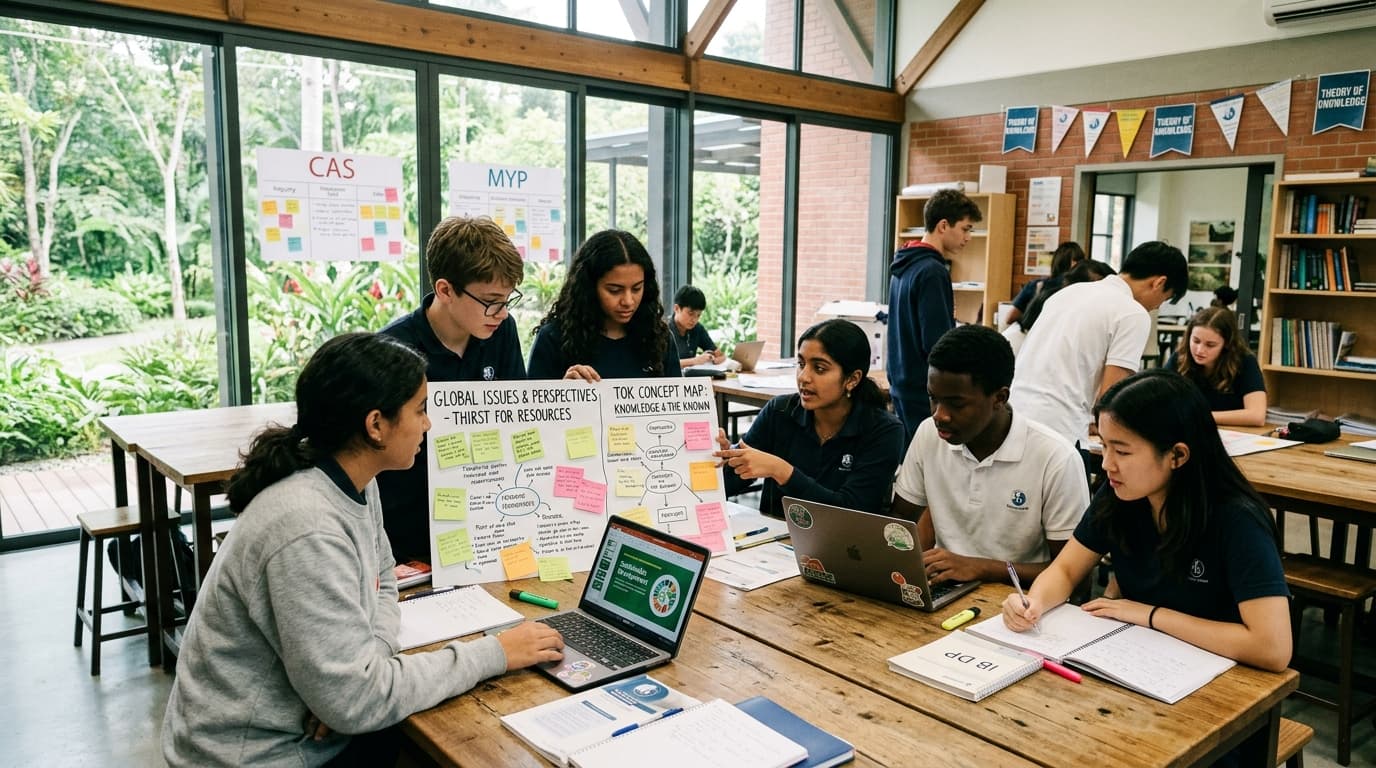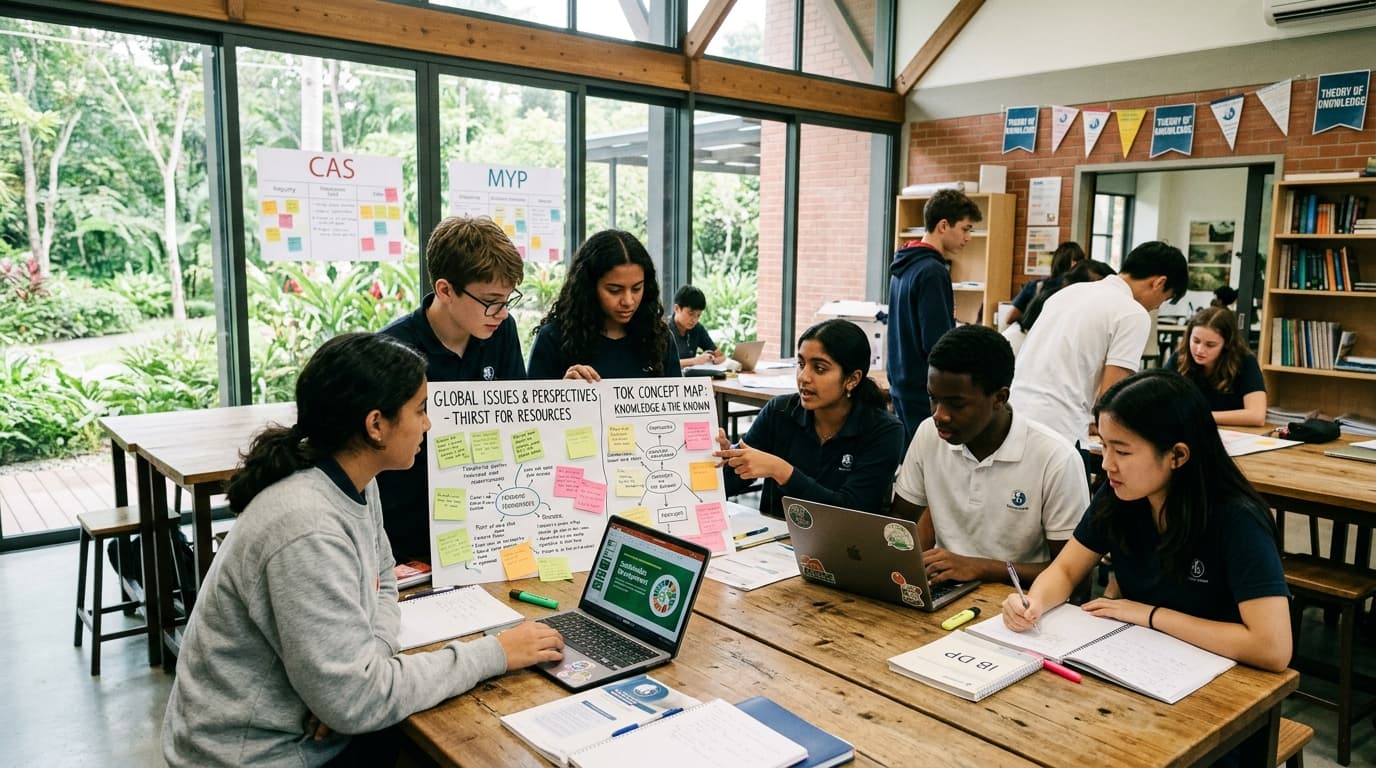
Executive Summary: The Intellectual Epicentre of the IB Diploma Programme
In the landscape of international secondary qualifications, the International Baccalaureate Diploma Programme (IB DP) is universally recognized for its academic rigor. However, what truly distinguishes the IB Diploma from national examination systems—such as British A-Levels, the French Baccalauréat, or American Advanced Placement—is not merely its six subject groups. It is the mandatory, non-negotiable DP Core:
- Theory of Knowledge (TOK): An epistemological course interrogating how we know what we claim to know.
- The Extended Essay (EE): An independent, 4,000-word academic research treatise.
- Creativity, Activity, Service (CAS): An experiential learning journey cultivating active global citizenship.
| Dimension / Category | Key Details & Guidance |
|---|---|
|
KNOWLEDGE │ │ EXTENDE .K.) │ │ (E.
|
ESSAY │ │ C. A .) │ │ (Creativit
|
|
ogical lens│ │ • 4,000-wo oncepts │ │ research ition (33%)│ │ • 3 Mandat d Essay │ │ reflecti │ │ • Criterio ore Points │ │ • Criterio
|
d academic │ ├─────────── paper │ │ • Experien ry RPPF │ │ • 18-month n sessions │ │ • 7 Learni A–E rubric│ │ • Zero dip C (12 pts)│ │ but fail
|
The DP Core is the intellectual anchor of the Diploma. Under the Diploma Points Matrix, performance in the Extended Essay and Theory of Knowledge combine to award up to 3 bonus points toward a student’s maximum possible score of 45. More critically, receiving an Elementary (Grade E) in either the Extended Essay or Theory of Knowledge is a catastrophic failing condition: the candidate is automatically disqualified from receiving the IB Diploma, regardless of how brilliantly they scored in their academic subjects.
For DP coordinators, EE supervisors, and TOK teachers, guiding adolescents through high-level epistemological inquiries and undergraduate-level research papers is one of the most demanding pedagogical tasks in international schooling.
This guide delivers an operational, supervisory handbook for mastering the Extended Essay and coaching Theory of Knowledge.
1. The Diploma Points Matrix and the Core Failing Condition
Before students begin brainstorming research questions or writing epistemological essays, they must understand the stakes governing the DP Core:
A candidate who achieves perfect 7s across all six subjects (42 points) but receives a Grade E in their Extended Essay will not be awarded the IB Diploma. The Core is non-negotiable.
2. Part 1: The Extended Essay (EE) Masterclass (4,000 Words)
The Extended Essay offers students the opportunity to conduct in-depth independent research on a topic of personal fascination, guided by a dedicated academic supervisor.
┌────────────────────────────────────────────────────────────────────────┐
│                   THE EXTENDED ESSAY 5-STAGE MILESTONE ARC             │
└────────────────────────────────────────────────────────────────────────┘
                                   │
    ┌──────────────────────────────┼──────────────────────────────┐
    ▼                              ▼                              ▼
[ STAGE 1: TOPIC & QUESTION ]  ➔ [ STAGE 2: LITERATURE REVIEW ]➔ [ STAGE 3: FIRST DRAFT ]
  • Disciplinary vs World Studies  • Source mining & logbook     • 3,500–4,000 words
  • Formulate refined RQ           • Primary lab data / archives • Strict formatting check
  • Formal Reflection 1 (RPPF)     • Outline methodology         • Formal Reflection 2
                                                                  │
                                                                  ▼
[ STAGE 5: VIVA VOCE & SUBMIT ] ◀─────── [ STAGE 4: REVISION & EDITING ]
  • 15-minute concluding interview          • Supervisor feedback conference
  • Final RPPF sign-off (Criterion E)       • Polish Criterion C (Critical Thinking)
  • Academic integrity check                • Complete APA/MLA bibliography
Disciplinary vs. World Studies Extended Essays (WSEE)
Students must choose their pathway:
- Disciplinary EE: Focuses exclusively through the lens of one recognized IB subject (e.g., Literature, History, Economics, Biology, Visual Arts). The student must adhere strictly to the scholarly conventions of that single discipline.
- World Studies EE (WSEE): An interdisciplinary inquiry exploring an issue of contemporary global significance (e.g., climate migration, antibiotic resistance, artificial intelligence ethics) through the lens of two distinct IB disciplines.
The Anatomy of an Exemplary Research Question (RQ)
The most common mistake in Extended Essays is proposing a research question that is either purely descriptive or unmanageably vast:
| Subject | Flawed / Descriptive RQ | High-Scoring / Evaluative Research Question |
|---|---|---|
|
History
|
"What were the causes of the Rwandan Genocide in 1994?"
|
"To what extent did the hate-speech radio broadcasts of the RTLM function as a primary catalyst for the 1994 Rwandan Genocide, compared to structural pre-colonial socio-economic disparities?"
|
|
Biology
|
"How does pollution affect marine algae growth?"
|
"To what extent does elevating dissolved nitrate concentrations from 0.0 to 50.0 mg/L alter the chlorophyll-a fluorescence ($F_v/F_m$) of Chlorella vulgaris under controlled photoperiods?"
|
|
Economics
|
"Is the minimum wage good or bad for Australia?"
|
"To what extent did the Fair Work Commission’s 2024 national minimum wage increase influence teenage employment elasticity in the hospitality sector of Greater Sydney?"
|
3. The 5 Extended Essay Assessment Criteria (34 Marks Total)
Extended Essays are marked externally by international IB examiners using five criteria:
| Criterion A: (Max 6 marks) | Focus and Method (Topic, RQ, methodology, selection of sources). |
|---|---|
|
Criterion B: (Max 6 marks)
|
Knowledge and Understanding (Subject-specific terminology, academic context, concept mastery).
|
|
Criterion C: (Max 12 marks)
|
Critical Thinking (Research analysis, discussion, evaluation, synthesis, cohesive argument).
|
|
Criterion D: (Max 4 marks)
|
Presentation (Title page, TOC, layout, references tables, word count compliance under 4,000).
|
|
Criterion E: (Max 6 marks)
|
Engagement (Process reflections on RPPF, intellectual initiative, metacognitive growth).
|
The Weight of Criterion C (Critical Thinking: 12 Marks)
Criterion C represents more than a third of the entire mark. To achieve the top band (10–12 marks), an essay must not simply present facts; it must:
- Interrogate conflicting empirical evidence.
- Evaluate methodological limitations and author bias.
- Formulate nuanced counter-arguments.
- Reach an evidence-backed conclusion that directly answers the research question without making unsubstantiated leaps.
The Reflections on Planning and Progress Form (RPPF) and Criterion E
Students must complete three formal reflection sessions with their supervisor, documented on the RPPF (capped at 500 words across all three sessions combined):
- Reflection 1 (Initial): Explaining why the topic was chosen and how the research question was refined.
- Reflection 2 (Interim): Reflecting on research roadblocks, unexpected data anomalies, and adjustments to methodology.
- Reflection 3 (Viva Voce): Following a 15-minute concluding interview, the student reflects on their intellectual journey, personal growth, and what they would do differently in future academic research.
4. Part 2: Theory of Knowledge (TOK) Guide
Theory of Knowledge is not a course in traditional philosophy; it is a course in applied epistemology. It challenges students to reflect critically on how knowledge is constructed, evaluated, and contested across different human disciplines.
| ORE THEME │ and the Knower │ | │ THE 5 ARE │ KNOWLE |
|---|---|
|
vs Shared Knowledge│ bias and heuristics│ ic echo chambers │ knowing │ │
|
│ 1. History │ 2. The Human S │ 3. The Natural │ 4. Mathematics │ 5. The Arts
|
The 12 TOK Core Concepts
Every TOK discussion, exhibition commentary, and essay must be grounded in the Twelve Core Concepts:
Lesson Planner
Generate comprehensive, CAPS-aligned lesson plans in seconds.
- Evidence
- Certainty
- Truth
- Interpretation
- Power
- Justification
- Explanation
- Perspective
- Culture
- Values
- Responsibility
- Authority
5. The TOK Knowledge Framework: Deconstructing the 5 Areas of Knowledge
To structure analytical arguments across the five Areas of Knowledge (History, The Human Sciences, The Natural Sciences, Mathematics, and The Arts), students must apply the Four Elements of the Knowledge Framework:
| Phase / Component | Operational & Pedagogical Focus |
|---|---|
|
1. SCOPE
|
What is the domain of this AOK? What practical or theoretical problems does it attempt to solve?
|
|
2. PERSPECTIVES
|
How do cultural, historical, and personal viewpoints shape the questions asked and theories
|
|
3. METHODS & TOOLS
|
What empirical methods, algorithms, models, or symbols are legitimate within this discipline?
|
|
4. ETHICS
|
What ethical responsibilities fall upon knowers? How does morality constrain research and claims?
|
Knowledge Questions: The Linguistic Key to TOK
Students often struggle because they write about real-world events rather than Knowledge Questions (KQs) about how we know:
- First-Order Question (Subject Specific / Descriptive): "Why did the Western Roman Empire collapse in 476 CE?" (This is a History question, not a TOK question).
- Second-Order Question (Epistemological / TOK): "To what extent does a lack of contemporary primary documentary evidence limit the certainty of historical interpretations?" (This is an authentic Knowledge Question).
6. Mastering Criterion E: Exemplar RPPF Reflection Entries
Criterion E (Engagement) awards up to 6 marks based entirely on the three student entries in the Reflections on Planning and Progress Form (RPPF). Examiners look for intellectual initiative, intellectual resilience, and deep metacognition rather than mechanical logs.
Exemplar High-Scoring (Band A) RPPF Sequence (Max 500 Words Total)
Entry 1: First Formal Reflection (Post-Topic Selection)
"Initially, I was drawn to the broad topic of international sanctions. However, during my initial reading of economic papers, I realised that evaluating global sanctions lacked focus and would lead to a descriptive summary. My supervisor challenged me to identify a measurable variable. I pivoted to investigate how targeted financial sanctions specifically influenced central bank foreign exchange reserve strategies in emerging economies between 2014 and 2022. Narrowing my focus has allowed me to isolate econometric models from the IMF. My main challenge now is reconciling disparate inflation accounting methodologies across three different national statistical agencies."
Entry 2: Interim Reflection (The Roadblock & Adaptation)
"Halfway through my research, I encountered a major crisis: secondary data from one key central bank contained unexplained reporting gaps during 2018. I had to choose between discarding the entire country case study or finding a proxy indicator. Consulting my supervisor, I realized this setback was an opportunity for critical evaluation. I integrated sovereign bond yield spreads as a proxy for capital flight, which revealed unexpected correlations that contradicted my initial hypothesis. This forced me to deconstruct my own confirmation bias and rewrite Section 3 to evaluate the limitations of econometric proxy data."
Entry 3: Viva Voce & Final Reflection (Intellectual Growth)
"Concluding my Extended Essay with the Viva Voce interview allowed me to step back from the spreadsheets and evaluate my growth as an independent scholar. I discovered that academic research is not a linear march toward a predetermined conclusion, but an iterative navigation of ambiguity. If I were to extend this investigation into university study, I would incorporate qualitative interviews with commercial bank treasurers to triangulate econometric trends. This project has fundamentally altered how I read economic journalism; I now look instinctively for statistical confidence intervals, methodology notes, and funding declarations."
5. The TOK Exhibition (33% Internal Assessment, Year 1 / DP 1)
Administered in DP Year 1, the TOK Exhibition requires students to create an exhibition of three real-world objects that connect to one of the 35 Prescribed IA Prompts.
┌────────────────────────────────────────────────────────────────────────┐
│                   THE TOK EXHIBITION ARCHITECTURE                      │
└────────────────────────────────────────────────────────────────────────┘
                                   │
                                   ▼
                 [ SELECT 1 OF 35 PRESCRIBED IA PROMPTS ]
     (e.g., Prompt 12: "Is bias inevitable in the production of knowledge?")
                                   │
              ┌────────────────────┼────────────────────┐
              ▼                    ▼                    ▼
        [ OBJECT 1 ]         [ OBJECT 2 ]         [ OBJECT 3 ]
      • Specific context   • Diverse format     • Digital or physical
      • Real-world provenance • Tangible link     • Personal/cultural tie
                                   │
                                   ▼
             [ 950-WORD EXHIBITION COMMENTARY (MAX) ]
             • Identifies objects and their specific real contexts
             • Justifies how each object exemplifies the prompt
             • Grounded in TOK concepts (Evidence, Bias, Power)
Exemplar TOK Exhibition Object Curation
Prompt Selected: IA Prompt 27: Does all knowledge impose ethical responsibilities on the knower?
- Object 1: The 1945 Trinity Nuclear Test Observation Log signed by J. Robert Oppenheimer (Exploring how scientific insight into nuclear fission created immediate ethical culpability for global annihilation).
- Object 2: The Student's Genetic 23andMe Health Risk Certificate revealing BRCA1 mutation (Interrogating whether personal biomedical knowledge obligates an individual to alter lifestyle or disclose risks to family).
- Object 3: A 2024 satellite photograph of illegal Amazonian mining camps in Yanomami territory (Examining whether visual geospatial evidence obligates international consumers of electronics to demand supply-chain transparency).
6. The TOK Prescribed Essay (67% External Assessment, Year 2 / DP 2)
In DP Year 2, the IB releases Six Prescribed Titles. Students select one title and write a formal 1,600-word academic essay exploring the question through two distinct Areas of Knowledge (AOKs).
| Dimension / Category | Key Details & Guidance |
|---|---|
|
1. INTRODUCTION (150–200 words)
|
Deconstruct prompt; define TOK concepts; state thesis; identify two chosen AOKs (e.g., History and Natural Sciences).
|
|
2. AREA OF KNOWLEDGE ONE: PART A (450–500 words)
|
Claim: Formulate epistemological argument. Real-Life Situation (RLS): Concrete case study. Counter-Claim: Alternative perspective or limit. Second RLS & Mini-Synthesis.
|
|
3. AREA OF KNOWLEDGE TWO: PART B (450–500 words)
|
Claim: Contrast argument in second discipline. Real-Life Situation (RLS): Disciplinary example. Counter-Claim: Methodological challenges. Synthesis: How does AOK 2 differ from AOK 1?
|
|
4. CONCLUSION (150–200 words)
|
Synthesise findings; evaluate implications of knowing; reflect on the significance to knower.
|
The "Real-Life Situation" (RLS) Protocol
A TOK essay without specific, verified Real-Life Situations (RLSs) collapses into empty philosophical speculation.
- Weak / Generic RLS: "Scientists do experiments and sometimes they are biased."
- High-Scoring / Authentic RLS: "The 1998 publication and subsequent retraction of Andrew Wakefield’s MMR vaccine paper in The Lancet illustrates how confirmation bias and fraudulent peer-review protocols can distort shared scientific knowledge for decades."
7. Academic Integrity and Generative AI in the DP Core
The proliferation of Generative AI has transformed the supervisory landscape for Extended Essays and TOK. An LLM can generate a plausible 4,000-word essay or invent three exhibition objects in seconds. Supervisors must protect institutional integrity through process-based authentication:
| Dimension / Category | Key Details & Guidance |
|---|---|
|
1. Cloud Version Control
|
Students must write Extended Essays in tracked Google Docs or Office 365. Supervisors audit version history to verify incremental keystrokes.
|
|
2. Viva Voce Authentication
|
Mandatory oral examination. If a student cannot defend their thesis or explain cited references, the supervisor cannot sign the declaration.
|
|
3. Object Grounding Verification
|
TOK exhibition objects must possess specific, verifiable real-world provenance, not AI images.
|
8. Whole-School Extended Essay and TOK Supervisory Checklist
Use this operational timeline and checklist to ensure your IB Diploma cohort completes the Core with academic excellence and zero procedural breaches:
════════════════════════════════════════════════════════════════════════════════
By framing the Extended Essay as an authentic apprenticeship in scholarship and Theory of Knowledge as a lifelong lens for critical discernment, IB educators empower senior students to become principled, inquiring thinkers prepared for university and ethical global leadership.