How to Implement the EYFS Statutory Framework and Master Continuous Provision in Reception Classrooms
Continuous provision is the beating heart of an exceptional Early Years Foundation Stage (EYFS) environment. Yet, within primary schools across England, the term is frequently misunderstood. Too often, continuous provision is reduced to passive, free-for-all play where children wander aimlessly between novelty activities, or conversely, an overly controlled carousel of adult-directed worksheets disguised as independent games.
Under the statutory Early Years Foundation Stage (EYFS) Framework, the non-statutory curricular guidance Development Matters, and Birth to 5 Matters, continuous provision serves a profound pedagogical purpose: it is the continuous enabling environment that provides children with the constant resources, agency, and cognitive challenge to consolidate, explore, and master learning in the absence of an adult.
When designed with intentionality, high-impact continuous provision transforms a Reception classroom into an engine of self-regulation, early oracy, mathematical reasoning, emergent literacy, and deep physical development. This masterclass provides Reception teachers, EYFS leaders, and primary headteachers with an exhaustive, research-backed architecture for designing, implementing, scaffolding, and assessing continuous provision across all seven areas of learning.
1. The Statutory Framework and the Characteristics of Effective Learning
Every aspect of continuous provision must be firmly anchored in the statutory requirements of the EYFS Framework. The framework designates seven areas of learning and development, divided into three Prime Areas and four Specific Areas:
The Three Characteristics of Effective Learning (CoEL)
Crucially, the EYFS statutory framework mandates that practitioners reflect on the different ways in which children learn. The Characteristics of Effective Learning describe the mental habits and executive functions children develop:
In high-quality continuous provision, the physical environment does not merely teach "curriculum facts"; it actively exercises these three cognitive muscles. If an area of provision does not inspire exploration, sustained engagement, and critical thinking, it must be redesigned.
2. Defining Continuous Provision vs. Enhanced Provision vs. Adult-Led Teaching
A major source of confusion in Reception classrooms is the boundary between continuous provision, enhanced provision, and adult-led instruction. High-performing Early Years teams maintain crystal-clear distinctions between these three pedagogical modes:
The "Curriculum in the Cupboard" Fallacy
A common pitfall is the belief that provision must be rotated entirely every week to match a new "theme" (e.g., turning the whole room into a pirate ship on Monday and a space station the next). This exhaustively exhausts staff, disorients children, and disrupts deep learning.
Continuous provision should be consistent, stable, and predictable. When children know that the unit blocks, clay, water trough, and mark-making tools will be there tomorrow, they engage in long-term, multi-day creative projects. Enhancements should be subtle tweaks (10-20% of the provision), not total overhauls.
3. Designing Core Continuous Provision Learning Zones
An enabling Reception classroom should be partitioned into clearly demarcated, acoustically managed zones that invite different forms of cognitive and physical activity.
Zone 1: The Block Play & Construction Area
Block play is mathematics, physics, and social collaboration in action.
- Core Resources: High-quality, unpainted solid wooden unit blocks (wooden architectural shapes following strict proportions: standard unit, double unit, quadruple, half-unit, cylinders, arches), wooden planks, cardboard tubes, cable reels, and fabric swatches.
- Small World Integration: Keep small world figures (diverse families, wild animals, emergency service workers, vehicles) immediately adjacent. Children build structures for a narrative purpose.
- Pedagogical Impact: Develops spatial reasoning, early geometry, balance, conservation of volume, subitising, and peer negotiation.
Zone 2: The Writing & Mark-Making Studio
Writing in the Early Years must never be confined to a solitary table where children are forced to sit and trace dotted lines.
- Core Resources: Clipboards of varying sizes, authentic writing implements (black fine-liner pens, gel pens, soft 2B pencils, chalks, ink stampers, envelopes, sticky notes, hole punchers, staplers, luggage tags, blank mini-books).
- Environmental Saturation: Mark-making resources must permeate every area of the classroom. Clipboards must hang in the construction area (for architectural blueprints), in the roleplay kitchen (for shopping lists), and at the outdoor mud kitchen (for recipe logs).
Zone 3: The Water & Sand Laboratory
Water and sand are foundational scientific and mathematical media.
- Core Resources: Clear measuring jugs with marked metric gradations, transparent vinyl tubing, funnels, ladles, pipettes, waterwheels, spray bottles, real whisk tools, and varied containers (tall/thin vs. short/wide) to investigate conservation of volume.
- Sand Variations: Provide dry sand with fine sieves and hourglass timers; provide wet sand with bucket moulds, trowels, and density sorting stones.
Zone 4: The Domestic & Storytelling Roleplay Area
Roleplay is the crucible of executive function and dialogic oracy.
- Core Resources: Authentic real-world domestic objects rather than garish plastic toys. Use real ceramic mugs (supervised), metal teapots, stainless steel pots, woven baskets, diverse clothing, fabric wraps, diaries, landline phone handsets, and multicultural cooking utensils (woks, chapati rollers, tagines).
- Pedagogical Impact: Fosters sustained shared thinking, social empathy, cultural inclusion, and conversational turn-taking.
4. The Role of the Adult: Interactions That Drive Progress
The most critical factor in continuous provision is not the physical furniture; it is the quality of adult-child interactions. In an effective EYFS classroom, practitioners do not stand back as passive monitors or classroom supervisors; nor do they hijack children's play with intrusive interrogations.
The Ladder of Adult Intervention in Continuous Provision
Practitioners must master the art of moving fluidly up and down the intervention ladder:
Lesson Planner
Generate comprehensive, CAPS-aligned lesson plans in seconds.
Sustained Shared Thinking (SST) in Action
Coined by the Researching Effective Pedagogy in the Early Years (REPEY) project led by Professor Iram Siraj-Blatchford, Sustained Shared Thinking (SST) occurs when two or more individuals (an adult and child, or children together) work together in an intellectual way to solve a problem, clarify an idea, evaluate activities, or extend a narrative.
Avoid the "Rapid-Fire Interrogation Trap" ("What colour is that? How many blocks? What are you making?"), which closes down pupil cognition and forces one-word compliance answers. Use tentative, curiosity-driven wonderings.
5. Integrating Core Skills: Phonics, Mathematics, and Oracy
Continuous provision must not be an academic wasteland where phonics and mathematics vanish after the morning direct instruction lesson finishes. High-performing classrooms build rigorous, playful bridges that allow children to apply core knowledge autonomously.
1. Phonics Application in Continuous Provision
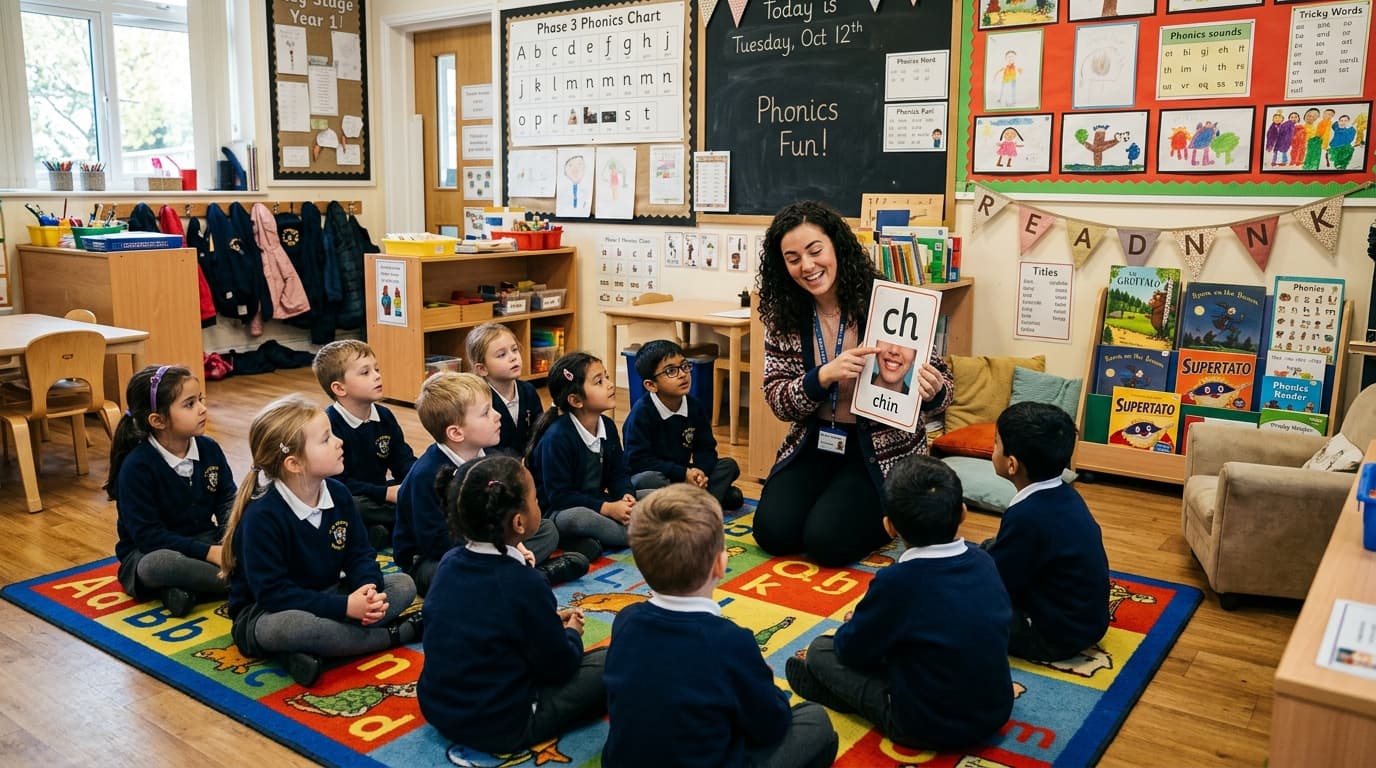
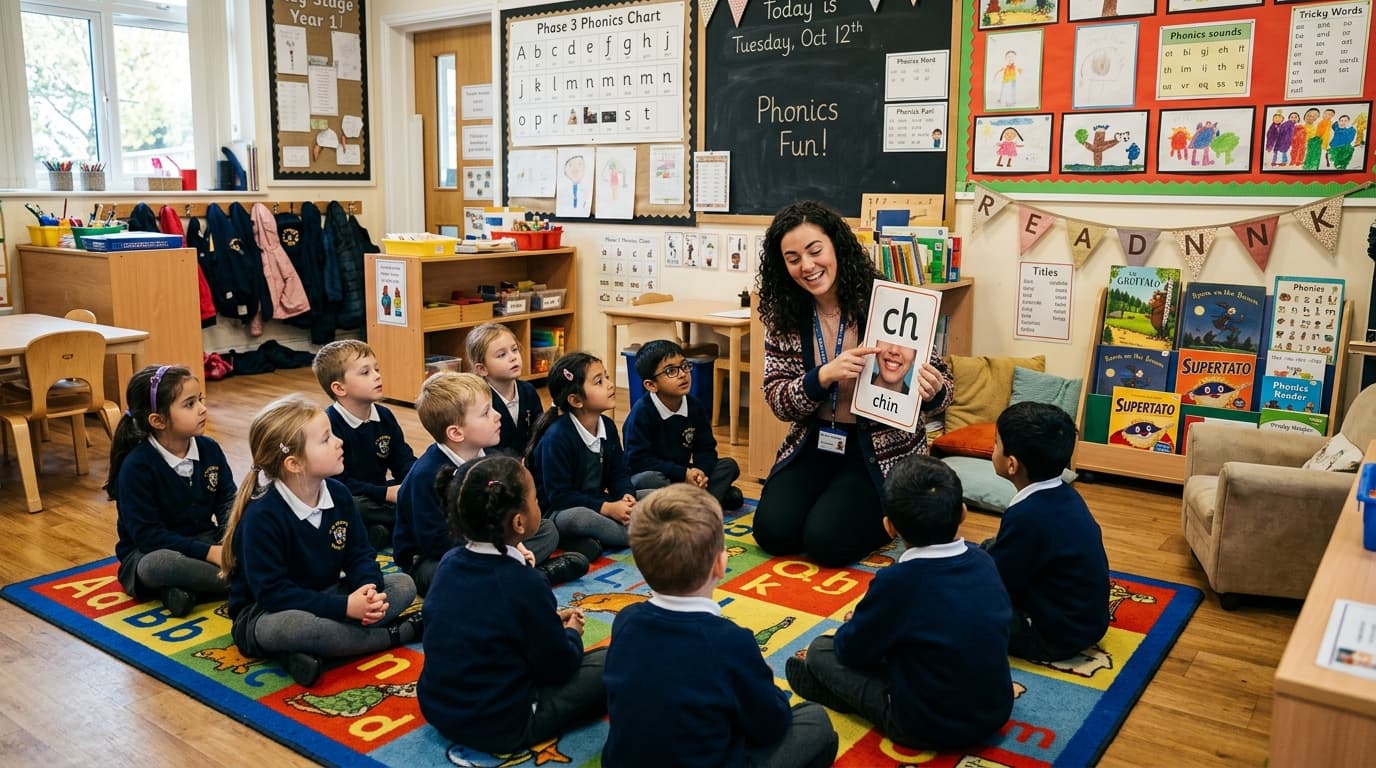
If pupils are taught the grapheme-phoneme correspondences (GPCs) /s/ /a/ /t/ /p/ /i/ /n/ in their morning systematic synthetic phonics session, the afternoon provision must provide organic invitations to apply those specific sounds:
2. Mathematics Mastery in Continuous Provision
Aligned with the NCETM Early Years Mastery framework, mathematics provision should prioritize deep understanding of small numbers (subitising, composition of numbers to 5 and 10, comparison) and spatial reasoning.
6. The Outdoor Continuous Provision Environment: Beyond "Bigger Classroom"
The outdoor environment in Reception is not an outdoor playtime yard; it is a statutory classroom with equal pedagogical weight to the indoor room. Outdoor continuous provision must offer what cannot physically be achieved inside: scale, gross motor dynamism, elemental contact, dynamic weather exploration, and calibrated risk-taking.
Calibrated Risk-Taking and Resilience
Physical development and self-regulation depend on children navigating calculated physical risk:
- Climbing to the top of an A-frame climbing triangle.
- Carrying heavy, awkward wooden railway sleepers with a peer.
- Using real woodworking tools (hammers, hand drills, coping saws) under supervised safety protocols. Eliminating all risk produces anxiety and motor fragility; scaffolding calibrated risk builds spatial competence, physical grip strength, confidence, and self-preservation instincts.
7. Assessment, Observation, and Reducing Documentation Burden
In the revised 2021 EYFS Framework and current Ofsted inspections, unnecessary tracking and photographic portfolio gathering have been decisively swept away. Teachers are explicitly instructed NOT to spend their days behind tablet screens photographing every child stacking blocks.
The Principle: "Data That Informs, Not Data That Overwhelms"
The "Focus Child" Assessment Model
Instead of attempting to track all 30 children simultaneously every day, high-performing Reception teams implement the Focus Child Model:
- 3 to 4 children are designated as the focus cohort for the week.
- Ahead of the week, parents receive a brief consultation slip asking about the child's current home passions, weekend discoveries, or concerns.
- During the week, practitioners deliberately observe these focus children across continuous provision, recording rich, qualitative notes regarding their:
- Communication and vocabulary development.
- Social interactions and emotional self-regulation.
- Application of phonics and numerical concepts.
- Characteristics of Effective Learning demonstrated.
- At the end of the week, the team holds a 15-minute professional dialogue to review observations, update learning adjustments, and plan targeted enhancements for the subsequent week.
8. Managing Transitions, Routines, and Self-Regulation
High levels of continuous provision require robust classroom management. If children do not know how to care for the environment or transition calmly, the classroom quickly devolves into chaos.
The 4 Pillars of Early Years Behaviour Management
9. Inclusion, SEND, and EAL Adaptations in Continuous Provision
Continuous provision is uniquely suited to children with Special Educational Needs and Disabilities (SEND) and those learning English as an Additional Language (EAL). The multi-sensory, open-ended nature of the environment eliminates the intimidating verbal barriers of traditional desks.
Practical Pedagogical Adaptations
- Speech, Language and Communication Needs (SLCN): Utilize Colourful Semantics and Communication Boards (PECS symbols or visual choice boards) attached to provision shelves. Model short, repetitive sentence structures with accompanying Makaton signing.
- Sensory Processing Differences: Maintain a designated "Calm Retreat Haven" within the provision — a darkened sensory tent with soft cushions, weighted lap blankets, bubble tubes, and noise-cancelling headphones where dysregulated children can decompress.
- English as an Additional Language (EAL): Continuous provision allows EAL children to observe and mirror peers without linguistic pressure. Pair EAL children with articulate, empathetic peer language buddies during collaborative loose-parts construction.
- Gross & Fine Motor Delays: Provide oversized tweezers, pipette squeezers, clay pinch pots, and vertical chalkboard easels to strengthen shoulder girdle stability and pincer grip muscles ahead of handwriting.
10. Frequently Asked Questions (Reception Practitioners & EYFS Leads)
How much time should Reception children spend in continuous provision?
Research into early childhood development indicates that children require sustained, uninterrupted periods of at least 60 to 90 minutes of continuous provision twice daily (morning and afternoon). Fragmenting the day into 20-minute teacher-led slots prevents children from entering deep, flow-state engagement and complex collaborative play.
How do we evidence progress during an Ofsted inspection without piles of workbooks?
Ofsted inspectors will not ask to see stacks of laminated learning journals or digital portfolios. They evaluate Early Years by:
- Observing the quality of adult-child interactions in provision.
- Speaking directly with staff about individual children ("Tell me about Noah: what could he do in September, what is he learning now, and how are you supporting his vocabulary?").
- Listening to children talk about their play, observing their independence, and checking their phonics blending and number sense.
How do we prepare Reception children for the transition to Year 1?
Transition to Year 1 should not involve stripping away continuous provision in the final term. Rather, the optimal approach is for Year 1 classrooms to adopt continuous provision principles in the Autumn term, gradually increasing formal direct instruction as the academic year unfolds.