How to Deliver BC's Redesigned Curriculum: Core Competencies, KDU Model, and Proficiency Scale Assessment
British Columbia's redesigned K-12 curriculum represents one of the most progressive, concept-based, and student-centered educational transformations in North America. Commissioned by the BC Ministry of Education and Child Care, the framework moved decisively away from an industrial-era curriculum packed with rigid checklists of disconnected facts. Instead, BC's curriculum prioritizes deep conceptual understanding, disciplinary inquiry, and lifelong intellectual adaptability.
At the core of this transformation is the tripartite Know-Do-Understand (KDU) curriculum model, anchored by the cross-curricular Core Competencies (Thinking, Communication, and Personal and Social). Furthermore, the province fundamentally restructured K-9 student reporting with the mandatory implementation of the criterion-referenced 4-Point Provincial Proficiency Scale, sweeping away letter grades and percentages in favor of descriptive, strength-based assessment.
However, delivering this visionary framework in daily classroom practice presents real pedagogical challenges: How do teachers meaningfully embed Core Competency self-assessment without it degenerating into shallow, rushed worksheets at the end of a reporting term? How do educators design units that genuinely synthesize Content (Know), Curricular Competencies (Do), and Big Ideas (Understand)? And how do teachers evaluate student progress against the Provincial Proficiency Scale with rigor and consistency?
This comprehensive guide provides BC educators, curriculum coordinators, and school leaders with an evidence-informed pedagogical blueprint for mastering the redesigned curriculum from Kindergarten through Grade 12.
1. The Core Architecture: The Know-Do-Understand (KDU) Model
The BC curriculum is built on a conceptual three-dimensional model that balances foundational facts with active inquiry and overarching transferable concepts:
1. Understand: The Big Ideas
The Big Ideas represent the enduring understandings, overarching concepts, and generalized principles that students will retain long after specific facts have faded. Each subject area at every grade level features three to five Big Ideas that answer the question: "Why does this learning matter in the real world?"
- Example (Science 6): "Everyday materials are often mixtures that can be separated using a variety of chemical and physical processes."
- Example (Social Studies 9): "Emerging ideas and ideologies profoundly influence societies and events."
2. Do: The Curricular Competencies
The Curricular Competencies describe the disciplinary skills, critical thinking routines, and investigative practices through which students explore knowledge. They define how authentic practitioners work in the real world: how a scientist conducts empirical inquiry, how a historian interrogates primary source evidence, or how an artist explores media.
3. Know: The Content
The Content provides the essential, foundational knowledge, facts, dates, scientific phenomena, and mathematical conventions needed to develop the Curricular Competencies. The Content is not an end in itself; it is the raw material through which the Big Ideas are investigated and understood.
2. Deconstructing the BC Core Competencies
While Curricular Competencies are subject-specific, the Core Competencies are universal, cross-curricular sets of intellectual, personal, and interpersonal proficiencies that all students need to live fulfilling lives and navigate an unpredictable future:
| Core Competency | Sub-Competencies | Core Focus & Intellectual Growth |
|---|---|---|
|
1. COMMUNICATION
|
- Communicating - Collaborating
|
Exchanging ideas, listening attentively, working in teams, resolving disagreements.
|
|
2. THINKING
|
- Creative Thinking - Critical and Reflective Thinking
|
Novelty and value, generating ideas, developing and refining concepts. Questioning, analyzing evidence, evaluatin arguments, making reasoned judgments.
|
|
3. PERSONAL AND SOCIAL
|
- Personal Values and Choice - Personal Strengths and Ability - Social Awareness & Responsibilit
|
Understanding identity, self-regulation, emotional well-being, persevering. | Contributing to community, caring for the environment, resolving conflict.
|
The Continuum of "I-Statements" (Profiles)
The Core Competencies are not designed to be graded by the teacher with a percentage. Instead, the Ministry articulated developmental profiles written as "I-Statements" that represent a child's internal journey of self-actualization:
- Profile 1 (Emerging): "I can express my ideas and opinions with guidance."
- Profile 3 (Intermediate): "I can ask open-ended questions, consider multiple perspectives, and synthesize information from different sources."
- Profile 5 (Advanced): "I can critically evaluate complex information, analyze hidden biases, and design innovative solutions to unscripted community problems."
3. High-Impact Core Competency Self-Assessment and Reflection
Under statutory BC reporting policy, students must engage in regular, ongoing self-assessment of the Core Competencies and author a formal summative self-reflection included in their end-of-year reporting package.
The Pitfall: "The End-of-Term Checklist Trap"
The most common mistake in BC classrooms is waiting until June, handing students a generic 4-page checklist with smiling face icons, and telling them to "check off" their competencies in 20 minutes. This produces shallow, compliance-driven reflection with zero metacognitive benefit.
The Solution: Integrated, In-the-Moment Reflections
High-performing teachers embed Core Competency reflections directly into daily, authentic project milestones:
Lesson Planner
Generate comprehensive, CAPS-aligned lesson plans in seconds.
By tying reflection to a concrete piece of evidence (a photograph, a video clip, a written draft, a lab graph), student self-assessment becomes authentic, visible, and deeply metacognitive.
4. Mastering the 4-Point Provincial Proficiency Scale
Under the updated K-9 Student Progress Reporting Order, British Columbia replaced traditional percentage marks and letter grades (A, B, C, F) with the Provincial Proficiency Scale for all students in Kindergarten through Grade 9.
| Proficiency Level | Ministry Definition & Pedagogical Meaning |
|---|---|
|
EMERGING (Beginning Steps)
|
The student demonstrates an INITIAL understanding of the concepts and competencies relevant to the expected learning. Requires ongoing support.
|
|
DEVELOPING (Building Fluency)
|
The student demonstrates a PARTIAL understanding of the concepts and competencies relevant to the expected learning. Demonstrates growing consistency with occasional scaffolding.
|
|
PROFICIENT (THE GOAL / ARE)
|
The student demonstrates a COMPLETE understanding of the concepts and competencies relevant to the expected learning. Consistently, independently applies skills and knowledge to target learning goals.
|
|
EXTENDING (Deep Mastery)
|
The student demonstrates a SOPHISTICATED understanding of the concepts and competencies relevant to the expected learning. Transfers concepts to novel, complex contexts and creates original insights.
|
Essential Principles of the Proficiency Scale
- "Proficient" is the Ultimate Goal: A pervasive misunderstanding among parents and students is equating "Proficient" to a mediocre "C" grade and "Extending" to an "A". This is fundamentally incorrect. "Proficient" means complete, fully independent, grade-level mastery. It is the gold standard of success.
- "Extending" is Depth, Not Extra Work: "Extending" is not awarded for doing five extra homework worksheets, staying after school, or reading faster. Extending is characterized by cognitive transfer: applying learned concepts to an entirely new, un-rehearsed problem or creating cross-disciplinary connections.
- Growth-Oriented (No Deficit Labels): The scale is intentionally non-punitive. An "Emerging" rating is not a failing grade; it is an honest, descriptive diagnostic showing where the child is beginning their learning journey.
5. Deconstructing a BC Concept-Based Unit Plan: The KDU Architecture in Action
To demonstrate how the KDU model and Core Competencies operate cohesively, examine this complete exemplar unit plan designed for an intermediate classroom:
Assessment Rubric Aligned to the Provincial Proficiency Scale for this Unit
| Skill Dimension | Developing (Building) | Proficient (Complete - Target) |
|---|---|---|
|
Analyzing Multiple Perspectives
|
Identifies that industry and environmentalists disagree, but relies on simple good/bad labels.
|
Analyzes how economic and cultural factors shape each stakeholder's perspective; uses authentic quotes and policy evidence.
|
|
Evidential Inquiry & Verification
|
Cites one website or source; struggles to evaluate bias or commercial sponsorship.
|
Evaluates credibility and bias across three diverse primary/secondary sources; notes commercial or ideological self-interest.
|
|
Consensus Building & Collaboration
|
Reasserts personal viewpoint without modifying ideas based on group stakeholder concerns.
|
Actively listens to opposing arguments; negotiates balanced policy compromises satisfying multiple stakeholder needs.
|
6. Indigenous Worldviews: Weaving the First Peoples Principles of Learning (FPPL)
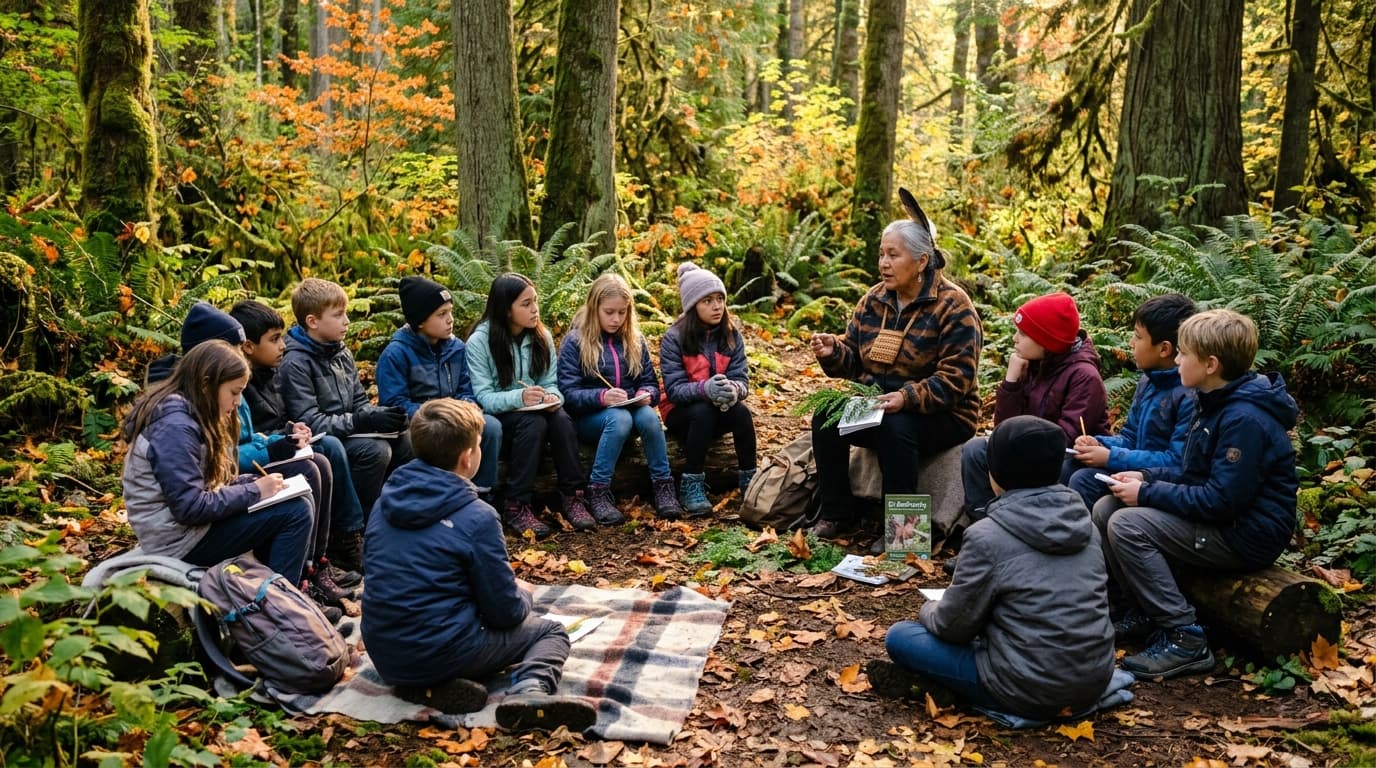
In British Columbia, the integration of Indigenous perspectives is not an optional add-on; it is woven into the very fabric of the curriculum. The Ministry co-developed the curriculum with the First Nations Education Steering Committee (FNESC).
Practical Classroom Translation of FPPL Principles
7. Writing Descriptive, Strength-Based Report Card Comments
Under BC's reporting framework, the traditional report card filled with standardized canned comments ("Johnny is a pleasure to have in class. He needs to pay better attention in social studies") is completely obsolete.
BC report card comments must be strength-based, descriptive, and actionable:
- Identify the student's strengths with specific curricular evidence.
- Describe areas for future growth aligned with target Curricular Competencies.
- Provide actionable next steps that the student, teacher, and family can partner on.
Exemplar Descriptive Report Card Comment (Grade 5 Mathematics)
8. Communicating Student Learning (CSL): Engaging Families as Partners
The transition away from traditional percentage grades often causes anxiety for parents who grew up under the legacy system: "If my child doesn't get an 88% or an A, how will I know if they are going to get into university?"
Educators must proactively lead Communicating Student Learning (CSL) workshops:
- Demystify the Proficiency Scale: Share concrete student work samples showing the difference between Developing, Proficient, and Extending.
- Student-Led Conferences: Replace 5-minute parent-teacher interview marathons with 30-minute Student-Led Conferences. The child leads the conference, opening their physical or digital portfolio (e.g., FreshGrade, Spaces, MyBlueprint), walking their parents through their learning evidence, explaining their Core Competency self-assessment, and articulating their personal goals.
- Continuous Digital Portfolios: Share learning moments continuously throughout the term via digital learning platforms, allowing parents to see real-time learning in action rather than waiting for an end-of-term surprise.
9. Frequently Asked Questions (BC Teachers & School Leaders)
Does the Proficiency Scale apply to Grade 10, 11, and 12 courses?
Under the current Ministry reporting policy:
- Kindergarten to Grade 9: The 4-point Provincial Proficiency Scale is mandatory for all subjects.
- Grades 10 to 12: Letter grades and percentages are maintained on official transcripts to satisfy post-secondary university entrance and scholarship requirements. However, many progressive high school teachers use the Proficiency Scale formatively during the semester before converting final evidence into a percentage grade.
Can a student be "Extending" in some areas and "Developing" in others?
Yes! Learning is not a uniform, monolithic block. A student in English Language Arts may be Extending in creative writing voice and metaphorical analysis, while concurrently Developing in technical punctuation conventions or oral debate. The proficiency scale allows nuanced, accurate profiling of individual competencies.
How do we support students on Individual Education Plans (IEPs) using the Proficiency Scale?
For students with IEPs who have accommodations (extra time, assistive technology, quiet spaces) but follow the standard provincial curriculum, evaluate their work directly on the Provincial Proficiency Scale with their accommodations in place. For students with modified curricula (individualized learning goals fundamentally different from the provincial curriculum), report progress descriptively against their specific IEP goals rather than the general provincial scale.