How to Implement Ontario's De-Streamed Grade 9 Math and Science: MTH1W and SNC1W Pedagogical Blueprint
The transition to de-streamed education in Ontario represents the most significant structural and pedagogical shift in the province's secondary schools in a generation. For decades, Ontario's early streaming into Academic and Applied courses at Grade 9 functioned as an institutional sorting mechanism. Extensive academic research—culminating in reports from the Ontario Ministry of Education, the Toronto District School Board (TDSB), and York University—demonstrated unequivocally that academic streaming disproportionately channeled Black, Indigenous, racialized, low-income students, and students with special education needs into Applied pathways, systematically truncating post-secondary opportunities and reinforcing generational inequities.
In response, the Ontario Ministry of Education mandated the elimination of Grade 9 streaming, introducing modernized, single-stream curricula: MTH1W (Grade 9 Mathematics) and SNC1W (Grade 9 Science).
However, dismantling systemic streaming at a policy level does not automatically guarantee instructional equity in the classroom. Secondary educators tasked with leading de-streamed classes face substantial instructional complexities: How does a teacher design daily lessons that simultaneously challenge students working at advanced mathematical thresholds while scaffolding conceptual understanding for students who entered high school with multiple-grade-level gaps in foundational numeracy? How do science teachers manage sophisticated laboratory investigations, coding, and socio-scientific inquiries in academically heterogeneous classrooms?
This comprehensive guide provides Ontario secondary educators, department heads, and instructional coaches with an evidence-informed, practical pedagogical blueprint for achieving excellence in de-streamed MTH1W and SNC1W classrooms.
1. De-Streaming Foundations: Research, Equity, and Ministry Mandates
De-streaming is fundamentally an equity-driven pedagogical project rooted in high expectations for all learners. It requires an ontological shift from a "deficit mindset" (asking what students lack) to an "asset-based framework" (identifying and leveraging the cultural, linguistic, and cognitive strengths each learner brings).
| Historic Practice | Applied vs. Academic Streaming | De-Streamed Framework (MTH1W / SNC1W) |
|---|---|---|
|
Structural Impact
|
Students sorted at age 14; 85% of students in Applied pathways never attended post-secondary education.
|
All students access rigorous, university/ college-preparatory foundational concepts keeping all post-secondary pathways open.
|
|
Demographic Bias
|
Stark overrepresentation of Black, Indigenous, and IEP learners in Applied and Essential streams.
|
Universal enrollment; intentional removal of systemic sorting mechanisms; high expectations paired with tiered support.
|
|
Instructional Style
|
Applied classes focused on low- cognitive procedural repetition; Academic focused on theory.
|
Deep conceptual inquiry, coding, STEM investigations, and culturally responsive problem-solving for every student.
|
The Curricular Architecture of MTH1W and SNC1W
Both modernized curricula are designed around interconnected conceptual strands rather than isolated procedural drills:
MTH1W (Grade 9 Mathematics):
- Strand A (Mathematical Thinking and Making Connections): Continuous integration of coding, mathematical modeling, and financial literacy.
- Strand B (Number): Real numbers, powers, rational numbers, proportional relationships.
- Strand C (Algebra): Algebraic expressions, linear relations, equations, coding concepts.
- Strand D (Data): Collection, representation, and critical evaluation of single- and two-variable data.
- Strand E (Geometry and Measurement): Geometric relationships, circle geometry, surface area, and volume.
- Strand F (Financial Literacy): Financial goals, interest, credit, depreciation, and consumer awareness.
SNC1W (Grade 9 Science):
- Strand A (STEM Skills, Careers, and Connections): Hands-on scientific research, experimental design, and emerging technology connections.
- Strand B (Biology - Sustainable Ecosystems): Biodiversity, ecosystem dynamics, climate impacts, and Indigenous ecological perspectives.
- Strand C (Chemistry - Atoms, Elements, and Compounds): Atomic theory, periodic table trends, material properties, and environmental impacts of chemical use.
- Strand D (Physics - The Nature of Electric Charges): Static electricity, electrical circuits, energy production, and sustainable power grids.
- Strand E (Earth and Space Science - Space Exploration): Astronomical phenomena, the solar system, Canadian space contributions, and space observation technologies.
2. Pedagogical Frameworks: Building Thinking Classrooms and Universal Design for Learning (UDL)
Attempting to teach a de-streamed class using traditional teacher-fronted lecture delivery ("I do, We do, You do") is guaranteed to fail. Front-of-room lecturing inevitably targets the perceived "middle" of the class, boring advanced students and bewildering struggling learners.
The two foundational pedagogical engines of high-impact de-streamed classrooms are Universal Design for Learning (UDL) and Dr. Peter Liljedahl's Building Thinking Classrooms in Mathematics (BTC) framework.
1. Building Thinking Classrooms (BTC) in MTH1W and SNC1W
Dr. Peter Liljedahl's research demonstrates that in traditional classrooms, students spend up to 80% of class time engaged in "non-thinking behaviours" (mimicking, stalling, slacking, or faking understanding). BTC structures the learning environment to mandate active cognitive engagement:
- Visibly Random Groups (VRGs): Every single period, students are assigned to random groups of three using cards, digital randomizers, or sticks. Research proves that visibly random groups eliminate social cliques, build an egalitarian classroom culture, foster cross-demographic collaboration, and lower math anxiety within three weeks.
- Vertical Non-Permanent Surfaces (VNPS): Groups work standing up at erasable vertical dry-erase whiteboards, chalkboards, or wipeable windows.
- Why Vertical? Standing increases physical alertness, prevents students from disengaging behind phone screens, and allows the teacher to see all 10 group solutions simultaneously at a glance.
- Why Non-Permanent? Writing on an erasable whiteboard has a low psychological risk. Students make mistakes freely because errors can be wiped away with the swipe of an eraser in half a second, whereas writing on paper feels permanent and intimidating.
- De-Fronting the Classroom: Remove the teacher's podium or front desk as the focal point. Distribute whiteboards across all four walls so there is no "back of the room" where students can hide.
- Thin-Slicing Tasks: Introduce complex mathematical concepts (such as exponent laws or linear relations) through sequences of tiny, incremental problem steps. Each step introduces one minute cognitive wrinkle, allowing students to construct the rule inductively rather than memorizing an abstract formula.
3. High-Leverage Instructional Design: Low-Floor, High-Ceiling Tasks
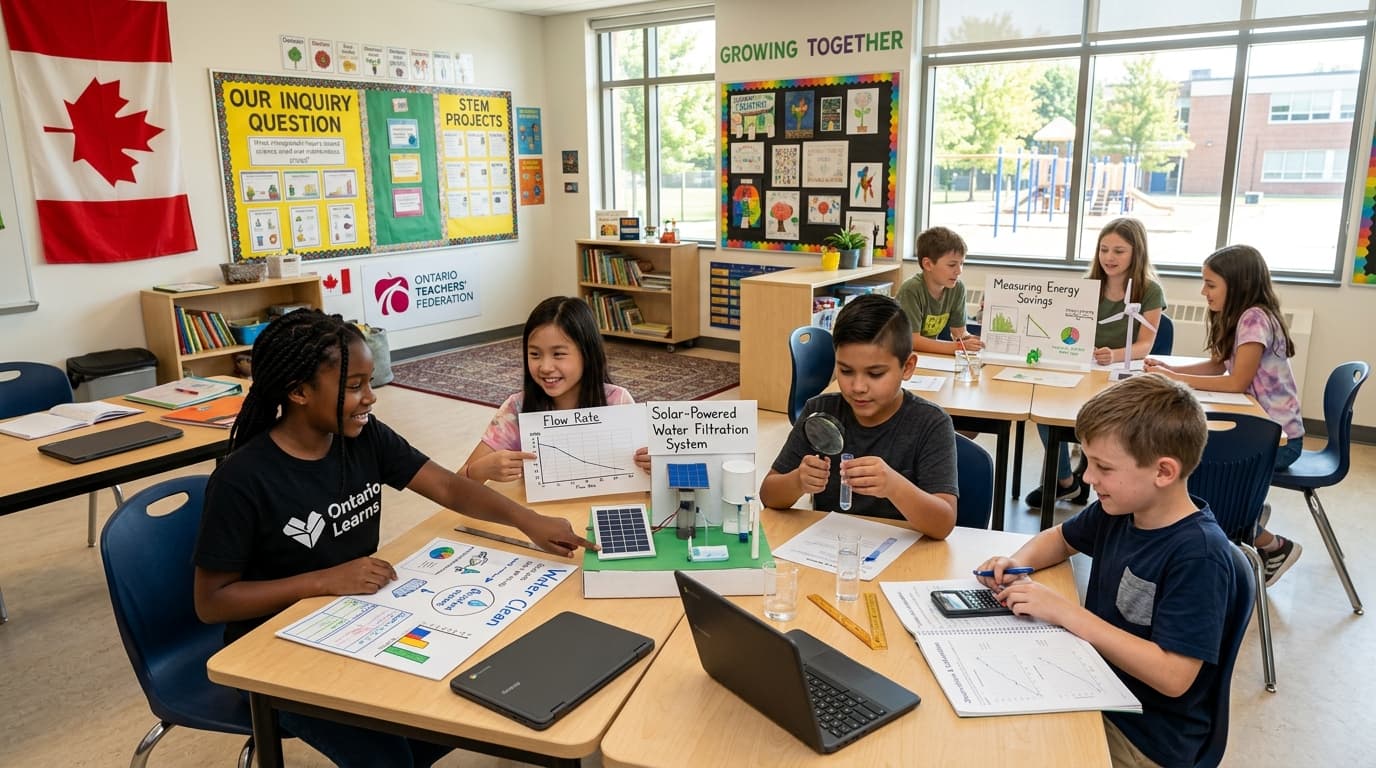
In a de-streamed environment, tasks must be accessible to every student on entry (Low Floor) while offering infinite mathematical or scientific depth for students ready to extend their thinking (High Ceiling).
Exemplar MTH1W Low-Floor, High-Ceiling Task: Linear Relations & Rates of Change
Instead of giving students a sheet of 20 abstract linear equations to graph ($y = 2x + 3$), present a context-rich, visually grounded inquiry:
Every student in the room can pick up a ruler and measure cups (Floor); yet within 40 minutes, the investigation scales into initial value ($y$-intercept), unit rate of change (slope), piecewise linear modeling, and systems of linear equations (Ceiling).
4. Culturally Responsive and Relevant Pedagogy (CRRP) in Ontario STEM
Culturally Responsive and Relevant Pedagogy (CRRP), articulated by Dr. Gloria Ladson-Billings and adapted for Ontario by scholars such as Dr. Carl James, is a statutory expectation within both MTH1W and SNC1W.
Lesson Planner
Generate comprehensive, CAPS-aligned lesson plans in seconds.
CRRP is not decorative tokenism (such as changing names in word problems to ethnic names or celebrating food days). Authentic CRRP operates across three fundamental tenets:
- Academic Success: Maintaining unapologetically high academic rigor and intellectual standards for all students.
- Cultural Competence: Validating students' lived experiences, histories, and heritage as legitimate sources of knowledge.
- Critical Consciousness: Empowering students to use mathematical and scientific tools to critique and dismantle social, economic, and environmental inequities.
Integrating CRRP into MTH1W: Critical Data Literacy & Spatial Justice
In Strand D (Data) and Strand F (Financial Literacy), replace frivolous datasets with genuine community data investigations:
- Food Desert and Transit Mapping: Pupils analyze municipal Open Data (e.g., City of Toronto or Ottawa GIS data) examining travel times by public transit versus personal vehicle from priority neighborhoods to grocery stores offering fresh produce. Pupils calculate descriptive statistics, scatter plots, and linear regressions to evaluate equitable municipal infrastructure investment.
- Predatory Lending Mathematics: In financial literacy, analyze the mathematical mechanics of payday loan operations versus traditional credit union loans. Calculate the staggering effective annual percentage rates (APR exceeding 400%) targeting marginalized working-class neighborhoods, using algebra to expose structural economic exploitation.
Integrating CRRP into SNC1W: Indigenous Ecological Knowledge (Two-Eyed Seeing)
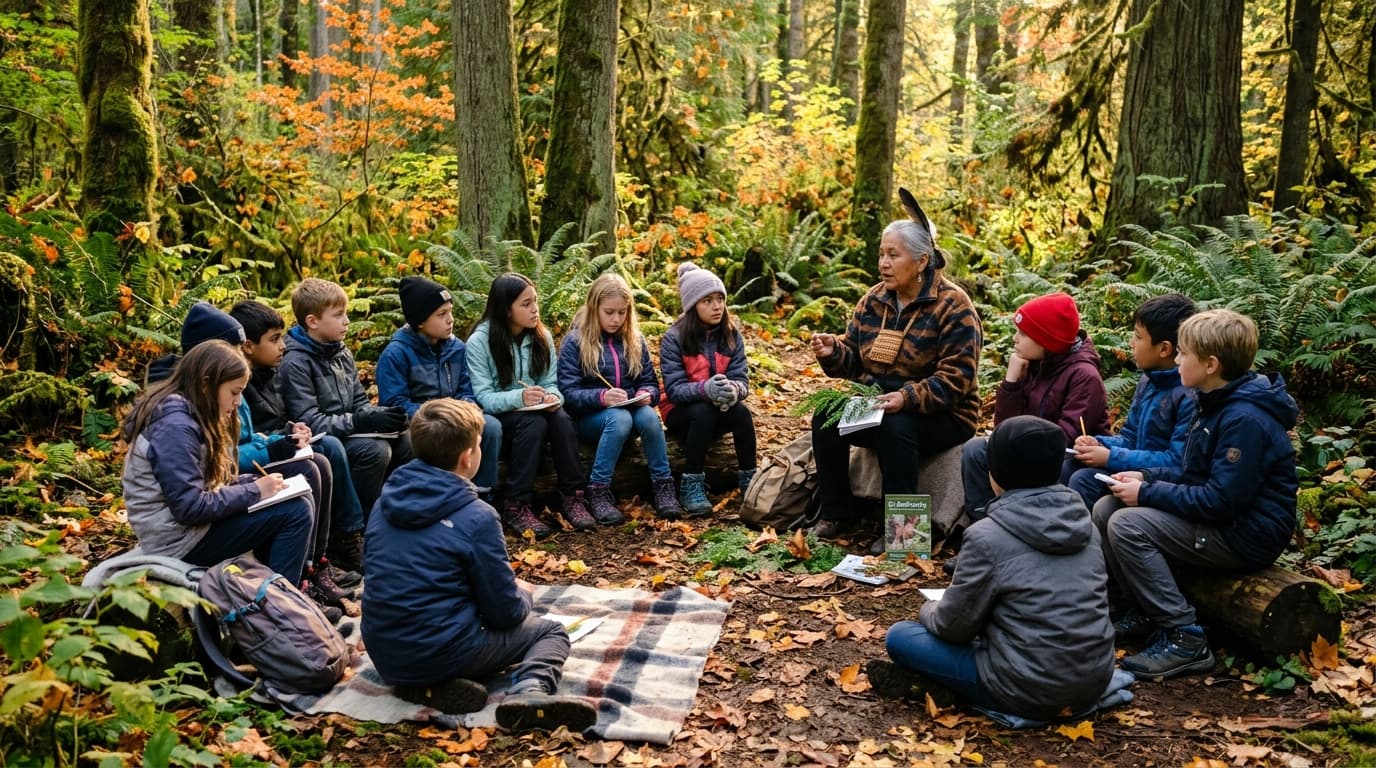
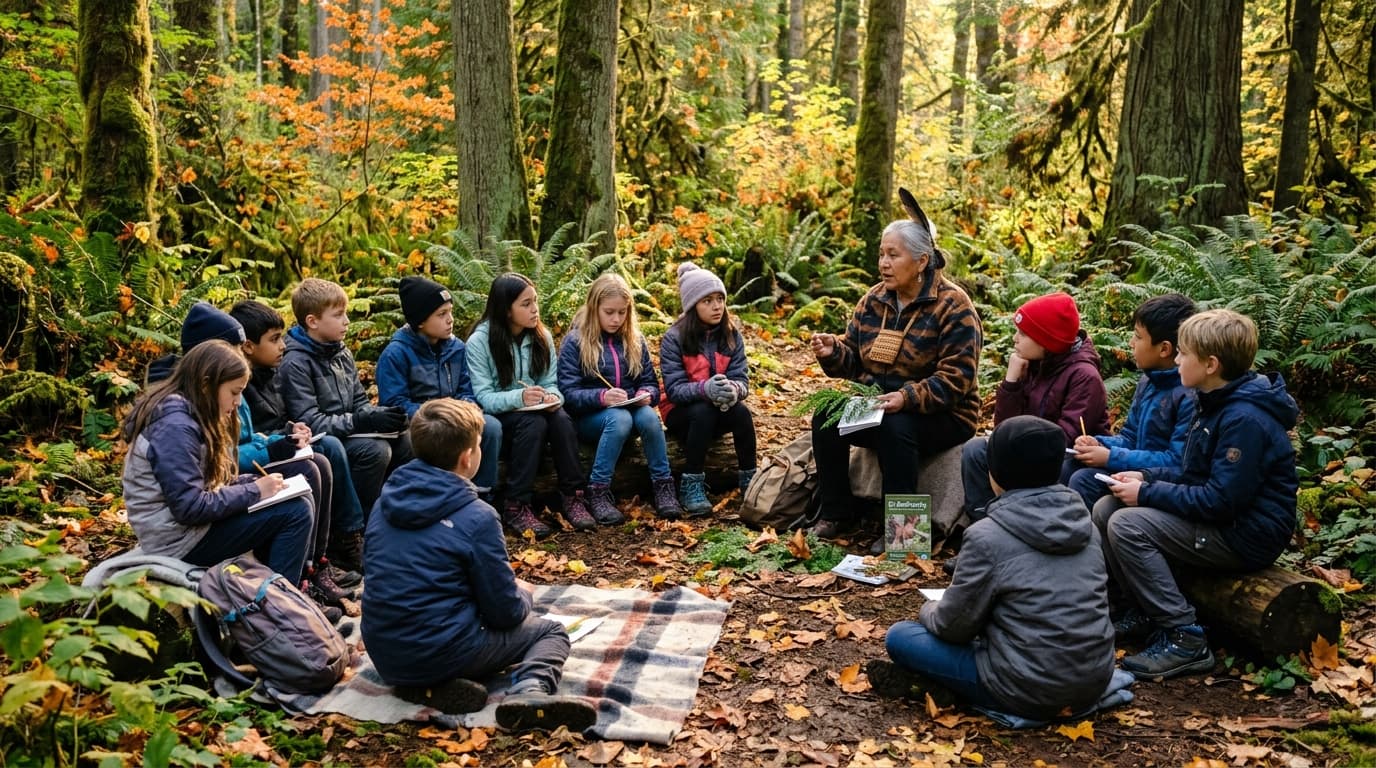
In Strand B (Sustainable Ecosystems), integrate the Mi'kmaw concept of Etuaptmumk (Two-Eyed Seeing), introduced by Elder Albert Marshall. Two-Eyed Seeing teaches students to see from one eye with the strengths of Indigenous ways of knowing, and from the other eye with the strengths of Western scientific methodologies, using both eyes together for the benefit of all.
| WESTERN SCIENTIFIC METHODOLOGY | INDIGENOUS ECOLOGICAL KNOWLEDGE (IEK) |
|---|---|
|
- Chemical titrations for dissolved oxygen and nitrates. - Digital pH and turbidity sensors. - Macro-invertebrate biotic index sampling and classification keys. - Statistical outlier calculations and chemical safety thresholds.
|
- Traditional ecological knowledge passed down through oral histories regarding seasonal water clarity and fish health. - Relationship with Water as a living entity (Nibi / Water is Life) carrying sacred responsibilities rather than being a mere exploitable economic resource. - Seventh Generation Principle: Evaluating long-term human impact over seven generations of community sustainability.
|
Students do not view Western science as superior or objective, but as one powerful lens alongside thousands of years of sophisticated Indigenous empirical land stewardship.
5. Coding Integration in MTH1W and SNC1W (Python & Block Scripting)
A defining innovation of Ontario's modernized STEM curricula is the mandatory integration of coding to solve mathematical problems and simulate scientific phenomena.
Coding in MTH1W: Automating Geometric and Number Relationships
In MTH1W, coding moves beyond basic block animation into computational mathematics. Students write automated algorithms in Python or block-based editors (such as Scratch or MakeCode) to model dynamic relationships.
Exemplar MTH1W Python Script: Optimizing Surface Area vs Volume (Strand E)
| 1 | # Exemplar MTH1W Python Script: Optimizing Surface Area vs Volume (Strand E) |
| 2 | # Students investigate packaging design constraints for a cylindrical juice can. |
| 3 | |
| 4 | 700;">import math |
| 5 | |
| 6 | 700;">def calculate_can_dimensions(volume_target): |
| 7 | print(f"--- CAN DESIGN OPTIMIZER FOR VOLUME = {volume_target} cm³ ---") |
| 8 | print(f"{'Radius (cm)':<12}{'Height (cm)':<12}{'Surface Area (cm²)':<18}") |
| 9 | |
| 10 | best_radius = 0 |
| 11 | min_surface_area = float('inf') |
| 12 | |
| 13 | # Iterate through plausible cylinder radii from 1.0 cm to 10.0 cm |
| 14 | 700;">for r 700;">in [x * 0.5 700;">for x 700;">in range(2, 21)]: |
| 15 | # Formula: V = pi * r^2 * h => h = V / (pi * r^2) |
| 16 | h = volume_target / (math.pi * (r ** 2)) |
| 17 | |
| 18 | # Formula: SA = 2 * pi * r * h + 2 * pi * r^2 |
| 19 | sa = (2 * math.pi * r * h) + (2 * math.pi * (r ** 2)) |
| 20 | |
| 21 | 700;">if sa < min_surface_area: |
| 22 | min_surface_area = sa |
| 23 | best_radius = r |
| 24 | |
| 25 | print(f"{r:<12.1f}{h:<12.2f}{sa:<18.2f}") |
| 26 | |
| 27 | print(f"\nOPTIMAL DESIGN: Radius = {best_radius} cm minimizes material cost!") |
| 28 | |
| 29 | # Run test for standard 355 mL drink can |
| 30 | calculate_can_dimensions(355) |
By decomposing the mathematical formulas into computational loops, students visualize the trade-off between geometric variables and develop authentic algorithmic thinking.
6. Tiered Scaffolding and Universal Interventions
Academically heterogeneous classrooms require intentional structural scaffolds that support emerging learners without lowering cognitive challenge.
| Challenge Area | Scaffolding Intervention | Cognitive Rationale |
|---|---|---|
|
Multi-Step Word Problems
|
3-Reads Protocol: 1st Read: Context & Story (No math 2nd Read: Identify Quantities 3rd Read: Mathematical Questions
|
Separates mathematical reasoning from | reading comprehension fatigue. Protects cognitive working memory.
|
|
Algebraic Equation Solving
|
Concrete-Representational-Abstract (CRA) Sequence: 1. Hands-on algebra tiles/balances 2. Visual area model sketches 3. Abstract symbolic equations
|
Grounding algebraic balance physically before transitioning to abstract algebraic manipulations.
|
|
Scientific Lab Practical Work
|
Dual-Coded Visual Protocols: Illustrated graphic step cards depicting glassware, tools, and measurements alongside text.
|
Reduces laboratory cognitive load; ensures safety compliance for EAL and processing- delayed learners without adult dependency.
|
7. Equitable Assessment: Growing Success in a De-Streamed Classroom
Assessment in de-streamed classrooms must be rooted in Ontario's statutory policy document, Growing Success: Assessment, Evaluation, and Reporting in Ontario Schools (2010).
In a de-streamed classroom, assessment practices must eradicate punitive grading systems that penalize students for early learning struggles. High-leverage equitable assessment practices include:
De-Streamed Assessment Rubric: Evaluating MTH1W Thinking & Inquiry
| Category | Level 2 (Approaching Standard) | Level 4 (Exceeding / Deep Mastery) |
|---|---|---|
|
Knowledge and Understanding
|
Demonstrates understanding of concepts with some clarity; basic procedural execution with errors.
|
Demonstrates thorough, flexible understanding of concepts; articulates theoretical principles fluently.
|
|
Thinking and Investigation
|
Applies problem-solving plans with partial success; requires guided cues to verify results.
|
Decomposes complex problems creatively; tests edge cases, evaluates reasonableness, and justifies alternative pathways.
|
|
Communication
|
Expresses mathematical/scientific thinking using everyday language; inconsistent notation and units.
|
Communicates reasoning with clarity and precision; uses standard mathematical and scientific vocabulary, conventions, graphs.
|
|
Application
|
Transfers concepts to familiar contexts with minor errors; needs scaffolding in novel scenarios.
|
Transfers concepts seamlessly to novel, authentic real-world contexts; proposes innovative solutions to complex problems.
|
8. Managing Classroom Dynamics, Math Anxiety, and Growth Mindsets
Many students enter Grade 9 carrying intense, internalized narratives of failure: "I am not a math person," "I am bad at science," or "I was only supposed to be in Applied." These anxieties trigger avoidance behaviors, defiance, or paralysis.
The 3-Step Math/Science Anxiety De-Escalation Routine
- Praising Cognitive Struggle (Normalizing the "Grit Zone"): Publicly celebrate mistakes on the whiteboards: "Look at Group 4's board! They made an assumption about negative exponents that didn't hold up. This mistake is fantastic because it forced them to uncover why the rule works. Let's look at this together."
- Defusing Evaluation Dread: In the first four weeks of the semester, eliminate all graded quizzes. Use only formative, un-graded diagnostic check-ins with descriptive feedback, proving to students that the classroom is a safe space for cognitive rehearsal.
- Student Reflection Journals: Provide weekly 5-minute reflection prompts: "What was a moment this week when you felt stuck? What specific strategy (talking to a peer, looking at another group's board, asking a clarifying question) helped you get unstuck?"
9. Frequently Asked Questions (Ontario Secondary Teachers & Department Heads)
Won't de-streaming hold back high-achieving students who want to enter advanced university STEM programmes?
Extensive research across international jurisdictions (such as Finland, Japan, and Massachusetts) proves that high-achieving students thrive in heterogeneous classrooms when instruction utilizes Low-Floor, High-Ceiling tasks. When high-attaining students explain concepts, justify alternative proofs, write algorithmic simulations, and tackle complex extensions, their conceptual mastery deepens far beyond the superficial algorithmic memorization encouraged by traditional Academic streaming.
How do we support students reading at a Grade 4 level in Grade 9 Science?
Use Universal Design for Learning (UDL) principles:
- Provide digital versions of text compatible with text-to-speech tools (Google Read&Write).
- Utilize dual-coded visual lab safety instructions and concept maps.
- Allow oral interviews or video explanations to serve as evidence of learning instead of written lab reports.
- Focus on developing scientific inquiry and conceptual reasoning rather than grading reading speed.
How should guidance counselors advise students for Grade 10 courses after de-streamed Grade 9?
Grade 10 mathematics is also de-streamed or aligned to ensure students maintain flexibility. Ensure that parents and students understand that completing de-streamed Grade 9 keeps all post-secondary pathways fully open, enabling students to transition confidently into college, university, apprenticeship, or workplace destinations based on their genuine passions.