How to Run High-Yield Guided Math Workstations in 3rd–5th Grade Classrooms
In upper elementary classrooms across the United States, the whole-group math lecture is increasingly recognized as inefficient. When a 4th-grade teacher spends 60 minutes lecturing from the whiteboard, a predictable dynamic unfolds: five advanced students are bored to tears, ten students follow along with moderate success, and ten students are lost, confused, and silently disengaging.
Mathematics is an inherently tiered discipline. A student who has not mastered single-digit multiplication cannot conceptualize equivalent fractions. A student who lacks place-value schema cannot execute multi-digit division algorithms.
The solution is Guided Math: a workshop model that combines a brief whole-group focus mini-lesson with differentiated, small-group instructional rotations.
This comprehensive guide delivers a classroom-tested blueprint for planning, organizing, and executing high-yield guided math workstations in Grades 3, 4, and 5.
Table of Contents
- 1. The Guided Math Workshop Architecture: Structure & Time Allocations
- 2. Diagnostic Grouping: Moving Beyond Static Ability Tracks
- 3. Step-by-Step Guide: Launching Guided Math Workstations
- Step 1: Deliver a Focused 10-Minute Whole-Group Mini-Lesson
- Step 2: Establish the 4-Station Rotation Framework (M.A.T.H.)
- Step 3: Engineer Independent Accountability Systems
- Step 4: Design the Teacher-Led Small Group Intervention Protocol
- Step 5: Train and Drill Classroom Transition Procedures
- Step 6: Close with Formative Exit Tickets & Debriefs
- 4. The M.A.T.H. Workstation Blueprint
- 5. Complete 60-Minute Worked Lesson Plan: 4th Grade Fractions
- 6. Managing Materials, Manipulatives, and Classroom Noise
- 7. Differentiating at the Teacher Table: Scaffolds & Extensions
- 8. Overcoming Common Guided Math Roadblocks
- 9. Digital Tools, Virtual Manipulatives, and AI Planning Support
- 10. Frequently Asked Questions (FAQ)
- 11. Action Plan for Elementary Math Teachers
- 12. Scholarly References and Pedagogical Resources
- 13. Related Teaching Resources and Math Tools
1. The Guided Math Workshop Architecture: Structure & Time Allocations
An optimal 60- to 75-minute elementary math block balances whole-class coherence with individualized small-group differentiation:
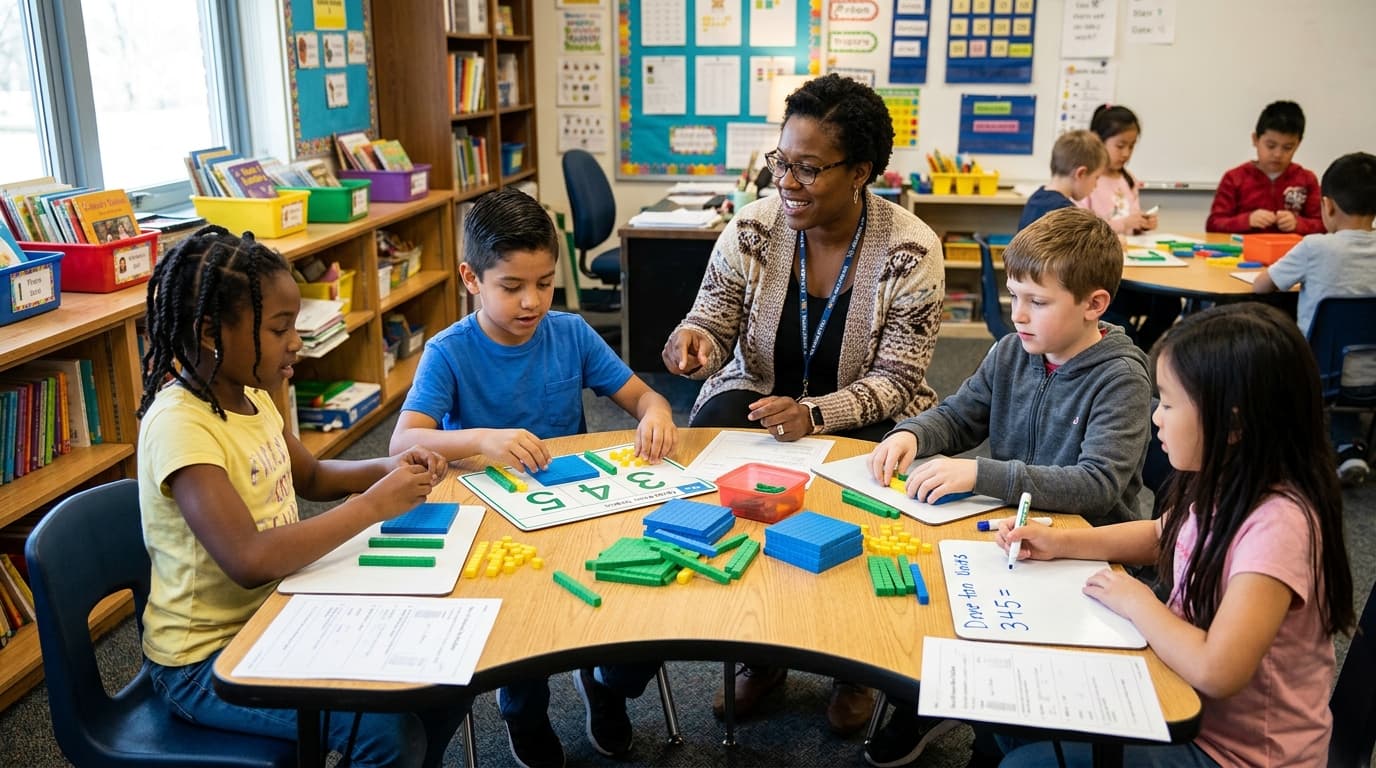
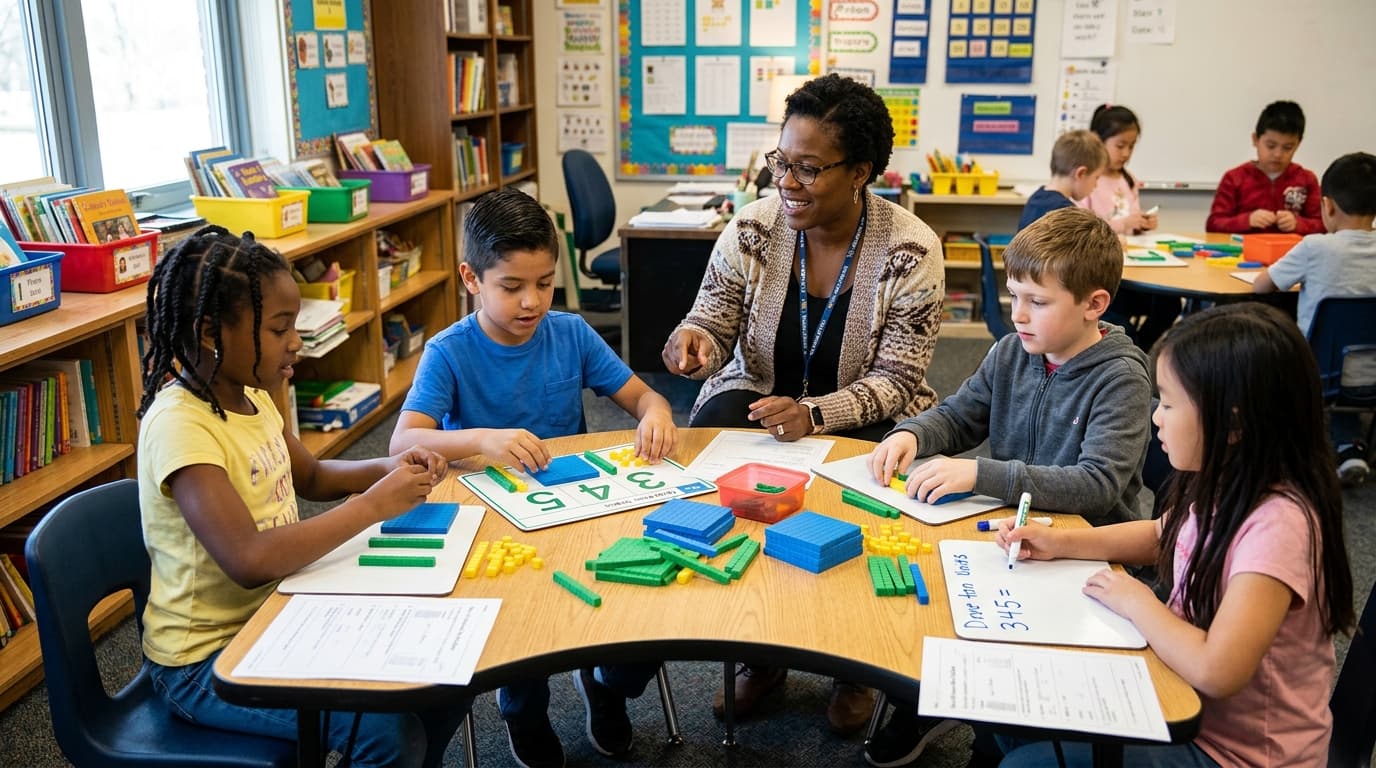
During the 40-minute rotation window, the teacher does not wander around the room policing behavior. The teacher sits at a designated small-group table, delivering targeted, diagnostic instruction to 4 to 6 students at a time, while the remaining students engage in purposeful, independent workstations.
2. Diagnostic Grouping: Moving Beyond Static Ability Tracks
A fatal flaw in traditional small-group math is creating static, permanent "low, medium, and high" groups. Children quickly discern these labels (e.g., "I'm in the slow group"), triggering math anxiety and fixed mindsets.
Under a modern Guided Math framework, student groupings are fluid and dynamic, shifting every 3 to 5 days based on specific pre-assessments and daily exit ticket data:
- A student might be in an intensive support group for multi-digit division, but transition to the advanced enrichment group next week when the topic shifts to 2D geometry and spatial symmetry.
- Form groups based on specific mathematical misconceptions, not generalized ability percentiles.
3. Step-by-Step Guide: Launching Guided Math Workstations
Step 1: Deliver a Focused 10-Minute Whole-Group Mini-Lesson
Resist the temptation to lecture for 30 minutes. Keep your whole-group mini-lesson brief and targeted:
- Announce the daily objective and show the connection to prior learning.
- Model one clean exemplar problem using think-aloud strategies.
- Present one intentional non-example to inoculate against common misconceptions.
- Dismiss students immediately into rotation 1.
Step 2: Establish the 4-Station Rotation Framework (M.A.T.H.)
To simplify classroom management, use the widely adopted M.A.T.H. Acronym:
- M: Math Facts / Fluency: Automaticity practice (games, flashcard routines, digital fact fluency).
- A: At Your Seat / Independent Practice: Rigorous curriculum problem-solving and application tasks.
- T: Teacher Table: High-intensity small group instruction and manipulative modeling.
- H: Hands-On / Tech: Tactile math games, geometric building, or adaptive digital math software.
Step 3: Engineer Independent Accountability Systems
The number one reason guided math fails is student off-task behavior at independent stations. Eliminate this by establishing visible accountability systems:
- The "Must Do / May Do" Board: Display a visual chart detailing the mandatory task that must be completed before students can choose an early-finisher math game.
- Math Station Recording Sheets: Require every independent game or station to produce a physical work product collected in student portfolios at the end of the block.
- The 3-Before-Me Rule: Students are strictly prohibited from interrupting the teacher table. If they have a question, they must: (1) Re-read the directions, (2) Check the classroom anchor chart, (3) Ask a designated peer expert.
Step 4: Design the Teacher-Led Small Group Intervention Protocol
At the teacher table, utilize the CPA (Concrete-Pictorial-Abstract) progression:
Lesson Planner
Generate comprehensive, CAPS-aligned lesson plans in seconds.
- Concrete (3–4 Min): Students physically manipulate base-ten blocks, fraction tiles, or counters.
- Pictorial (4–5 Min): Students sketch visual representations (area models, number lines, bar diagrams) on individual dry-erase boards.
- Abstract (4–5 Min): Students solve standard numerical algorithms and explain their mathematical reasoning aloud.
Step 5: Train and Drill Classroom Transition Procedures
Spend the first two weeks of the school year explicitly practicing station transitions without doing complex math. Use a visual timer and a gentle auditory chime:
- Chime 1: "Freeze and Clean" (1 minute to pack up manipulatives and return stations to pristine order).
- Chime 2: "Walk and Transition" (30 seconds to move silently to the next station).
Step 6: Close with Formative Exit Tickets & Debriefs
Always reconvene as a whole group for the final 5 minutes. Distribute a 2-problem exit ticket to evaluate daily mastery and determine tomorrow's small-group groupings.
4. The M.A.T.H. Workstation Blueprint
| Station | Core Purpose | Sample Activities | Accountability Mechanism |
|---|---|---|---|
|
M - Math Facts
|
Automaticity & Number Sense
|
Fact fluency dice games, war with cards, digital adaptive apps
|
Weekly fact fluency graph
|
|
A - At Your Seat
|
Standards-Aligned Application
|
Core curriculum workbook pages, error analysis tasks, word problem journals
|
Turn-in basket daily
|
|
T - Teacher Table
|
Differentiated Guided Re-Teaching
|
Targeted re-teaching with manipulatives, extension challenges, Socratic questioning
|
Teacher anecdotal checklist
|
|
H - Hands-On
|
Tactile Spatial & Conceptual Play
|
Fraction tile puzzles, geometric tangrams, balance scales, measurement labs
|
Completed task card recording sheet
|
5. Complete 60-Minute Worked Lesson Plan: 4th Grade Fractions
1. Number Talk & Warm-Up (8 Minutes)
- Display: $\frac{3}{4}$ and $\frac{3}{8}$.
- Prompt: "Which fraction is larger? Prove your thinking without cross-multiplying."
- Solicit student mathematical discourse: Both have 3 pieces, but fourths are much larger than eighths because the whole is divided into fewer, bigger parts.
2. Whole-Group Mini-Lesson (10 Minutes)
- Introduce benchmark fractions: Using $0, \frac{1}{2},$ and $1$ as mental anchors.
- Model comparing $\frac{5}{8}$ and $\frac{2}{6}$:
- $\frac{5}{8}$ is greater than $\frac{1}{2}$ (since $\frac{4}{8} = \frac{1}{2}$).
- $\frac{2}{6}$ is less than $\frac{1}{2}$ (since $\frac{3}{6} = \frac{1}{2}$).
- Therefore, $\frac{5}{8} > \frac{2}{6}$.
- Create anchor chart: "Benchmarking to One-Half".
3. Rotations Schedule (3 Rotations × 12 Minutes = 36 Minutes)
Group 1 at Teacher Table (Tier 2 Support):
- Students struggle with conceptual fraction magnitude.
- Teacher provides physical fraction tiles. Students physically build fractions and line them up against a $\frac{1}{2}$ tile.
- Practice drawing number lines from 0 to 1, marking $\frac{1}{2}$, and plotting fractions.
Group 2 at Teacher Table (On-Grade Level):
- Students compare fractions that both fall on the same side of $\frac{1}{2}$ (e.g., $\frac{5}{6}$ vs. $\frac{7}{8}$).
- Teacher guides students in finding common denominators through multiplication and using tape diagrams.
Group 3 at Teacher Table (Advanced / Enrichment):
- Challenge problem: Ordering sets of 4 unequal fractions from least to greatest.
- Introduce algebraic comparison reasoning and real-world recipe scaling challenges.
4. Whole-Class Closure & Exit Ticket (6 Minutes)
- Exit Ticket Question: "Compare $\frac{4}{6}$ and $\frac{3}{8}$. Use the benchmark of $\frac{1}{2}$ to justify which fraction is greater in 2 complete sentences."
6. Managing Materials, Manipulatives, and Classroom Noise
To prevent chaotic classrooms:
- Individual Math Tubs: Organize student supplies into color-coded plastic caddies (one per station). Store dry-erase markers, dice, and manipulatives inside so students never wander the room looking for tools.
- Visual Sound Level Meter: Utilize a digital decibel meter display on your screen. Set clear expectations: Math stations operate at Level 1 (whisper talk only).
- The Clean-Up Captain: Assign one student per group as the materials manager responsible for inventorying all items before transition chimes sound.
7. Differentiating at the Teacher Table: Scaffolds & Extensions
Scaffolding for Struggling Mathematicians
- Never jump straight to abstract algorithms (e.g., cross-multiplication or butterfly methods), which teach mechanical tricks without conceptual understanding.
- Ground instruction in the Concrete-Representational-Abstract (CRA) model. Let students handle fraction circles and grid models until their mental representation is secure.
Extending High-Achieving Students
- Ask "What if?" questions: "What happens to the fraction when we double both the numerator and the denominator? What happens if we only double the denominator?"
- Task students with creating complex, multi-step math tasks for their peers to solve.
8. Overcoming Common Guided Math Roadblocks
9. Digital Tools, Virtual Manipulatives, and AI Planning Support
Leveraging modern tools like the SA Teachers AI Worksheets Generator and Lesson Planner allows educators to produce multi-tiered workstation activities effortlessly.
Prompt Strategy for Guided Math Workstations
"Generate a 4th-grade math workstation packet for comparing fractions with unlike denominators. Include: 1) A 6-item independent practice worksheet with error analysis, 2) A 2-player dice comparison game with rules and recording sheet, and 3) A 3-tiered small-group lesson plan progressing through the Concrete-Representational-Abstract framework."
Comprehensive 4-Week Launch Protocol for Guided Math Workstations
Launching guided math successfully requires a deliberate, step-by-step socialization process. Attempting to launch all four M.A.T.H. stations on Day 1 is the primary cause of classroom chaos. Use this 4-week rollout sequence:
Week 1: Establishing Station Stamina & Classroom Culture
- Focus: Zero academic small-group instruction. The teacher remains mobile, coaching student behavior and building workstation stamina.
- Station Deployment: Introduce only one station: "A - At Your Seat" practice.
- Instructional Steps:
- Teach the physical boundaries: where students sit, where materials are stored, and how pencils are sharpened.
- Set a visual timer for 8 minutes. Students practice working completely in silence on review math coloring sheets or review puzzles.
- Debrief as a class: Did we work the whole time? Was our noise level appropriate?
- Gradually increase stamina from 8 minutes to 15 minutes by Friday.
Week 2: Introducing Partner Games & the "Math Facts" Station
- Focus: Social interaction, respectful turn-taking, and noise-level regulation.
- Station Deployment: Introduce "M - Math Facts" games (e.g., Multiplication Top-It, Math Fact Dominoes).
- Instructional Steps:
- Fishbowl Modeling: Have two student volunteers demonstrate how to play the game while sitting in the center of the room.
- Model non-examples explicitly: What does arguing over a dice roll look like? What does poor sportsmanship look like? How do we handle disagreements calmly?
- Divide class into two halves: Half the class does "At Your Seat", half the class does "Math Facts". Practice the transition chime.
Week 3: Introducing "Hands-On" Manipulative Stations & Technology
- Focus: Manipulative care, inventory preservation, and tech login efficiency.
- Station Deployment: Introduce "H - Hands-On" (tangrams, geometric measurement, digital adaptive apps).
- Instructional Steps:
- Establish the "Manipulatives are Math Tools, Not Toys" contract. Any student throwing or misusing base-ten blocks loses access for the rotation.
- Drill technology logins until every child can log into their assigned math software in under 60 seconds without teacher assistance.
- Run three rotations daily with the teacher still acting as a mobile facilitator.
Week 4: Opening the Teacher Table for Small-Group Instruction
- Focus: Deep diagnostic instruction and independent student autonomy.
- Station Deployment: The teacher table officially opens. The "3-Before-Me" rule is strictly enforced.
- Instructional Steps:
- Place the "Do Not Disturb" visual cue (a small light or visual flag) on the teacher table.
- Deliver targeted CPA small-group lessons to Group 1, Group 2, and Group 3 while the rest of the class operates autonomously.
Differentiated Station Task Cards & Print-Ready Templates
To ensure that independent workstation time translates into rigorous mathematical thinking, provide students with structured task card templates:
Assessment and Anecdotal Tracking Matrix at the Teacher Table
While working with students at the teacher table, use this rapid-capture diagnostic matrix to document conceptual understanding in real time:
| Student Name | Concrete Mastery (Manipulatives) | Pictorial Mastery (Visual Representation) | Abstract Mastery (Equations & Algorithms) | Mathematical Justification (Student Talk) | Next Instructional Action |
|---|---|---|---|---|---|
|
Marcus
|
High (uses blocks easily)
|
Moderate (sketches arrays)
|
Developing (algorithm errors)
|
Emerging (uses basic vocabulary)
|
Provide grid paper scaffold
|
|
Sophia
|
High
|
High
|
High
|
Exceptional (explains properties)
|
Move to open-ended enrichment
|
|
Jayden
|
Developing (needs physical cubes)
|
Developing (needs guided lines)
|
Developing (confuses regrouping)
|
Emerging (hesitant to speak)
|
Schedule Tier 2 WIN re-teach
|
|
Elena
|
High
|
High
|
High
|
High (clear academic talk)
|
Introduce multi-step word challenge
|
10. Frequently Asked Questions (FAQ)
Can guided math work in a 45-minute elementary math block?
Yes. If you have only 45 minutes, run two rotations per day instead of three or four. See two groups on Monday/Wednesday and the remaining two groups on Tuesday/Thursday, reserving Friday for whole-group project-based math investigations.
How do I assess students who are working independently?
Collect the workstation recording sheets into weekly math folders. Conduct a quick 3-minute spot-check on Friday, and rely on daily exit tickets to monitor individualized standard mastery.
11. Action Plan for Elementary Math Teachers
- Next Week: Transition your 60-minute block to include a brief 10-minute mini-lesson followed by one single pilot small-group rotation.
- Week 2: Introduce the M.A.T.H. rotation framework. Train and practice transition routines with zero math content until transitions take under 45 seconds.
- Week 3: Launch full 3-station daily guided math rotations with targeted CRA instruction at the teacher table.
12. Scholarly References and Pedagogical Resources
- Sammons, L. (2010). Guided Math: A Framework for Mathematics Instruction. Shell Education.
- Van de Walle, J. A., et al. (2019). Elementary and Middle School Mathematics: Teaching Developmentally. Pearson.
- Boaler, J. (2016). Mathematical Mindsets: Unleashing Students' Potential through Creative Math, Inspiring Messages and Innovative Teaching. Jossey-Bass.
- National Council of Teachers of Mathematics (NCTM). (2014). Principles to Actions: Ensuring Mathematical Success for All.
13. Related Teaching Resources and Math Tools
- International Teaching Resources Hub — Explore comprehensive pedagogical guides for mathematics and science educators.
- AI Worksheets Generator — Generate custom, tiered mathematics practice sheets and workstation recording sheets.
- AI Lesson Planner — Design standards-aligned guided math rotations and small-group intervention scripts.