How to Lead Culturally Responsive Community Circles and Family Partnerships
In elementary schools across the United States, student demographics have undergone a profound demographic transformation over the past three decades. Today, more than half of America's public elementary school students are children of color, representing hundreds of distinct linguistic backgrounds, immigrant experiences, and rich cultural traditions.
Yet all too often, traditional school structures remain anchored in monocultural, Eurocentric norms of individualism, silent compliance, and hierarchical teacher authority.
When children from collectivist, relational cultures enter classrooms characterized by cold, transactional compliance systems—such as public behavior clip charts or punitive detentions—they experience what neuroscientist and educator Dr. Zaretta Hammond terms a "neurobiological threat response." When a child senses that their cultural identity, home dialect, or familial traditions are devalued or policed, their brain's amygdala triggers stress hormones that actively inhibit higher-order cognition, working memory, and academic risk-taking.
Furthermore, traditional family engagement frequently operates from a deficit perspective: schools reach out to immigrant, Black, Indigenous, and working-class families almost exclusively when a child misbehaves, fails a reading benchmark, or misses attendance targets. Caregivers who work multiple shifts, lack reliable transportation, or do not speak fluent English are unjustly branded by school staff as "disengaged" or "unsupportive."
The research-validated antidote to this systemic breakdown is the practice of Culturally Responsive Community Circles paired with Asset-Based Family Partnerships.
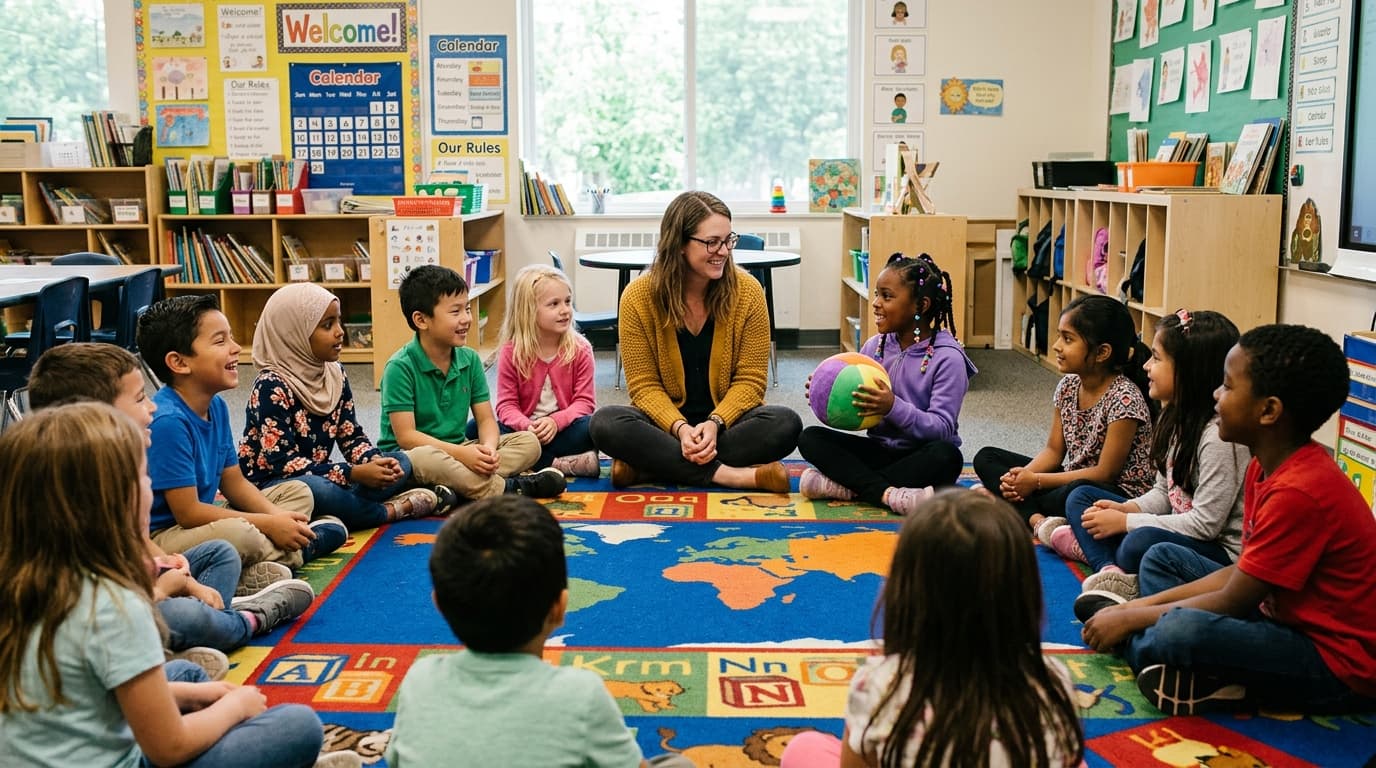
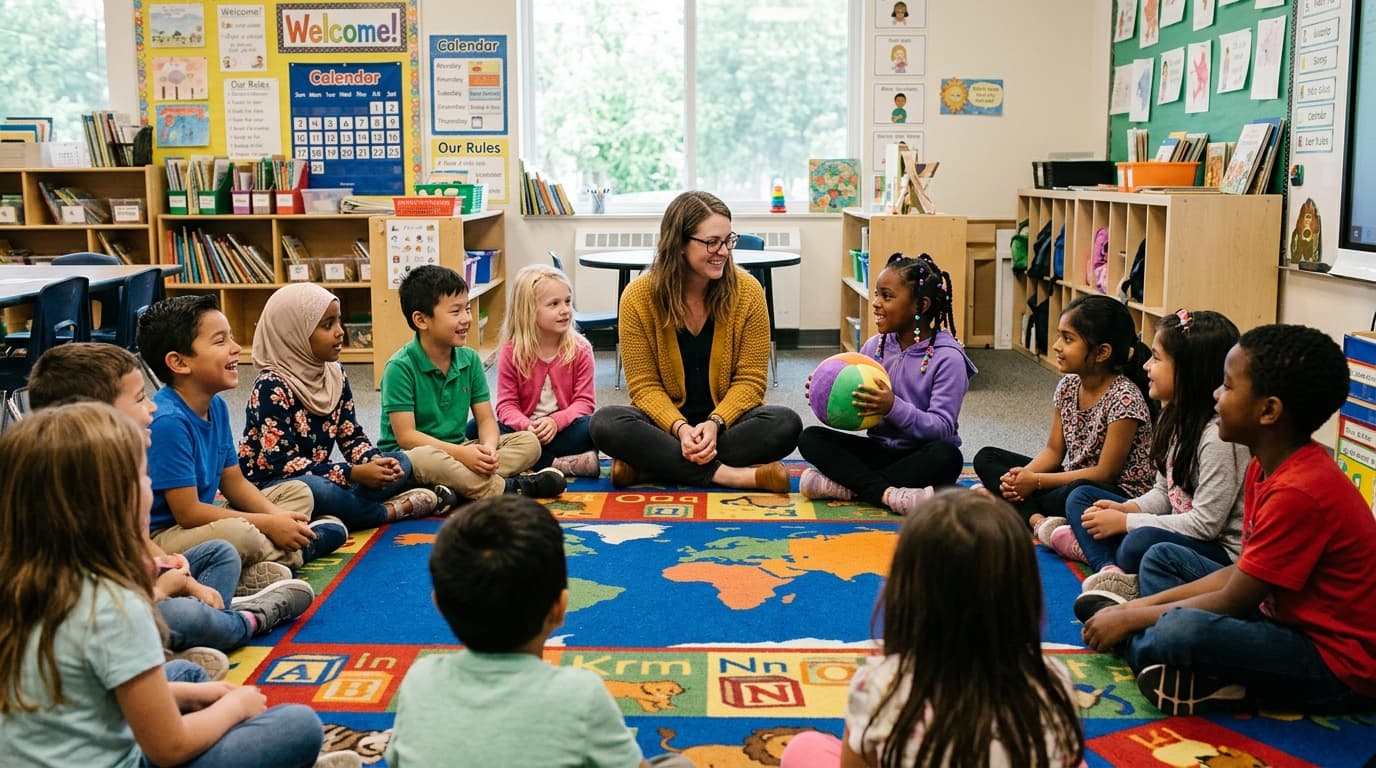
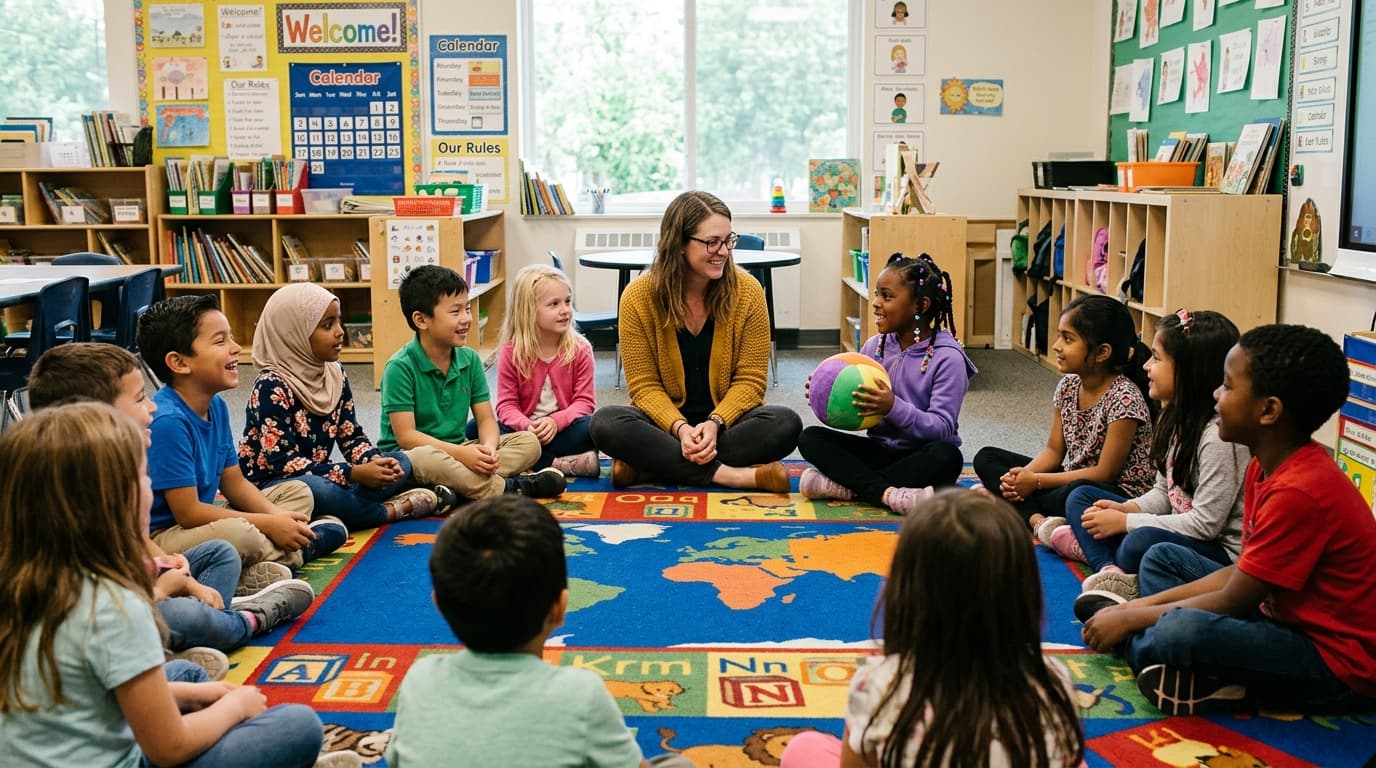
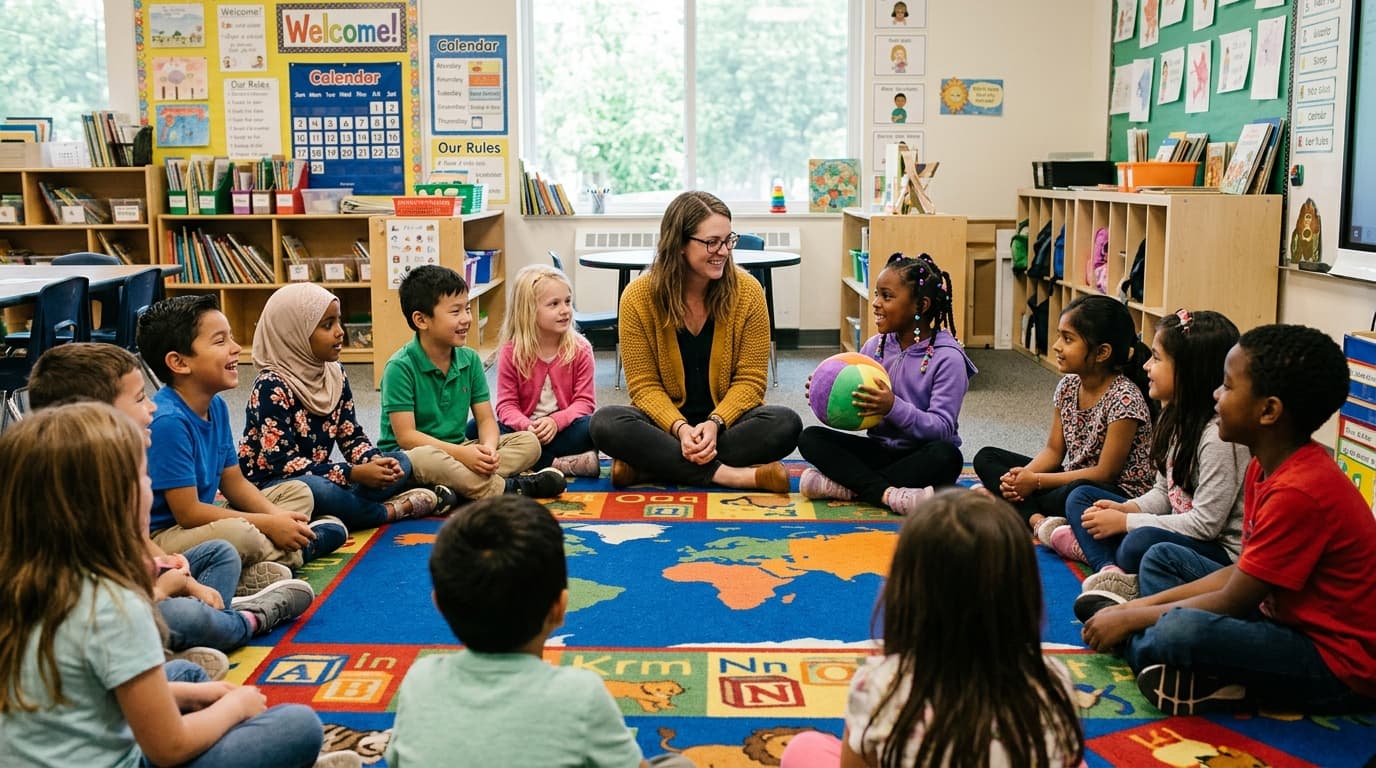
Grounded in indigenous restorative traditions, the Funds of Knowledge framework (Moll et al.), and the neurobiology of relational trust, community circles establish a daily sanctuary where every child's lived experience is honored, oral storytelling is celebrated, and collective responsibility replaces punitive isolation.
This comprehensive guide delivers an evidence-based roadmap for elementary educators to lead transformative culturally responsive community circles, build genuine reciprocal caregiver alliances, conduct bilingual home listening tours, and eliminate deficit-based narratives from school culture.
Table of Contents
- 1. Theoretical Foundations: CRT and the Brain & Funds of Knowledge
- 2. Dismantling the Deficit Paradigm: Asset-Based Mindsets
- 3. The Architecture of the Culturally Responsive Community Circle
- 4. The 4-Phase Community Circle Routine
- 5. Master Catalog of Culturally Responsive Circle Prompts
- 6. Navigating Difficult Moments: Circle Defense and Emotional Safety
- 7. Transforming Family Engagement: From Transactional to Relational
- 8. Overcoming Language and Structural Barriers for Immigrant Families
- 9. Year-Long Implementation Timeline and Community Celebrations
- 10. Measuring Impact: Qualitative Climate and Belonging Rubrics
1. Theoretical Foundations: CRT and the Brain & Funds of Knowledge
Culturally responsive circles are not merely "feel-good" activities; they are rooted in rigorous cognitive neuroscience and educational sociology:
When children recognize that their family's labor, ancestral languages, and cultural traditions are held in high esteem by their teacher, classroom anxiety dissolves. Students transition from defensive self-preservation into curious intellectual engagement.
2. Dismantling the Deficit Paradigm: Asset-Based Mindsets
To build authentic reciprocal partnerships, educators must actively interrogate and unlearn deficit-laden assumptions:
| Deficit-Framed Perspective | Asset-Based Culturally Responsive Reality |
|---|---|
|
"These parents don't value education because they never attend Back-to-School Night."
|
"Caregivers work night shifts, lack transportation, or face childcare barriers. We will offer flexible phone updates, bilingual video summaries, and community-based meetings."
|
|
"The student speaks broken English at home, which is why their reading test scores are low."
|
"The student is a developing multilingual scholar with emerging metalinguistic flexibility across two rich linguistic systems. We will leverage their Spanish/Arabic roots to accelerate English decoding."
|
|
"Marcus has no positive male role models at home."
|
"Marcus lives within an extended kinship network including uncles, grandmothers, older cousins, and church mentors who provide deep emotional wisdom."
|
|
"This community lacks cultural resources."
|
"This community possesses vibrant oral storytelling traditions, intergenerational resilience, and agricultural/artistic craftsmanship that enrich our science and history units."
|
3. The Architecture of the Culturally Responsive Community Circle
The physical and symbolic layout of the circle dictates the emotional safety of the room:
Lesson Planner
Generate comprehensive, CAPS-aligned lesson plans in seconds.
1. The Sacred Geometry (Unbroken Symmetry)
- Every participant—including the teacher and support staff—sits at the exact same physical elevation (either on chairs or directly on carpet floor cushions).
- There are no desks, no podiums, and no barriers. In a circle, every person has direct, unobstructed eye contact with everyone else. Power is democratized; the teacher is not a judge on an elevated platform, but a community participant holding space.
2. The Talking Piece
The Talking Piece is an object of shared respect. Only the individual physically holding the talking piece has the floor to speak; all other circle members practice empathetic, active listening with eyes and hearts.
- Selecting the Talking Piece: Never use a random plastic marker. Invite students to co-create or bring meaningful objects: a smooth river stone polished by local water, a carved wooden animal representing classroom agreements, or a handmade woven textile reflecting community diversity.
- The Rule of the Talking Piece: The piece moves sequentially around the circle in a clockwise direction. A student always holds the absolute right to pass silently; forced vulnerability destroys trust.
3. The Centerpiece
In the visual center of the floor sits the Centerpiece—a small circular mat adorned with artifacts honoring classroom identity: bilingual class agreements, miniature flags representing students' ancestral heritages, seasonal leaves, or an electric amber candle signifying warmth and safety.
4. The 4-Phase Community Circle Routine
Community circles should be held daily for 15 to 20 minutes (typically during Morning Meeting or directly prior to afternoon dismissal), following an unvarying ritual structure:
5. Master Catalog of Culturally Responsive Circle Prompts
Prompts must be carefully tiered. Jumping into deep trauma too quickly triggers emotional defense; staying at surface-level trivialities ("What is your favorite ice cream?") fails to build relational intimacy.
Tier 1: Connection & Cultural Heritage (Low Vulnerability)
- "What is a special tradition, food, or celebration your family enjoys when you gather together?"
- "Who is an elder or family member you look up to, and what is one lesson they taught you?"
- "If you could teach our class one word or phrase in your home language, what is it and what does it mean?"
Tier 2: Emotional Awareness & Empathy (Moderate Vulnerability)
- "What is something that made you feel proud of yourself this week that nobody else saw?"
- "When you feel frustrated or nervous in school, where do you feel it in your body, and what helps you settle?"
- "Think about a time someone showed you unexpected kindness. How did that change your day?"
Tier 3: Restorative Community Problem-Solving (High Vulnerability)
- "Recently on the playground, hurtful words were used during four-square. How does exclusionary language impact the trust in our classroom circle?"
- "What is one commitment each of us can make today to make sure every single classmate feels welcomed at recess?"
6. Navigating Difficult Moments: Circle Defense and Emotional Safety
7. Transforming Family Engagement: From Transactional to Relational
Traditional school communication is overwhelmingly transactional: "Sign this permission slip," "Attend this parent conference," "Marcus was inattentive today." Relational engagement seeks to build authentic, two-way trust before conflicts occur.
The "Hopes and Dreams" Caregiver Survey (Bilingual Outreach)
During the first two weeks of the school year, send home a personal, open-ended reflection form in the family's primary language:
Conducting Empathetic Home Listening Conferences
Replace traditional 10-minute critique conferences with Caregiver Listening Tours:
- Begin every conference by asking the parent: "Tell me about who your child is at home when they are happy and thriving."
- Listen for 80% of the meeting without looking at a gradebook. Record their insights into your student profile notes.
8. Overcoming Language and Structural Barriers for Immigrant Families
9. Year-Long Implementation Timeline and Community Celebrations
10. Measuring Impact: Qualitative Climate and Belonging Rubrics
The impact of culturally responsive community circles is reflected in classroom climate, reduced disciplinary referrals, and student voice:
| Qualitative Indicator | Culturally Responsive Mastery (Level 4) | Developing (Level 3) | Emerging (Level 2) | Needs Intervention (Level 1) |
|---|---|---|---|---|
|
Sense of Belonging
|
100% of students express high safety; students actively defend each other's dignity in circle.
|
Most students participate comfortably; rare minor teasing redirected quickly.
|
Several students routinely disengage or express reluctance to join circle.
|
Severe behavioral friction; circle feels like an adversarial confrontation.
|
|
Caregiver Trust & Reciprocity
|
Continuous, warm two-way communication; families proactively reach out with insights and cultural assets.
|
Families respond positively to school outreach; attend conferences consistently.
|
Communication is sporadic and largely one-way from teacher to home.
|
Antagonistic communication; families feel judged, alienated, or ignored.
|
|
Conflict Resolution Agency
|
Students independently request restorative circles to resolve peer friction without adult punishment.
|
Students resolve conflicts in circle with moderate teacher coaching.
|
Students rely entirely on teacher punishment to handle interpersonal issues.
|
Conflicts escalate into physical altercations or chronic isolation.
|
By committing to culturally responsive community circles and genuine asset-based family partnerships, elementary educators dismantle historical inequities—creating vibrant, loving classrooms where every child's full humanity is honored, validated, and empowered to excel.