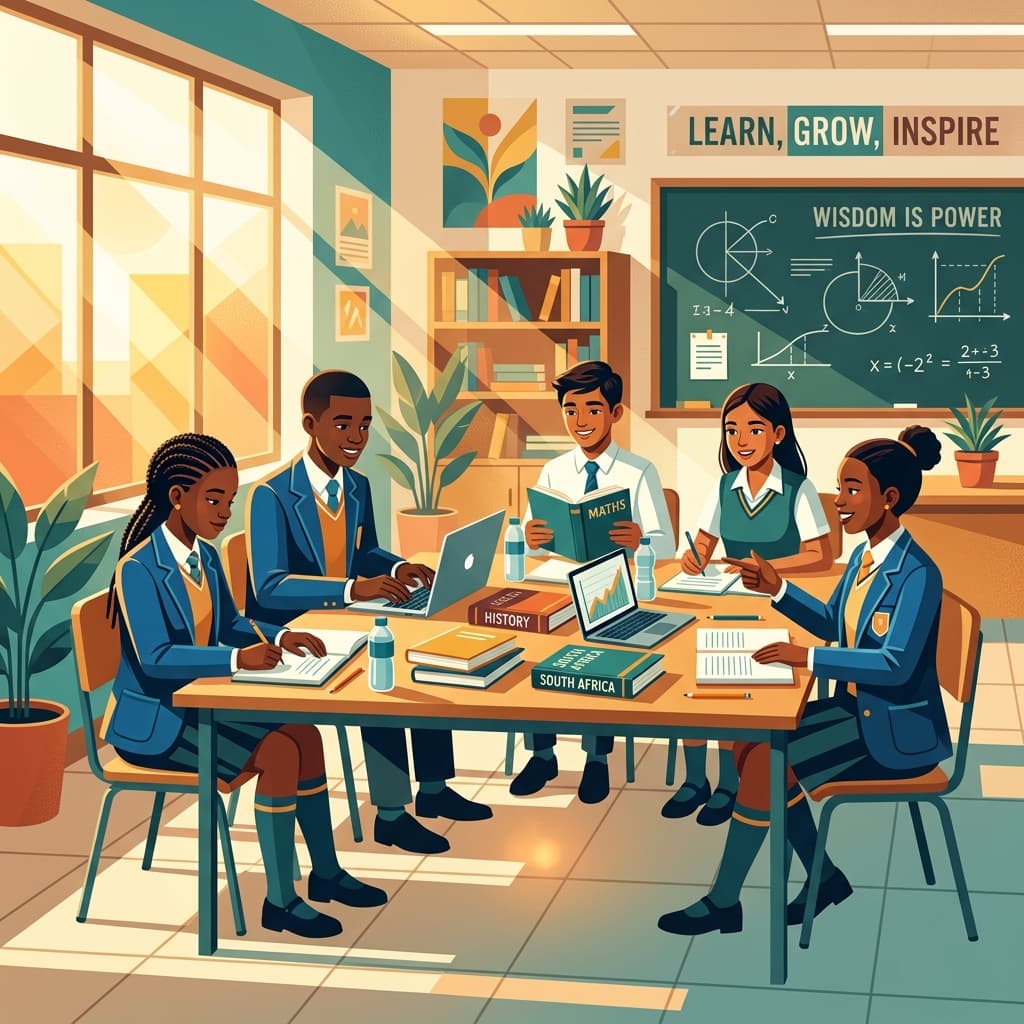
A Teacher's Guide to Implementing Project-Based Learning (PBL) within the South African CAPS Framework
As South African educators, we stand at a critical crossroads. We are tasked with delivering the comprehensive and demanding CAPS curriculum, yet we see learners who are often disengaged, struggling to connect abstract knowledge with the vibrant, complex world outside our classroom walls. We diligently follow the Annual Teaching Plan (ATP), prepare for standardised tests, and manage our School-Based Assessment (SBA) tasks, but a persistent question lingers: Are we truly equipping our learners with the skills they need to thrive in the 21st-century South African economy?
The answer lies in a pedagogical shift—a move away from rote memorisation and towards authentic, inquiry-driven learning. This is the promise of Project-Based Learning (PBL), a dynamic instructional approach that empowers students to gain knowledge and skills by working for an extended period to investigate and respond to an authentic, engaging, and complex question, problem, or challenge.
But for many dedicated South African teachers, HODs, and school principals, the immediate response is one of practical concern: "This sounds wonderful, but how on earth do I fit Project-Based Learning into the rigid, content-heavy CAPS framework?"
This comprehensive guide is designed to answer that exact question. We will demystify PBL and provide a practical, actionable blueprint for integrating this powerful methodology directly into your existing CAPS planning, from the Foundation Phase right through to the FET Phase. This is not about adding another burden to your workload; it’s about transforming how you deliver the curriculum you are already required to teach.
Demystifying Project-Based Learning for the South African Classroom
Before we can align PBL with CAPS, we need a shared understanding of what it truly is. It's a term often misunderstood and misapplied, so let's clarify.
What is Authentic PBL (and What it Isn't)?
Authentic Project-Based Learning is not the "dessert project"—the fun diorama or poster made at home after the "real learning" has happened in class. In a PBL classroom, the project is the vehicle for learning. It is the main course, not the after-thought.
PBL is NOT:
- A once-off, fun activity disconnected from the curriculum.
- A set of step-by-step instructions for students to follow to create an identical end product.
- An unstructured "free-for-all" where the teacher takes a backseat.
- A project assigned as homework with no in-class support or scaffolding.
Authentic PBL IS:
- Curriculum-Centred: It is built around the core knowledge, concepts, and skills outlined in your CAPS document.
- Inquiry-Based: It starts with a meaningful, open-ended "Driving Question" that sparks curiosity and creates a need to know.
- Authentic: The project has a real-world context, addresses a genuine problem, and has a purpose beyond a mark in the teacher's file. The final product is often shared with a public audience.
- Student-Led: It fosters student voice and choice, allowing learners to make decisions about their work process and final product.
- Collaborative: Learners work in teams, developing crucial communication, teamwork, and conflict-resolution skills.
- Feedback-Driven: The process involves cycles of feedback and revision, from both peers and the teacher, to improve the quality of the work.
Why PBL is a Game-Changer for CAPS Learners
The National Curriculum Statement Grades R-12, the foundation of CAPS, aims to produce learners who are able to: "identify and solve problems and make decisions using critical and creative thinking" and "work effectively as individuals and with others as members of a team."
This is the very heart of Project-Based Learning. While traditional teaching methods can sometimes fall short of these goals, PBL is explicitly designed to cultivate them. By engaging in well-structured projects, South African learners develop the critical 21st-century skills—the 4Cs—that employers and tertiary institutions demand:
- Critical Thinking: Analysing information, evaluating sources, and solving complex problems.
- Collaboration: Working effectively in diverse teams to achieve a common goal.
- Creativity: Generating innovative ideas and solutions.
- Communication: Articulating thoughts and ideas clearly and persuasively, both orally and in writing.
PBL bridges the gap between the CAPS content we must teach and the real-world competencies our learners must develop.
The Blueprint: Aligning PBL with the CAPS Framework
The secret to successful PBL implementation is not to see it as separate from CAPS, but as a framework for delivering CAPS. The process begins not with a cool project idea, but with your CAPS documents and your ATP. This "backward design" approach ensures every project is academically rigorous and curriculum-aligned.
Step 1: Unpack Your CAPS Document
Before you even think about a project, select a term or a significant chunk of your Annual Teaching Plan. Let's use a concrete example: Grade 7 Social Sciences (History), Term 2: The Mineral Revolution in South Africa.
Identify Core Concepts and Content: Go through the CAPS document for this topic. List the non-negotiable content knowledge learners must acquire.
- Discovery of diamonds and gold.
- Britain's annexation of the diamond fields.
- Deep-level mining.
- The formation of De Beers Consolidated Mines.
- Migrant labour system, compounds, and the pass system.
- The changing balance of power in Southern Africa.
Identify Key Skills: What does CAPS require learners to do with this knowledge?
- Analyse sources (written and visual).
- Explain cause and effect.
- Understand different perspectives.
- Construct historical arguments.
- Present information.
You now have your learning targets. The project's purpose will be to teach and assess these specific content points and skills.
Step 2: Integrate Across Subjects for Deeper Learning
The power of PBL is magnified when you break down the silos between subjects. A single project can cover multiple learning areas, making it a highly efficient way to cover the curriculum.
Continuing with our Mineral Revolution example, how could we integrate?
Lesson Planner
Generate comprehensive, CAPS-aligned lesson plans in seconds.
- English (Home Language/FAL): Research skills, writing informative texts (e.g., a museum plaque), preparing and delivering an oral presentation, persuasive writing (e.g., a letter from a migrant worker's perspective).
- Mathematics: Calculating distances, creating timelines to scale, basic data handling on population growth in Kimberley or Johannesburg.
- Economic and Management Sciences (EMS): Concepts of supply and demand, monopoly (De Beers), labour, and capital.
- Creative Arts: Designing a visual exhibit, creating dramatic representations of historical events.
By mapping these connections, you're not adding work; you are combining the work of multiple subjects into one cohesive, meaningful experience. This requires collaboration with your fellow teachers and HODs, but the payoff in learner engagement and efficient use of time is immense.
Step 3: Craft a Powerful Driving Question
The Driving Question is the engine of the project. It converts the CAPS content into a compelling challenge. It must be open-ended, engaging, and require critical thinking—not a quick Google search.
- Weak Question (Googleable): "When were diamonds discovered in South Africa?"
- Strong Driving Question: "How can we, as junior historians, create a museum exhibit for our school that tells the real story—both the triumphs and the tragedies—of the Mineral Revolution for all the people of South Africa?"
This question immediately sets a context (we are junior historians), defines the final product (a museum exhibit), specifies the audience (our school), and demands a nuanced, multi-perspective approach that directly addresses the CAPS content.
More South African Driving Question Examples:
- Grade 5 Natural Sciences & Technology: "How can we design and propose a system to capture and reuse greywater at our school to help combat local water shortages?"
- Grade 9 English & Life Orientation: "How can we create a powerful social media campaign to raise awareness among our peers about the dangers of cyberbullying and promote a safer online school community?"
- Grade 11 Mathematical Literacy & Business Studies: "How can we develop a comprehensive business plan and budget for a tuck shop that sells healthy, affordable food to students while still making a profit?"
A Practical Walkthrough: The Phases of a CAPS-Aligned PBL Unit
Once you have your CAPS targets and your Driving Question, the project unfolds in a structured sequence. The teacher's role shifts from a "sage on the stage" to a "guide on the side," facilitating learning, providing resources, and asking probing questions.
Phase 1: Launch the Project with an "Entry Event"
Start with a bang to generate excitement and a "need to know." This could be a guest speaker (e.g., a local historian), a compelling video, a field trip (even a virtual one), or a provocative reading that introduces the problem or challenge. For our Mineral Revolution project, it could be a collection of powerful historical photos showing the stark contrast between the lives of mine owners and migrant workers.
Phase 2: Build Knowledge and Skills
This is where direct instruction, textbook work, and traditional teaching methods have their place. Learners can't answer the Driving Question without foundational knowledge. This phase involves:
- Teacher-led lessons on key concepts from the CAPS curriculum.
- Workshops on specific skills (e.g., how to analyse a primary source, how to write a formal report, how to use presentation software).
- Shared readings, research using provided resources, and class discussions. This learning is "just-in-time," not "just-in-case." Learners are more motivated because they need this information to complete their project.
Phase 3: Develop, Critique, and Revise
Learners, working in their collaborative teams, begin to develop their final product. This phase is messy, iterative, and absolutely crucial. The teacher's role is to facilitate a culture of constructive feedback.
- Prototypes and Drafts: Encourage students to create early versions of their work.
- Peer Feedback: Use protocols (like "I like, I wonder, What if...") to teach students how to give and receive kind, helpful, and specific feedback.
- Teacher Conferencing: Meet with groups to check for understanding, address misconceptions, and push their thinking deeper.
Phase 4: Assessment and The Role of the SBA
Assessment in PBL is ongoing. It is not just a single mark at the end. You are assessing the process as much as the product.
- Formative Assessment: This happens daily through observations, questioning, and checking drafts. This is assessment for learning.
- Summative Assessment (The SBA Link): The final project product can, and should, be a formal School-Based Assessment task. The key is to design a clear rubric before the project starts. This rubric should be shared with learners so they understand the expectations.
A CAPS-Aligned Rubric should assess:
- Content Knowledge (from CAPS): Does the museum exhibit accurately explain the impact of the migrant labour system? Is the historical information correct?
- Key Skills (from CAPS): Does the project demonstrate the ability to analyse sources? Is the written work well-structured?
- 21st-Century Skills: How well did the team collaborate? How creative and engaging is the final product?
You can also design smaller project milestones to serve as individual SBA tasks throughout the unit, ensuring you gather enough evidence for your assessment portfolio.
Phase 5: Present the Final Product
The project culminates in a public presentation. This raises the stakes and makes the work authentic. The "public" doesn't have to be the whole world. It could be:
- Another class in the same grade.
- The school management team or HOD.
- Parents and community members.
- Presenting to a panel of "expert" judges (other teachers).
For our History project, this would be the official "opening" of the museum exhibit, where groups act as docents, guiding visitors through their section and answering questions.
Overcoming Hurdles in the South African Classroom
PBL is not a magic bullet, and implementing it in the context of South African schools comes with unique challenges. But these are obstacles to be managed, not barriers that make it impossible.
The Challenge of Large Classes
Managing 40+ learners in a PBL environment requires structure.
- Assign Clear Roles: Within each group, assign roles like Project Manager, Resource Collector, Quality Controller, and Spokesperson. Rotate these roles for different projects.
- Use Visible Checklists: Have clear, publicly displayed checklists for tasks so groups can manage their own progress.
- Establish Routines: Create clear routines for group work, asking for help, and managing noise levels.
The Challenge of Limited Resources
Authenticity does not require expensive technology. Some of the most powerful projects are low-tech.
- Leverage the Community: The community is your greatest resource. Invite local experts to speak. Have learners interview their grandparents or community elders.
- Use Recycled Materials: Challenge learners to build prototypes and models using recycled and found objects.
- Focus on Performance: A powerful play, a debate, a spoken-word poem, or a community presentation requires little more than human ingenuity.
The Challenge of the Paced ATP
The fear of "not covering the curriculum" is the biggest hurdle for most teachers. The key is to shift your mindset: a well-designed, integrated PBL unit covers more CAPS content more deeply and efficiently than a series of disconnected lessons. By integrating subjects, you are tackling multiple ATPs at once. Start small—replace just one traditional unit per term with a PBL unit. Document meticulously how you have covered the required CAPS content and skills.
The First Step on Your PBL Journey
Implementing Project-Based Learning within the CAPS framework is not about abandoning what you know. It's about enhancing it. It’s about honouring the professional judgment of you, the teacher, to design learning experiences that are rigorous, relevant, and profoundly engaging for your learners.
Start small. Choose one topic in one term. Find a colleague to plan with. Use the CAPS documents as your foundation and build from there. Be prepared for it to be a little chaotic, but also be prepared to witness a level of engagement, critical thinking, and ownership from your learners that you may have never seen before.
By embracing PBL, you are not just teaching the CAPS curriculum; you are bringing it to life. You are empowering the next generation of South African leaders, innovators, and problem-solvers with the skills and mindset they need to build a better future. The journey begins with a single, powerful question.
Tyler. M
Dedicated to empowering South African teachers through modern AI strategies, research-backed pedagogy, and policy insights.