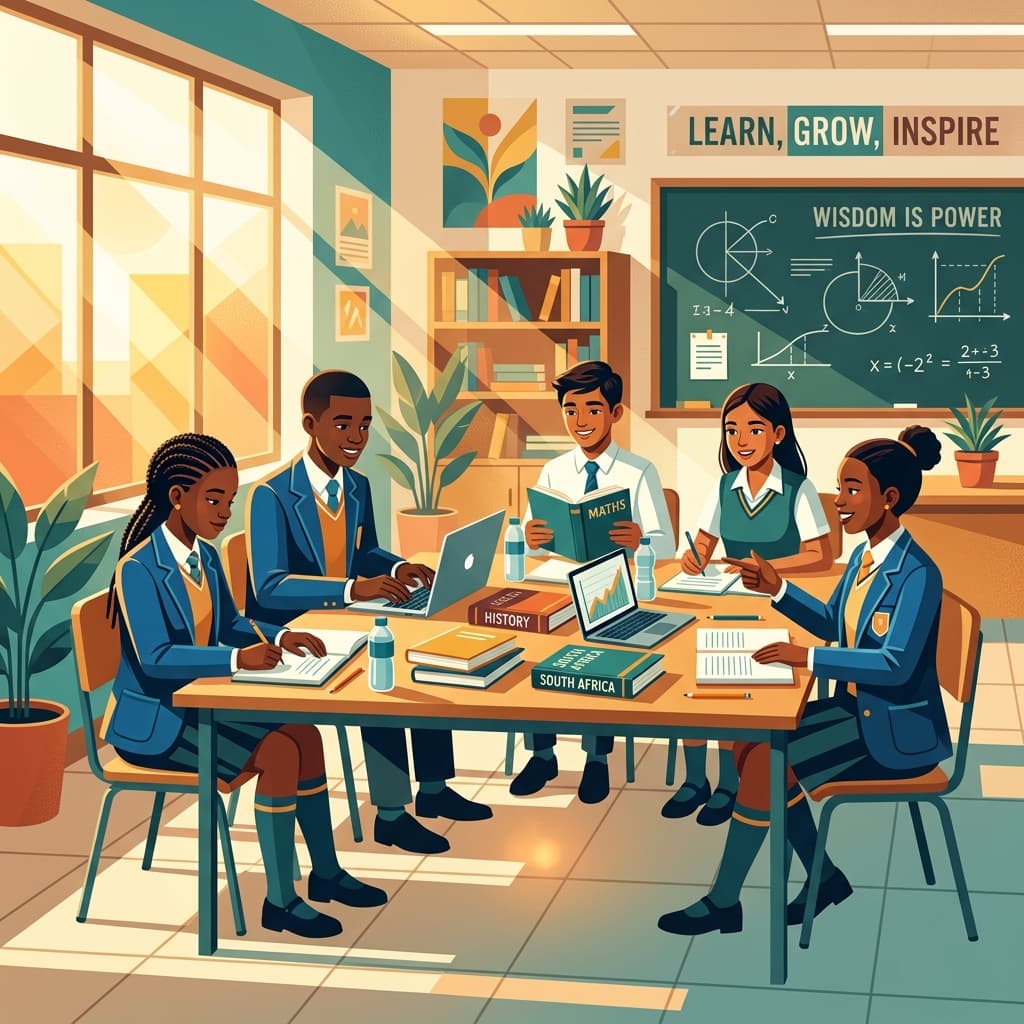
Beyond the Chaos: Collaborative Learning Techniques for Crowded South African Classrooms
The bell rings, and the daily reality for thousands of South African teachers begins. It’s the challenge of the crowded classroom: a sea of 40, 50, even 60 young faces looking back at you. In this environment, the traditional "chalk and talk" method feels like the only manageable approach. But we know, deep down, that it's not enough. It doesn't foster the critical thinking, problem-solving, and interpersonal skills mandated by our own CAPS curriculum and demanded by the 21st-century workplace.
So, what’s the alternative? The answer lies in a powerful, often misunderstood strategy: collaborative learning.
For many educators grappling with large class sizes and limited resources, the phrase "group work" can trigger anxiety. Visions of chaos, unmanageable noise, and learners off-task are common fears. But what if we reframed this? What if structured, purposeful collaborative learning was not the cause of chaos, but the solution to managing it?
This comprehensive guide is designed for the South African teacher, Head of Department (HOD), and School Management Team (SMT) member on the ground. We will unpack practical, high-impact collaborative learning techniques that are not just theoretical ideals but have been proven to work within the unique constraints and incredible potential of our nation's classrooms.
Why Collaborative Learning is a Necessity, Not a Luxury, in the South African Context
Before we dive into the "how," it's crucial to understand the "why." In a resource-strained educational landscape, every strategy must justify its place. Collaborative learning isn't just a progressive trend; it's a pedagogical powerhouse perfectly suited to our needs.
Aligning Directly with the CAPS Curriculum
The Curriculum and Assessment Policy Statement (CAPS) is more than a list of topics to be covered. Its core principles are deeply rooted in active, learner-centred education. CAPS documentation repeatedly calls for learners to:
- Identify and solve problems using critical and creative thinking.
- Work effectively with others as members of a team, group, organisation, and community.
- Communicate effectively using visual, symbolic, and/or language skills in various modes.
These are not skills that can be developed by passively listening to a lecture. They are forged in the dynamic interplay of discussion, debate, and joint problem-solving. Structured collaborative learning is the most direct and effective vehicle for bringing the foundational principles of the CAPS curriculum to life in your classroom.
Developing Critical 21st-Century Skills for the Economy
Our learners will graduate into a world that values collaboration, communication, and adaptability above rote memorisation. The South African economy, like the global one, needs innovators and team players. By making collaboration a daily practice, we are providing learners with essential "soft skills" that will directly impact their future employability and contribution to society. They learn to negotiate, to articulate their ideas, to listen to differing viewpoints, and to synthesise information collectively—all vital competencies.
Managing Classroom Dynamics and Engagement
This may seem counterintuitive, but a well-structured collaborative classroom can be easier to manage than a large, disengaged lecture-style class. Here’s why:
- Shift in Role: The teacher moves from being the "sage on the stage" (the sole source of information) to the "guide on the side" (a facilitator of learning). This allows you to circulate, listen in on conversations, address misconceptions in smaller groups, and provide targeted support where it's needed most.
- Positive Peer Pressure: In a functional group, learners hold each other accountable. The desire to contribute to the team's success can be a powerful motivator for learners who might otherwise switch off.
- Channeling Energy: Learners, by nature, are social beings. Collaborative tasks channel their social energy into productive, curriculum-focused activity, reducing the likelihood of disruptive, off-topic chatter.
Fostering Inclusivity and the Spirit of Ubuntu
Our classrooms are a microcosm of our diverse nation. They are filled with learners from different linguistic, cultural, and socio-economic backgrounds, with a wide range of learning abilities. Collaborative learning, when implemented thoughtfully, embodies the principle of Ubuntu – "I am because we are." It breaks down social barriers, encourages empathy, and teaches learners that everyone has something valuable to contribute. Stronger learners solidify their own understanding by explaining concepts to their peers, while learners who are struggling gain support from multiple sources, not just the teacher.
The Foundation: Setting the Stage for Successful Collaboration
You cannot simply announce "get into groups" and expect magic to happen. Success in a crowded collaborative classroom is built on a foundation of clear structures and explicit teaching of collaborative skills.
Establishing Clear Norms and Expectations
Before you launch your first collaborative task, you must co-create a "social contract" for group work with your learners. This involves a whole-class discussion to establish the rules of engagement.
Key areas to cover:
- Voice Levels: What does a productive "buzz" sound like versus disruptive noise? You can create a visual chart (e.g., Level 0: Silence, Level 1: Whisper, Level 2: Table Talk, Level 3: Presentation Voice).
- Participation: Everyone contributes. No passengers allowed.
- Listening: We listen respectfully to each other's ideas, even if we disagree.
- Help-Seeking: First, "Ask 3 Before Me." Learners should consult their group members for clarification before raising their hand for the teacher. This builds independence and reduces your workload.
- Movement: When is it acceptable to move around the classroom, and what is the procedure?
Post these norms visibly in the classroom and refer to them constantly until they become second nature.
The Art of Group Formation in a Full Class
Lesson Planner
Generate comprehensive, CAPS-aligned lesson plans in seconds.
How you group learners is a critical strategic decision.
- Teacher-Selected Groups (Highly Recommended): For most tasks, especially in a large class, this is the best approach. It allows you to create mixed-ability, heterogeneous groups. This ensures each group has a blend of skills, preventing the formation of "super groups" and groups that will struggle without support.
- Random Grouping (For Quick Tasks): Use methods like numbering off (all the 1s together, 2s together, etc.) or handing out different coloured cards for quick, low-stakes activities like a Think-Pair-Share.
- Learner-Selected Groups (Use Sparingly): While it can be good for motivation, this often leads to social clustering and off-task behaviour. Reserve this for more long-term, passion-based projects where group synergy is paramount.
Defining Roles Within Groups
Assigning specific roles is the single most effective strategy for ensuring individual accountability and preventing "social loafing." Roles ensure that every member has a clear responsibility.
Essential Roles for Any Group:
- Facilitator/Chairperson: Ensures everyone is on task, encourages participation from all members, and keeps the group focused on the objective.
- Scribe/Recorder: Writes down the group's main ideas, answers, or plans. This is the only person who holds the pen for the final product.
- Resource Manager/Getter: The only person allowed to leave the group to collect materials (e.g., textbooks, chart paper, scissors) or to ask the teacher a question on behalf of the group.
- Reporter/Spokesperson: Shares the group's findings with the rest of the class.
- Timekeeper: Keeps an eye on the clock and ensures the group completes the task within the allocated time.
Rotate these roles regularly so that all learners get to practice different skills.
High-Impact, Low-Prep Collaborative Techniques for Any Subject
Here are four powerful, field-tested techniques that are perfectly suited for the realities of crowded South African classrooms.
Technique 1: Think-Pair-Share
This is the foundational collaborative strategy. It's simple, quick, and can be used multiple times in a single lesson to break up teacher talk and check for understanding.
- What It Is: A three-step process where learners first think individually about a prompt, then discuss their thoughts with a partner, and finally, some pairs share their ideas with the whole class.
- Why It Works in Large Classes: It involves every single learner simultaneously. In a class of 50, a traditional "hands-up" approach might engage 2-3 learners. Think-Pair-Share engages all 50. It requires minimal movement and is very easy to manage.
- Step-by-Step Guide:
- Think (30-60 seconds): Pose a high-order question. For example, in a Grade 8 History class studying the Mineral Revolution, you might ask, "What was one long-term social consequence of the discovery of diamonds in Kimberley?" Instruct learners to think silently. This wait time is critical.
- Pair (1-2 minutes): Ask learners to turn to their pre-assigned "elbow partner." They then take turns sharing their thoughts. This makes it safe for shy learners to voice their ideas in a low-stakes setting.
- Share (2-3 minutes): Use a random selection method (like pulling a name from a cup) to call on a few pairs to share their combined ideas with the class. This keeps everyone accountable, as anyone could be called upon.
Technique 2: The Jigsaw Method
The Jigsaw method is a more advanced strategy, but it is incredibly effective for covering large amounts of CAPS content efficiently while promoting deep understanding and interdependence.
- What It Is: The class is divided into "home groups." Each member of the home group is assigned a different piece of the topic to become an "expert" on. They then meet with members from other groups who have the same piece (in "expert groups") to study it together. Finally, they return to their "home group" to teach their piece to the other members.
- Why It Works in Large Classes: It breaks down a large topic into manageable chunks. It creates individual accountability—the home group cannot succeed unless every "expert" does their job. It also transforms learners into teachers, which is a powerful way to consolidate learning.
- Step-by-Step Guide:
- Form Home Groups: Divide your class into groups of 4-5 learners. Let's say you're a Grade 10 Life Sciences teacher covering Ecosystems.
- Assign Expert Topics: Within each home group, assign each member a different sub-topic: Learner A gets "Biotic Factors," Learner B gets "Abiotic Factors," Learner C gets "Food Chains & Food Webs," and Learner D gets "Energy Flow."
- Move to Expert Groups: Have all the 'A's from across the classroom meet in one corner, all the 'B's in another, and so on. These are the "expert groups." Provide them with the relevant textbook pages or a worksheet. Their job is to master their sub-topic together and plan how they will teach it.
- Return to Home Groups: Learners return to their original home groups. Each "expert" now takes a turn to teach their sub-topic to the rest of their group.
- Assess: Give a quiz or a short task that covers all the sub-topics. The individual's success is tied to the quality of their group's teaching.
Technique 3: Numbered Heads Together
This strategy is fantastic for review and for ensuring that every member of the group not only knows the answer but can also explain it.
- What It Is: Learners are in groups, and each member is given a number (1, 2, 3, 4). The teacher poses a question. The group works together to ensure everyone knows the answer. The teacher then randomly calls out a number, and only the learners with that number can answer for their group.
- Why It Works in Large Classes: It combines positive group interdependence with individual accountability. Since learners don't know which number will be called, they all have a vested interest in making sure everyone in their group understands the material.
- Step-by-Step Guide:
- Group and Number: Place learners in groups of 4 and have them number off 1 to 4.
- Pose a Question: Ask a question that requires some thought, for example, in a Grade 7 EMS class: "Explain the difference between a need and a want, and give two examples of each."
- Heads Together: Instruct the groups to "put their heads together" and formulate an answer. Emphasise that their goal is not just to find the answer, but to ensure everyone in the group can confidently explain it.
- Call a Number: After a minute or two, say "All the number 3s, stand up."
- Answer: Randomly select one of the standing number 3s to provide the answer on behalf of their group.
Technique 4: Gallery Walk
A Gallery Walk gets learners moving and interacting with each other's work in a structured way. It is excellent for sharing ideas, providing peer feedback, and synthesising information.
- What It Is: Groups create a poster or a written response to a prompt. These are displayed around the classroom. Groups then circulate the room, observing the other groups' work, and can leave comments or questions on sticky notes.
- Why It Works in Large Classes: It's an organised way to manage movement. Even in a packed classroom, you can have half the class circulate while the other half stays at their station to explain their work, then switch. It promotes active engagement and makes thinking visible.
- Step-by-Step Guide:
- Create Artifacts: Put learners in groups and give them a task that results in a visual product. For instance, in a Grade 11 English class, each group could analyse a different stanza of a poem and write their analysis on a large sheet of paper.
- Display: Have groups post their work on the classroom walls (or place it on their desks if wall space is limited).
- Walk and Comment: Give each group a stack of sticky notes. They then move from one station to the next, reading the other groups' work and leaving a "Glow" (a positive comment) and a "Grow" (a constructive question or suggestion) on a sticky note.
- Debrief: Learners return to their own work and read the feedback. You can then facilitate a whole-class discussion about common themes or interesting points that were raised.
A Call to Action for School Leadership: HODs and SMTs
For collaborative learning to become truly embedded in a school's culture, teacher effort must be supported by school leadership.
- Prioritise Professional Development: Don't just tell teachers to use collaborative learning; show them how. Organise practical, hands-on workshops where teachers can experience these techniques as learners themselves.
- Foster a Culture of Collaboration: Encourage teachers to collaborate in their own planning. Phase meetings and subject meetings should be models of effective collaboration.
- Rethink Assessment Policies: How can your school's assessment policy reward and recognise collaborative skills? Consider incorporating marks for group projects that include both a product mark and a process/participation mark based on peer- and self-evaluation.
- Support with Resources: Even small changes, like providing chart paper, markers, and sticky notes, can make a huge difference. Advocate for flexible furniture arrangements where possible.
Conclusion: From Crowded Classrooms to Collaborative Communities
The crowded South African classroom is not a barrier to effective teaching; it is the very context that demands it. By shifting our mindset and equipping ourselves with structured, practical collaborative learning techniques, we can transform our classrooms from spaces of passive reception into vibrant hubs of active learning.
These strategies are not a magic bullet, and they require practice, patience, and preparation. But the payoff is immense. We see deeper engagement, improved academic outcomes, the development of essential life skills, and a classroom culture that reflects the very best of our nation's spirit of community and shared success. Let's embrace the organised buzz of collaboration and unlock the incredible potential that sits in every one of our crowded, wonderful classrooms.
Tyler. M
Dedicated to empowering South African teachers through modern AI strategies, research-backed pedagogy, and policy insights.