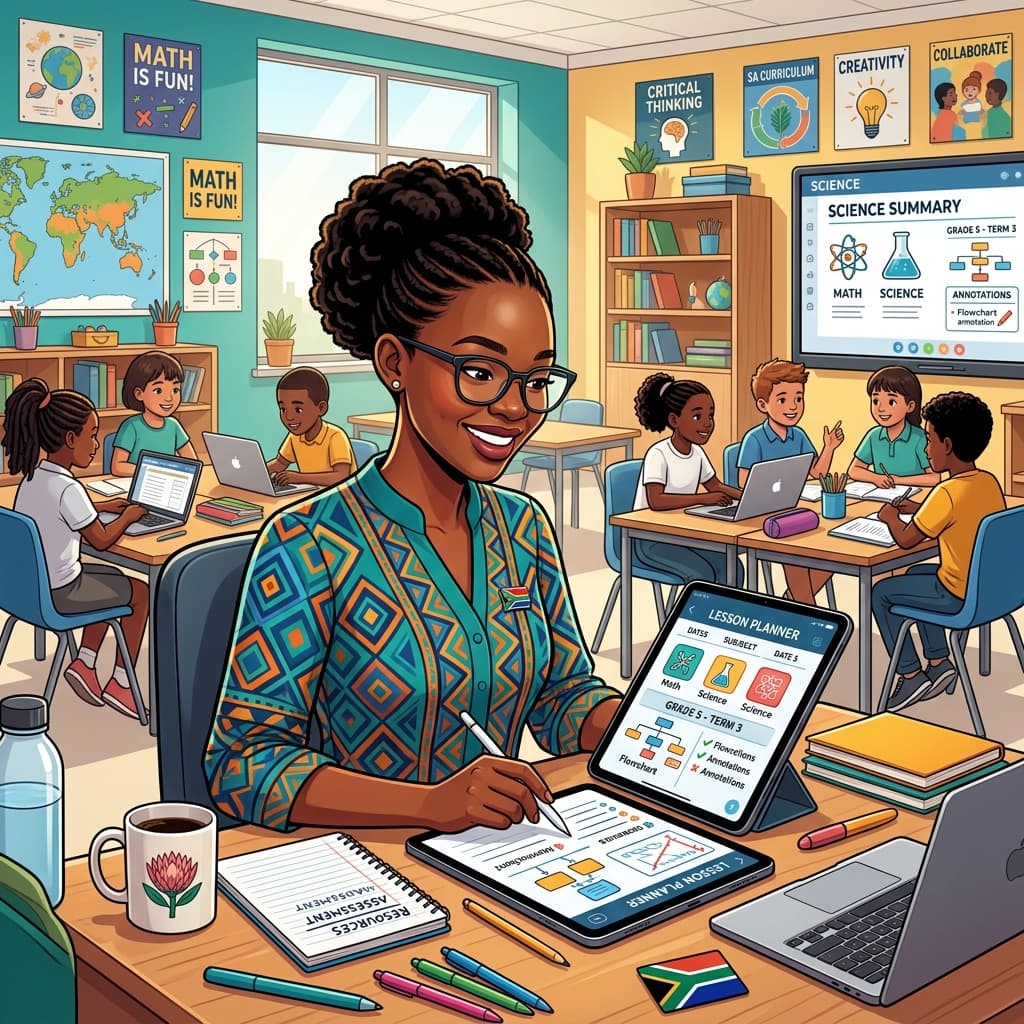
But digital literacy for teachers is about far more than just knowing how to operate a laptop or navigate a PowerPoint presentation. It is about a fundamental shift in pedagogy—a movement towards using technology to enhance critical thinking, streamline administrative heavy lifting, and provide personalised support to learners who come from vastly different socio-economic backgrounds.
In today’s South African context, where Annual Teaching Plans (ATPs) are packed and classroom sizes are often large, digital literacy is not a luxury; it is a survival skill. It is the bridge between being an overwhelmed educator and being an empowered facilitator of 21st-century learning.
Defining Digital Literacy in the CAPS Context
Before we dive into the "why," we must clarify what digital literacy means for a South African educator. It is the ability to find, evaluate, create, and communicate information through various digital platforms. In the context of our schools, this includes:
- Instructional Literacy: Using digital tools to deliver the CAPS curriculum more effectively.
- Administrative Literacy: Using software to manage marks, attendance, and the dreaded "admin load" that often leads to teacher burnout.
- Data Literacy: Understanding how to interpret learner performance data to intervene where necessary.
- AI Literacy: The newest and perhaps most transformative frontier—knowing how to use Artificial Intelligence to automate routine tasks.

Reducing the Administrative Burden: The Time-Saving Power of Literacy
One of the most significant challenges cited by South African teachers is the sheer volume of administrative work. Between meeting the requirements of School Management Teams (SMTs) and ensuring every line of the ATP is covered, teachers are left with very little time for actual teaching or lesson preparation.
This is where digital literacy changes the game. A digitally literate teacher knows that they don't have to start from scratch every Sunday evening.
Streamlining Lesson Planning
Traditionally, lesson planning involved hours of manual typing, aligning objectives with CAPS, and scouring old textbooks for relevant examples. By leveraging the CAPS-Aligned Lesson Planner on sateachers.co.za, a teacher can generate a comprehensive, compliant lesson plan in minutes. Digital literacy allows you to input the specific requirements of your grade and subject—whether it’s Grade 4 Mathematics or Grade 12 Life Sciences—and receive a structured plan that follows the correct pedagogical flow (Introduction, Body, Conclusion, and Assessment).
Automated Assessment Creation
Assessment is the backbone of the South African schooling system. However, creating high-quality tests and exams that adhere to the correct cognitive levels (Bloom’s Taxonomy as required by CAPS) is incredibly time-consuming.
A teacher with strong digital literacy skills understands how to use a Worksheet & Exam Generator. Instead of spending an entire weekend drafting a formal assessment for Term 3, you can use AI to generate questions based on specific topics, complete with a professional memorandum. This doesn't just save time; it ensures that your assessments are standardised and rigorous.
Enhancing Learner Engagement and Personalisation
Our classrooms are not homogenous. In a single FET phase classroom, you might have learners who are ready for university-level challenges alongside those who are still struggling with foundational concepts.
The Role of the AI Tutor
Digital literacy enables teachers to introduce "blended learning." When a teacher understands how to deploy an AI Tutor, they effectively provide each student with a personal teaching assistant. For example, during a revision period for Grade 11 Physics, learners can interact with an AI-powered tutor that explains the laws of motion in different ways until the learner understands. This frees the teacher to move around the room and assist the learners who are most in need of one-on-one intervention.
Customised Study Material
We know that not every learner can afford expensive supplementary study guides. A digitally literate teacher can bridge this inequality gap by using the Study Guide Creator. By taking the core concepts covered in class and transforming them into a concise, easy-to-digest study booklet, you ensure that every learner—regardless of their home circumstances—has the tools they need to pass their exams.
The Crisis of Assessment: Solving the Marking Backlog
If there is one thing that causes South African teachers more stress than anything else, it is marking. Large class sizes mean that a single English FAL teacher might have 150 to 200 essays to mark in a single cycle. This often leads to a delay in feedback, which is detrimental to learner progress.

Real Classroom Scenario: The Grade 9 Natural Sciences Teacher
Let’s look at a practical example of how these skills manifest in a South African classroom.
Mrs. Khumalo teaches Grade 9 Natural Sciences. She has four classes of 45 learners each. Her ATP requires her to cover "Cells as the Basic Units of Life" within a specific two-week window.
Without Digital Literacy: Mrs. Khumalo spends her Sunday night drawing diagrams on posters because she doesn't have a projector. She spends three hours writing a test and another five hours hand-writing a memorandum. She stays up until 11 PM every night for a week marking 180 scripts. She is exhausted, and her lessons become uninspired.
With Digital Literacy and SA Teachers Tools:
- Planning: Mrs. Khumalo uses the CAPS-Aligned Lesson Planner to generate a 2-week block plan that includes creative activities and indigenous knowledge system (IKS) integration as required by the DBE.
- Resource Creation: She uses the Worksheet Generator to create three different versions of a quiz on cell structure—one for high achievers, one for the average learner, and one with more scaffolding for those who struggle.
- Support: She points her learners to an AI Tutor link (accessible via their parents' phones) so they can ask questions while studying at home.
- Reporting: When the term ends, she uses the Report Comments Generator to produce 180 unique, professional comments in under an hour.
The result? Mrs. Khumalo is not burnt out. Her learners are more engaged because her lessons are well-structured, and her assessments are fair and returned promptly.
Overcoming the "Technophobia" Barrier
It is natural to feel intimidated by the rise of AI and digital tools. Many educators fear that technology will replace them. However, the opposite is true. Technology cannot replace the empathy, the mentorship, and the cultural understanding that a South African teacher brings to the classroom.
Andile M.
Dedicated to empowering South African teachers through modern AI strategies, research-backed pedagogy, and policy insights.