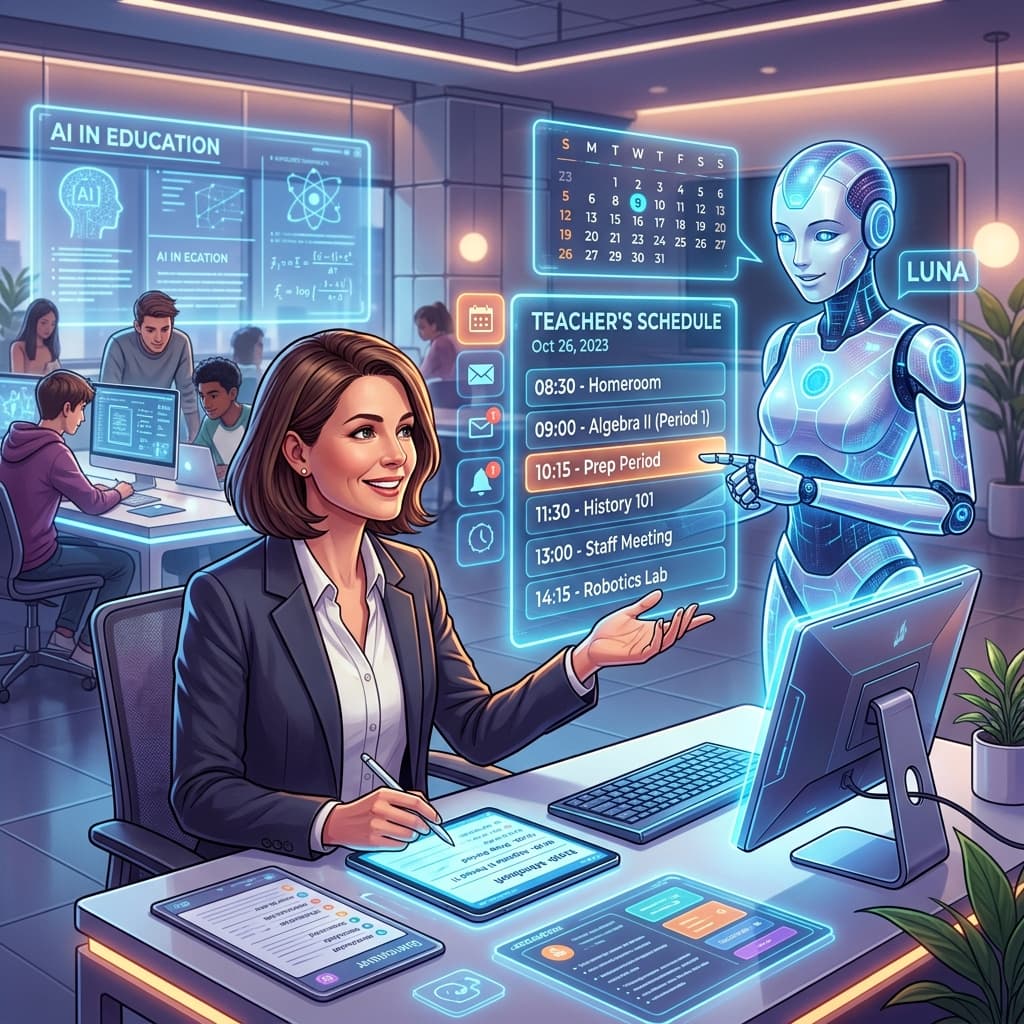
The Evolving Educator: Navigating the AI Revolution in South African Schools (Case Study 51)
The hum of artificial intelligence (AI) is no longer a distant echo; it’s a growing presence in our classrooms. As South African educators, we stand at a pivotal moment, tasked with understanding and integrating this transformative technology into our daily practice. This article, Case Study 51, delves into the evolving role of the educator in an AI-driven school, specifically within the South African context, focusing on how we can leverage AI to enhance, not replace, our crucial human-centric pedagogy, aligned with the CAPS curriculum and the realities of our diverse classrooms.
For many of us, the initial reaction to AI might be a mix of apprehension and curiosity. Will AI automate our jobs? Will it diminish the vital human connection we foster with our learners? As experienced educators who have navigated the complexities of South Africa’s unique educational landscape – from resource constraints to diverse linguistic backgrounds – we understand that AI’s true potential lies in its ability to augment our capabilities, freeing us to focus on what truly matters: cultivating critical thinking, creativity, and socio-emotional development.
AI as a Co-Pilot, Not a Replacement: Reimagining the Educator's Role
The fundamental role of the educator in South Africa, guided by the Curriculum and Assessment Policy Statement (CAPS), is to facilitate learning, assess understanding, and nurture well-rounded individuals. AI can act as a powerful co-pilot in this endeavor, empowering us to be more efficient, insightful, and responsive to the individual needs of our learners.
1. Personalised Learning Pathways: Tailoring to CAPS and Beyond
CAPS, while providing a robust framework, often presents challenges in fully catering to the diverse learning paces and styles within a single classroom. AI can revolutionise this.
- AI-powered assessment tools: Imagine AI analysing learner responses to quizzes or assignments, identifying specific areas of struggle within a CAPS topic. This allows us to intervene proactively, offering targeted support or enrichment activities. Instead of spending hours manually marking, we can receive instant feedback on common misconceptions, enabling us to adjust our next lesson plan.
- Adaptive learning platforms: These platforms can present content at a pace and difficulty level suited to each learner. For example, a learner struggling with fractions in Grade 5, as outlined in the CAPS Grade 5 Mathematics curriculum, could receive additional practice exercises and explanations, while a more advanced learner could be challenged with problem-solving tasks. This frees us to provide individualised guidance and support to those who need it most.
- Content differentiation: AI can help us generate differentiated learning materials. Need a simpler explanation of a science concept for a Grade 7 learner struggling with reading comprehension? AI can rephrase complex sentences or provide visual aids. Need extension activities for a Grade 10 learner excelling in Afrikaans? AI can suggest advanced vocabulary exercises or research prompts.
Practical Application for South African Teachers:
- Start small: Explore free AI tools designed for educators. Many platforms offer free trials or basic versions.
- Focus on a specific area: Don't try to implement AI across your entire curriculum at once. Choose one subject or a specific CAPS topic where you see the most potential for AI integration.
- Pilot with a small group: Experiment with AI-powered tools with a select group of learners before rolling them out to the whole class. Gather feedback from both learners and colleagues.
2. Streamlining Administrative Burdens: Reclaiming Teaching Time
South African teachers are often burdened with extensive administrative tasks. AI can significantly alleviate this, allowing us to dedicate more time to our core teaching responsibilities.
- Automated lesson planning assistance: While AI cannot replace our pedagogical expertise, it can act as a brainstorming partner. We can input CAPS learning objectives for a specific grade and subject, and AI can suggest lesson ideas, activities, and even assessment questions. This can be particularly helpful when planning for multi-grade classrooms or when time is scarce.
- Automated feedback on assignments (initial drafts): For subjects like English or Afrikaans, AI can provide preliminary feedback on grammar, spelling, and even basic sentence structure. This allows us to focus our feedback on higher-order skills like critical analysis, argumentation, and creative expression, which are essential for the CAPS curriculum.
- Resource curation: AI can help us quickly find relevant and up-to-date resources aligned with CAPS. Instead of sifting through numerous websites, we can ask AI to suggest videos, articles, or simulations for a particular topic.
Practical Application for South African Teachers:
- Leverage AI for lesson idea generation: When you’re stuck for inspiration or short on time, use AI to generate a range of activity ideas for your next CAPS lesson.
- Explore AI for initial grammar checks: If you’re teaching essay writing, consider using AI to provide students with initial feedback on mechanical errors, freeing you to focus on content and structure.
- Use AI to find supplementary resources: For challenging topics, ask AI to curate a list of diverse resources that align with the CAPS learning outcomes.
3. Fostering Critical Thinking and Digital Literacy: Preparing Learners for the Future
In an AI-driven world, our role shifts towards equipping learners with the skills to critically engage with AI, understand its limitations, and use it responsibly. This is a crucial aspect of preparing them for future careers and active citizenship, aligning with the transversal competencies embedded in the CAPS curriculum.
- Teaching about AI: We need to demystify AI for our learners. This involves explaining how AI works (at an age-appropriate level), discussing its ethical implications, and exploring its potential biases. This is not just about technology; it's about developing informed citizens.
- Prompt engineering for learners: As AI becomes more prevalent, the ability to effectively communicate with AI (prompt engineering) will become a valuable skill. We can guide learners on how to formulate clear and specific prompts to get the desired information or output from AI tools, fostering their critical thinking and problem-solving abilities.
- Evaluating AI-generated content: Learners must learn to critically assess information generated by AI. Is it accurate? Is it biased? Does it cite its sources? This aligns directly with the CAPS emphasis on critical thinking and information literacy.
Practical Application for South African Teachers:
- Design activities that involve critiquing AI output: Give learners an AI-generated essay or summary and ask them to identify its strengths and weaknesses, comparing it to human-created work.
- Incorporate lessons on AI ethics: Discuss the societal impact of AI, including issues of data privacy and job displacement, in age-appropriate ways.
- Teach basic prompt engineering: Show learners how to ask better questions to AI tools to get more relevant and useful answers, linking it to effective research skills.
The Unwavering Importance of the Human Educator
While AI offers incredible potential, it cannot replicate the essential qualities that define a great educator: empathy, creativity, intuition, and the ability to build meaningful relationships. These are the cornerstones of effective teaching, especially in South Africa, where strong teacher-learner relationships are vital for academic success and personal growth.
- Emotional intelligence and mentorship: AI can provide data, but it cannot offer a reassuring word, a gentle nudge, or a celebration of a learner’s breakthrough. Our ability to connect with learners on an emotional level, understand their anxieties, and inspire them to reach their full potential remains irreplaceable.
- Cultivating creativity and collaboration: AI can generate content, but it is the educator who fosters an environment where learners feel safe to experiment, take risks, and collaborate with their peers. These are the skills that AI cannot replicate.
- Ethical guidance and character development: In a rapidly changing world, the moral compass we provide to our learners is more important than ever. We guide them in making ethical decisions, developing a sense of responsibility, and becoming compassionate members of society.
The Road Ahead: Embracing Change with Confidence
The integration of AI into our schools is not a question of "if," but "how." As South African educators, we have a unique opportunity to shape this integration, ensuring that it serves our learners and our nation’s educational goals. By embracing AI as a powerful tool to enhance our teaching, personalize learning, and prepare our learners for the future, while steadfastly upholding the human-centric values that define our profession, we can navigate this AI-driven era with confidence and continued impact. Our role is not diminishing; it is evolving into something even more vital and influential.
Siyanda M.
Dedicated to empowering South African teachers through modern AI strategies, research-backed pedagogy, and policy insights.