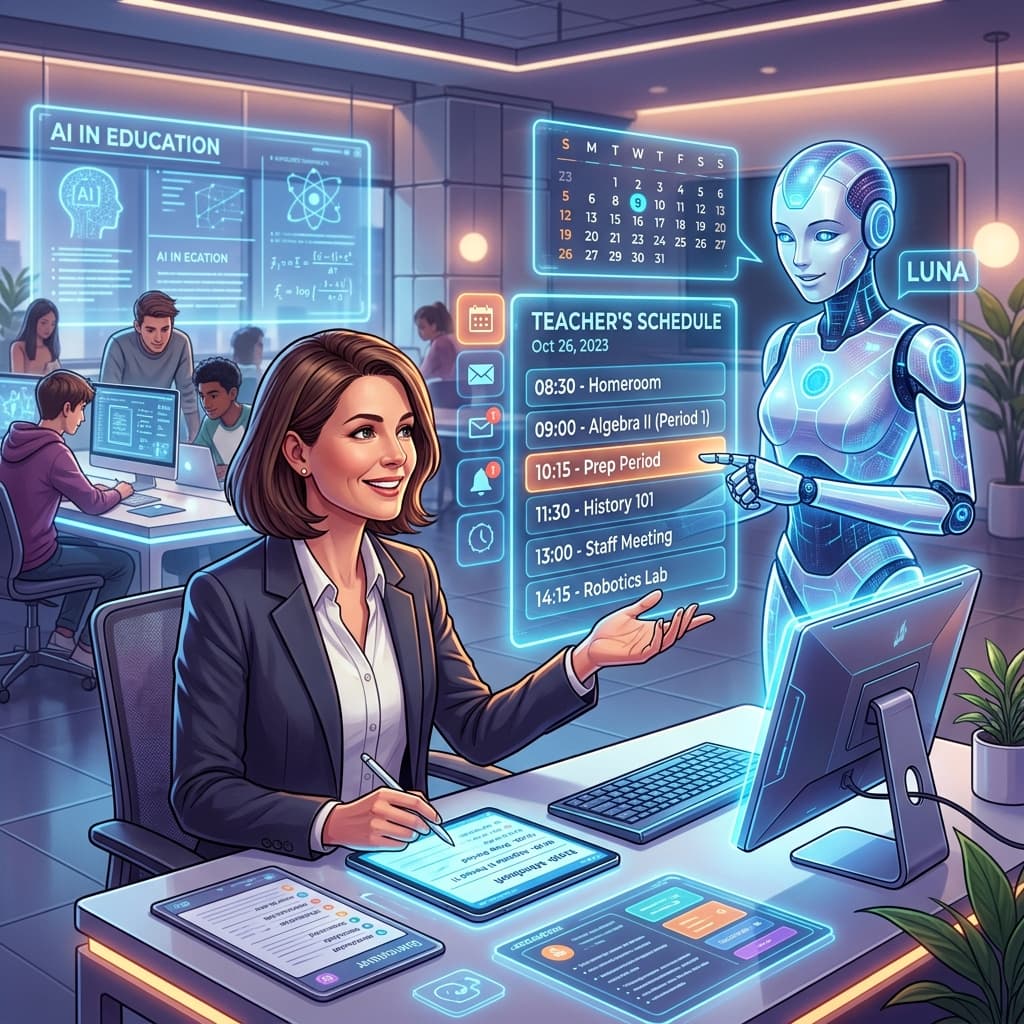
The Educator's Evolving Role in the AI-Driven South African School: Case Study 95
The digital revolution, powered by Artificial Intelligence (AI), is no longer a whisper in the wind; it's a palpable force reshaping industries, and education is not immune. For South African educators navigating the complexities of the CAPS curriculum across Grades R-12, the advent of AI in schools presents both exhilarating opportunities and significant questions. This article, drawing insights from our hypothetical "Case Study 95," delves into the indispensable role of the educator in this evolving landscape, offering practical guidance for our dedicated South African teachers.
Understanding the AI Landscape in South African Education
Before we explore the educator's role, it's crucial to contextualise AI's presence in South African schools. We are not talking about sentient robots leading classes tomorrow. Instead, AI is manifesting in several tangible ways:
- Personalised Learning Platforms: Adaptive learning software that adjusts content difficulty and pace based on individual student performance, offering targeted remediation or enrichment.
- Automated Assessment and Feedback Tools: AI-powered grading for objective questions, plagiarism detection, and even initial feedback on written assignments, freeing up teacher time for more qualitative analysis.
- Content Curation and Recommendation Engines: AI assisting in identifying relevant educational resources, lesson plan ideas, and supplementary materials aligned with CAPS objectives.
- Administrative Support: AI tools for managing timetables, student data, and communication, streamlining non-teaching burdens.
- Emerging AI Tutors (under careful supervision): Early stages of AI-powered tutors offering supplementary explanations and practice exercises, particularly for foundational subjects.
It’s vital to remember that in the South African context, access to these technologies can be uneven. Our focus remains on empowering educators to leverage AI where it’s available, and to anticipate its integration while upholding pedagogical principles.
Case Study 95: The Unseen Architects of Learning
"Case Study 95" focused on a diverse group of South African primary and secondary schools – some with cutting-edge tech infrastructure, others with more limited resources. Across all these settings, a consistent truth emerged: AI is not a replacement for the educator; it is a powerful tool, and the educator is its skilled operator.
The Educator as the Curator and Navigator of AI Tools
One of the primary roles AI thrusts upon educators is that of the curator and navigator. With a plethora of AI tools emerging, teachers are tasked with discerning which ones are pedagogically sound, aligned with CAPS, and genuinely beneficial for their learners.
- Practical Advice:
- Start small and experiment: Don't feel pressured to adopt every new AI tool. Select one or two that address a specific challenge (e.g., providing more differentiated practice in Mathematics for Grade 4 learners).
- Seek professional development: Attend workshops and webinars focused on educational AI. South African education bodies and tech providers are increasingly offering such training.
- Collaborate with colleagues: Share experiences and discoveries. What works for Ms. Nomsa in Cape Town might offer valuable insights for Mr. Patel in Pretoria.
- Prioritise CAPS alignment: Always ask: "Does this AI tool help me achieve the specific learning outcomes for this CAPS content area?"
The Educator as the Facilitator of Critical Thinking and Digital Literacy
As AI handles more of the rote tasks, the educator's role shifts towards fostering higher-order thinking skills. This is where human nuance, empathy, and critical analysis are irreplaceable. AI can provide information, but it’s the teacher who guides learners to question, synthesise, and evaluate that information.
- Practical Advice:
- Teach AI literacy explicitly: Explain to learners what AI is, how it works (at an age-appropriate level), its limitations, and ethical considerations. This is a crucial life skill for the 21st century.
- Focus on inquiry-based learning: Use AI tools to provide data or information, then prompt learners with questions that require them to analyse, interpret, and draw conclusions. For example, an AI can generate climate data for different regions; the teacher then guides learners to discuss causes, effects, and potential solutions, connecting it to CAPS Natural Sciences or Geography.
- Develop critical evaluation skills: Encourage learners to question the output of AI. "Is this information accurate? Is it biased? What other perspectives are missing?" This is especially important when using AI for research.
- Emphasise creativity and problem-solving: AI can assist in generating ideas, but the unique human capacity for innovative solutions remains paramount. Use AI as a brainstorming partner, but the final creative output and problem-solving strategies should be driven by the learners under your guidance.
The Educator as the Architect of Socio-Emotional Learning (SEL)
AI, for all its advancements, cannot replicate the human connection, empathy, and emotional intelligence that are the bedrock of effective teaching and learning. In an AI-driven classroom, the educator’s role in nurturing SEL becomes even more pronounced.
- Practical Advice:
- Prioritise classroom community: AI can support individual learning, but it cannot build a supportive, inclusive classroom environment. Continue to foster collaboration, respect, and empathy through group activities and discussions.
- Be the emotional anchor: Learners will always need a trusted adult to guide them through their academic and personal challenges. AI cannot provide the nuanced emotional support that a caring teacher can.
- Use AI to free up time for SEL: By automating some administrative and grading tasks, AI can give you more time to engage in one-on-one check-ins with learners, facilitate discussions on ethical dilemmas, or support learners experiencing difficulties.
- Model ethical behaviour: As you integrate AI, model responsible and ethical use. Discuss with learners the importance of academic integrity and appropriate data usage.
The Educator as the Differentiator and Personaliser (Beyond Algorithms)
While AI excels at algorithmic personalisation, the educator brings a deeper, more holistic understanding of each learner. Teachers know their students’ home contexts, their individual learning styles, their moments of frustration, and their sparks of curiosity – insights that algorithms may not fully capture.
- Practical Advice:
- Blend AI insights with your own observations: Use data from AI learning platforms as a starting point, but always overlay it with your professional judgment and direct interaction with learners.
- Design learning experiences that cater to diverse needs: AI can provide differentiated content, but the educator designs the overall learning journey, incorporating a variety of teaching methodologies (direct instruction, group work, project-based learning) to cater to different learning preferences, all within the CAPS framework.
- Focus on conceptual understanding: AI might drill facts, but the educator ensures learners grasp the underlying concepts. For instance, in Life Sciences (CAPS), AI might help with memorising cell organelles, but the teacher facilitates understanding of cellular processes and their interdependencies.
- Provide human feedback: While AI can offer feedback, the educator's qualitative, encouraging, and constructive feedback is invaluable for learner motivation and growth. This is especially true for subjects like Creative Arts or English Home Language where nuance and subjective expression are key.
Navigating the South African Reality: Equity and Access
It’s crucial to acknowledge that the "AI-driven school" will look different across South Africa. The disparity in infrastructure and resources means that some schools will embrace AI more readily than others. The educator's role, therefore, also includes being an advocate for equitable access to technology and its benefits.
- Practical Advice:
- Focus on foundational principles: Even without advanced AI tools, the core pedagogical skills of effective teaching – clear explanations, differentiated instruction, formative assessment, fostering critical thinking – remain paramount. These are the skills that will underpin your effectiveness regardless of the technology.
- Leverage free and low-cost resources: Explore open-source educational software, online resources, and readily available digital tools that can supplement traditional teaching methods.
- Advocate for infrastructure: Engage with school management, district officials, and parent communities about the need for improved digital infrastructure.
- Embrace a blended approach: Even in schools with limited AI integration, teachers can still introduce basic digital literacy skills and use readily available digital tools to enhance learning.
The Future is Human-Centric, AI-Augmented
Case Study 95 reinforces a critical truth: the future of education in South Africa is not about AI replacing teachers, but about AI augmenting their capabilities. The educator remains the indispensable architect of learning, the empathic guide, and the critical thinker who ensures that education serves not just the acquisition of knowledge, but the development of well-rounded, resilient, and empowered South African citizens, all while diligently adhering to the spirit and letter of the CAPS curriculum. Your role is evolving, becoming more strategic, more human, and more vital than ever. Embrace the change, equip yourself with new skills, and continue to be the incredible educators you are.
Siyanda M.
Dedicated to empowering South African teachers through modern AI strategies, research-backed pedagogy, and policy insights.