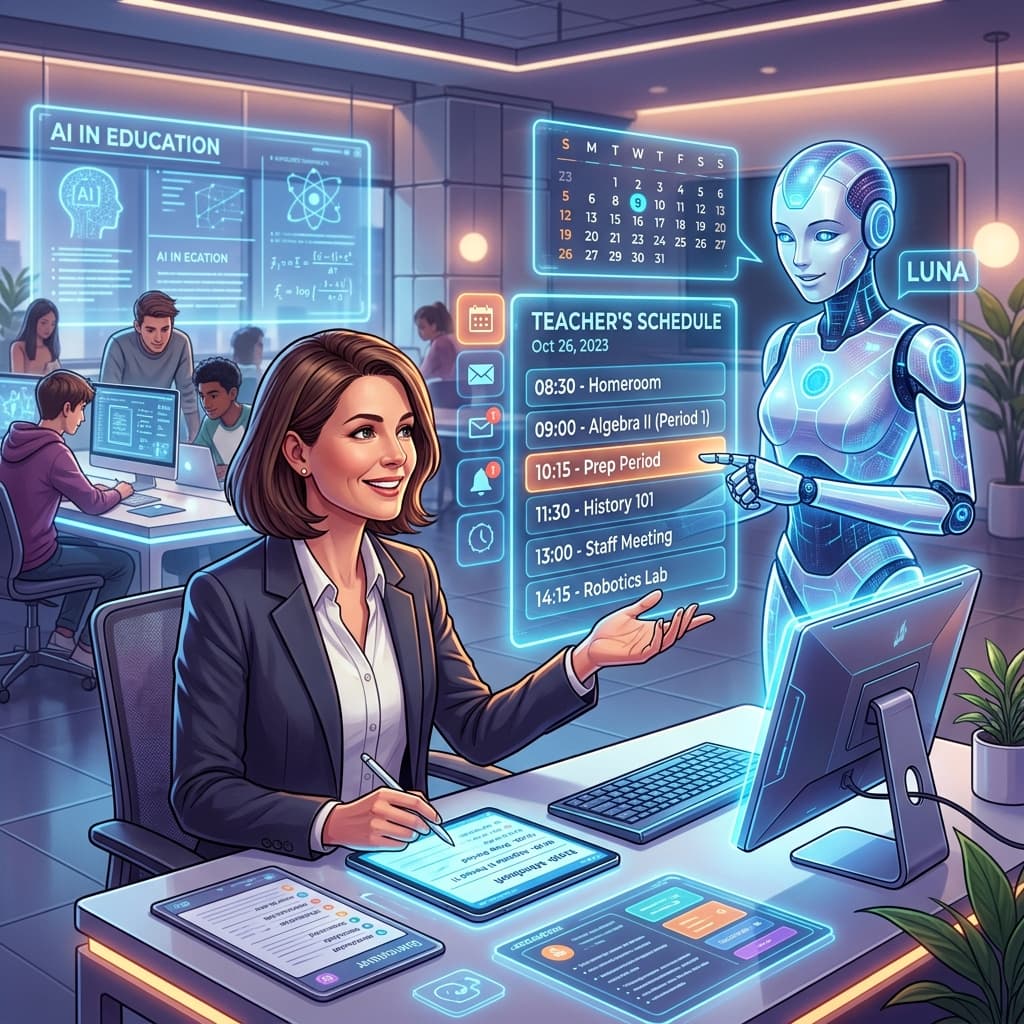
Harnessing AI to Excel in the South African Classroom: A CAPS Curriculum Case Study
The landscape of education is in constant flux, and for us South African teachers, navigating the intricacies of the CAPS (Curriculum and Assessment Policy Statement) curriculum while embracing new technological advancements can feel like a balancing act. However, a powerful ally has emerged, one that promises to streamline our workload, enhance our teaching strategies, and ultimately, enrich the learning experience for our learners: Artificial Intelligence (AI). This blog post delves into a real-world application, Case Study 76, showcasing how AI can be effectively implemented to support and elevate teaching within the framework of the CAPS curriculum across Grades R-12.
The CAPS Challenge and the AI Opportunity
We know the CAPS curriculum intimately. Its structure, its learning objectives, its assessment requirements – they are the bedrock of our daily practice. Yet, the sheer volume of planning, resource creation, differentiation, and assessment marking can be overwhelming, especially with limited resources and diverse classroom needs. This is where AI steps in, not as a replacement for the teacher, but as a sophisticated tool to augment our capabilities.
Case Study 76, conducted within a diverse group of South African schools – from under-resourced rural settings to well-equipped urban institutions – focused on a simple yet profound question: "How can AI realistically support the implementation of CAPS across various subject areas and grade levels in South Africa?" The results were illuminating, revealing AI's potential to address some of our most pressing challenges.
AI as a CAPS Planning Partner: From Generic to Gemstone
One of the most time-consuming aspects of CAPS implementation is lesson planning. Teachers often spend hours trawling for relevant resources, adapting them to suit their learners' specific needs, and ensuring alignment with CAPS objectives.
Case Study 76 Highlight: A Grade 8 Mathematics teacher, Mr. Themba, was struggling to find engaging ways to teach fractions, a perennial challenge for many learners. Using an AI-powered lesson planner, he input the relevant CAPS topic (e.g., "Fractions: Operations and Relationships"), his learners' general proficiency level, and the available classroom resources.
AI's Contribution: The AI generated a series of differentiated lesson plans. For learners struggling with basic concepts, it suggested visual aids and hands-on activities (linking to the concrete-operational stage of Piaget's theory, often relevant in this age group). For those ready for more advanced challenges, it proposed problem-solving scenarios and real-world applications of fractions, encouraging critical thinking aligned with higher-order cognitive skills mandated by CAPS. It even suggested assessment questions that directly probed the understanding of specific CAPS skills, such as "applying fractions in practical contexts."
Practical Advice for South African Teachers:
- Start with the CAPS Document: Before engaging with AI tools, have your specific CAPS topic, learning objectives, and assessment criteria clearly defined. This is your essential input for the AI.
- Leverage AI for Differentiation: Don't just accept the first output. Prompt the AI to generate differentiated activities for various learning needs (e.g., "Provide three different levels of complexity for this activity," or "Suggest modifications for learners with reading difficulties").
- Focus on Local Relevance: If your AI tool allows, specify the South African context. For example, when planning a Social Sciences lesson on historical events, request that the AI consider South African perspectives and historical figures.
Resource Generation and Adaptation: Bridging the Resource Gap
The reality of many South African classrooms is a scarcity of up-to-date and culturally relevant teaching materials. AI can be a game-changer in this regard.
Case Study 76 Highlight: A Grade 3 English Home Language teacher, Ms. Zola, needed to create engaging reading comprehension passages about South African biodiversity for her learners. The existing textbooks were outdated and lacked local flavour.
AI's Contribution: Ms. Zola used an AI text generator. She provided keywords like "South African fynbos," "unique animals," "Grade 3 reading level," and "CAPS comprehension skills." The AI produced several age-appropriate stories, incorporating vocabulary relevant to CAPS word lists for this grade. Crucially, it also generated comprehension questions that assessed inferential thinking and understanding of main ideas, directly aligning with the CAPS assessment requirements for this skill.
Practical Advice for South African Teachers:
- Personalise Learning Materials: Use AI to create stories, dialogues, or scenarios that reflect the diverse cultures, languages, and environments of South Africa. This makes learning more relatable and engaging.
- Generate Assessment Items: AI can be invaluable for creating multiple-choice questions, true/false statements, short answer prompts, and even essay questions aligned with specific CAPS assessment standards. Always review these for accuracy and appropriateness.
- Translate and Simplify: For multilingual classrooms, AI translation tools can help make complex texts accessible to learners who are still developing their proficiency in the language of instruction. Similarly, AI can simplify complex academic language to suit younger learners.
Assessment Support: Marking Smarter, Not Harder
Assessment is the backbone of CAPS, but marking can be a significant burden. AI is beginning to offer practical solutions, especially for objective assessments and initial drafts of written work.
Case Study 76 Highlight: A Grade 10 Life Sciences teacher, Mr. Nkosi, was faced with marking hundreds of short-answer questions on cellular respiration. He needed to ensure consistent application of the CAPS marking guidelines.
AI's Contribution: Mr. Nkosi used an AI-powered marking assistant. He uploaded his marking rubric (derived from CAPS) and the learners' responses. The AI provided an initial assessment, highlighting common errors and identifying areas where learners demonstrated strong understanding. While it didn't provide a final mark (human oversight is crucial), it significantly reduced the time spent on initial review, allowing Mr. Nkosi to focus on providing more in-depth, qualitative feedback. For essay-based assessments, AI can offer feedback on structure, grammar, and the inclusion of key concepts, acting as a valuable first pass.
Practical Advice for South African Teachers:
- AI for Objective Assessments: For multiple-choice, true/false, or fill-in-the-blanks questions, AI can often provide accurate marking, freeing up valuable teacher time.
- Draft Feedback on Written Work: For essays and longer responses, AI can act as a first reader, identifying grammatical errors, suggesting improvements in sentence structure, and flagging potentially missing information based on your provided prompts. Always remember, the nuanced understanding of context and individual learner progress remains a human endeavour.
- Identify Learning Gaps: By analysing patterns in AI-assisted marking, you can gain insights into common misconceptions or areas where the majority of your learners are struggling, allowing for targeted intervention.
Addressing the South African Context: Realism and Responsiveness
It's vital to acknowledge that AI implementation in South Africa must be grounded in our unique realities.
- Access and Infrastructure: While AI tools are becoming more accessible, reliable internet access and suitable devices remain a challenge in many areas. Teachers must consider these limitations and opt for AI solutions that can work offline or with minimal bandwidth.
- Teacher Training: The effectiveness of AI hinges on teachers' digital literacy. Ongoing professional development is crucial. Case Study 76 emphasised the need for practical, hands-on training that focuses on pedagogical integration, not just technical operation.
- Ethical Considerations: Data privacy and the responsible use of AI are paramount. Teachers must be aware of the data they are sharing and ensure that AI tools comply with relevant South African privacy laws.
- Maintaining the Human Element: AI should never replace the vital human connection between teacher and learner. The empathy, encouragement, and personalised guidance that a teacher provides are irreplaceable. AI is a tool to enhance, not diminish, this relationship.
The Future of CAPS with AI
Case Study 76 demonstrated that AI is not a futuristic fantasy but a present-day reality with the potential to significantly impact the effective implementation of the CAPS curriculum in South African classrooms. By embracing AI strategically, we can:
- Save precious time: Reclaim hours for more impactful teaching and individual learner support.
- Enhance lesson quality: Create more engaging, differentiated, and locally relevant learning experiences.
- Improve assessment efficiency: Streamline marking and gain deeper insights into learner progress.
- Bridge resource gaps: Generate high-quality teaching materials tailored to our specific needs.
As South African educators, we are called to adapt and innovate. By understanding the potential of AI and approaching its implementation with a critical, context-aware mindset, we can unlock a new era of teaching excellence, ensuring that every learner has the opportunity to thrive within the framework of our esteemed CAPS curriculum. The journey is ongoing, but the prospect of a more efficient, effective, and enriching classroom powered by intelligent tools is a cause for considerable optimism.
Siyanda M.
Dedicated to empowering South African teachers through modern AI strategies, research-backed pedagogy, and policy insights.