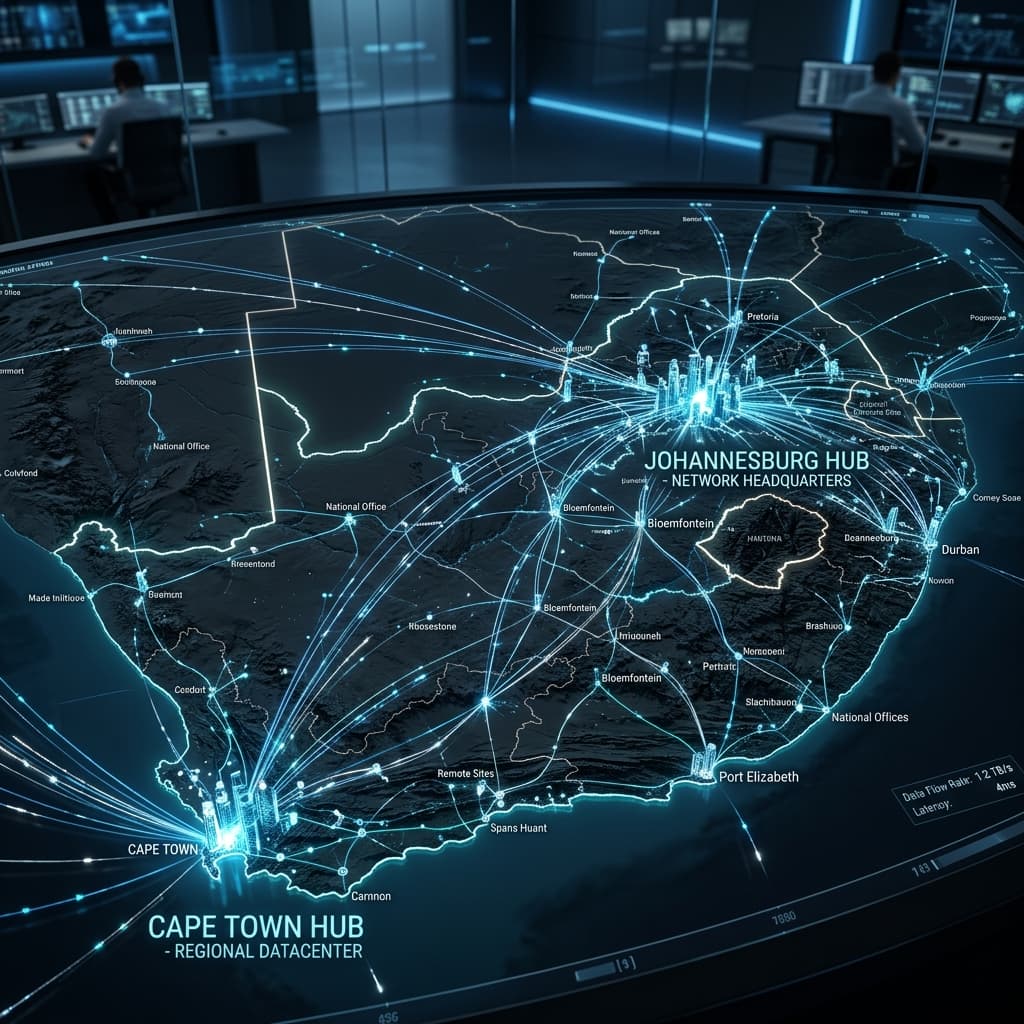
The Backbone of Commerce: The Importance of Computer Networks in Modern Businesses
In the bustling commercial hubs of Johannesburg, the tech-forward offices of Cape Town, and even the smallest agricultural enterprises in the Free State, there is a silent force that drives productivity. It isn't a single person or a specific machine, but a complex web of connections known as a computer network. In 2026, a business without a robust network is effectively invisible. But what makes these networks so vital, and how do they empower South African organizations to compete on a global scale?
What is a Computer Network?
At its simplest, a computer network is a group of two or more computers and other devices (like printers, servers, and smartphones) that are connected to share resources and exchange information. These connections can be physical (via Ethernet cables or fiber-optics) or wireless (via Wi-Fi and 5G).
Whether it's a small Local Area Network (LAN) within a single office or a Wide Area Network (WAN) connecting multiple branches across the country, the principles remain the same: connectivity leads to efficiency.
The Pillars of Network Utility in Business
Why should a business owner invest in high-quality networking? The answer lies in the four pillars of modern operation: communication, resource sharing, data management, and security.
1. Seamless Communication
Communication is the lifeblood of any organization. In the past, this meant landline phones and physical memos. Today, computer networks power instant messaging, video conferencing, and unified communication systems.
A project manager in Pretoria can hold a high-definition video meeting with a client in London and a developer in Durban simultaneously. This real-time interaction reduces delays, eliminates the costs of unnecessary travel, and allows for much faster decision-making. Networks don't just connect computers; they connect people.
2. Efficient Resource Sharing
One of the most immediate cost-saving benefits of a network is resource sharing. Instead of buying a printer for every employee, an entire department can share a single high-capacity networked printer.
This extends to software as well. Many businesses now use network-based licenses for their critical software, which is often more cost-effective than buying individual copies for every machine. By sharing hardware and software, businesses can drastically reduce their overhead costs.
3. Centralized Data Management and Storage
In a non-networked environment, information is scattered across different individual computers. This creates "data silos" where one department doesn't know what another is doing.
A computer network allows for centralized storage, typically on a local server or in the cloud. This ensures that every authorized employee has access to the most up-to-date information. When everyone is working from the same "source of truth," the risk of errors and duplication is significantly reduced. This centralized approach also makes backing up data much more manageable, as we only need to backup the central storage rather than every individual device.
Lesson Planner
Generate comprehensive, CAPS-aligned lesson plans in seconds.
4. Advanced Network Security
While connecting devices introduces risks, a well-managed network actually provides better security than a collection of disconnected machines. A central network allows for the implementation of robust firewalls, intrusion detection systems, and centralized antivirus updates.
Furthermore, network administrators can control who has access to which information. A junior administrator shouldn't have access to the company's confidential payroll data, and a network allows you to enforce those "minimum privilege" policies effectively. In the age of POPIA, this level of control is not just good practice—it is a legal requirement.
Types of Networks for Different Business Needs
Not every business requires a massive infrastructure. The key is to build a network that fits your specific operational goals.
- LAN (Local Area Network): Ideal for single-office environments. It is fast, secure, and perfect for sharing files and printers locally.
- WLAN (Wireless Local Area Network): Provides flexibility, allowing employees to move around the office with their laptops and mobile devices while remaining connected.
- WAN (Wide Area Network): Necessary for businesses with multiple locations. It uses public or private transmitters (like satellite or fiber lines) to bridge the gap between cities.
- VPN (Virtual Private Network): Essential for the modern remote work era. A VPN creates a secure, encrypted "tunnel" over the public internet, allowing remote employees in South Africa to access the company's internal network as if they were sitting in the office.
The Challenge: Maintenance and Scalability
A computer network is not a "set it and forget it" asset. It requires constant monitoring to ensure performance remains high. As a business grows and more devices are added, the network must be able to scale without slowing down.
This is where Managed Service Providers (MSPs) come in, offering local South African businesses the expertise to maintain their networks without needing a full-time, in-house IT department.
Connectivity as a Competitive Advantage
In South Africa, where internet infrastructure is rapidly improving but still varies by region, having a reliable network is a competitive advantage. It allows a business to participate in the burgeoning e-commerce market, provide better customer service through digital channels, and leverage AI tools that require constant data flow.
Conclusion: Investing in Your Infrastructure
A robust computer network is the silent engine of the modern South African business. It powers the communication that wins deals, the collaboration that creates innovation, and the security that protects your assets.
At SA Teachers, we rely on our sophisticated network infrastructure to deliver high-quality educational tools to thousands of educators in real-time. Whether you are running a school or a startup, the message is the same: your network is your foundation. Invest in it wisely, maintain it diligently, and it will support your growth for years to come.
Trust Molai is the Founder of SA Teachers and an advocate for digital business transformation. He believes that strong technical foundations are the key to economic success in South Africa.
Trust Molai
Founder of SA Teachers. Passionate about educational technology, programming, and empowering the next generation of South African learners.