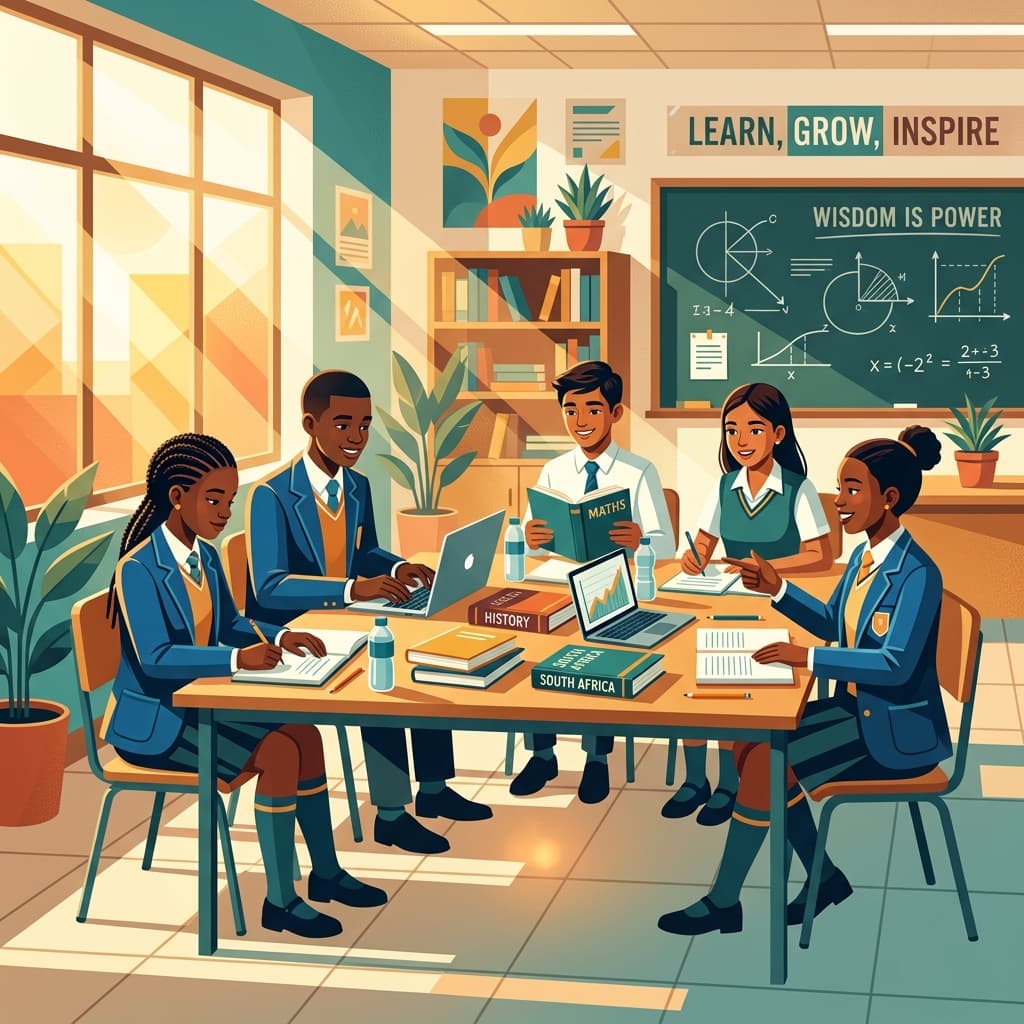
Beyond the Textbook: How to Create Engaging Lesson Plans That Captivate South African Learners (CAPS-Aligned)
We’ve all been there. It’s Sunday evening, the week's prep looms large, and you're staring at a blank lesson plan template. The pressure is on. You need to cover the CAPS curriculum, prepare for potential departmental visits, manage a diverse classroom of 40+ learners, and somehow, amidst it all, spark a genuine love for learning. It feels like an impossible task. The temptation to just "get through the content" is real.
But what if we shifted our perspective? What if a lesson plan wasn't just a compliance document for your HOD, but a strategic blueprint for engagement? What if it was the single most powerful tool you have to transform a restless, distracted classroom into a hub of curiosity and active participation?
As South African educators, we face unique challenges—from resource constraints and large class sizes to learners from a vast array of linguistic and socio-economic backgrounds. A "one-size-fits-all" approach simply won't cut it. This comprehensive guide will provide you with practical, actionable strategies rooted in the South African context to design lesson plans that not only meet CAPS requirements but also keep your learners genuinely interested and invested in their own education.
The Foundation: What is "Engagement" in a South African Classroom?
Before we dive into the "how," let's clarify the "what." Learner engagement isn't about being a stand-up comedian at the front of the class or having the most colourful PowerPoint slides. Those things can help, but true engagement is cognitive, not just performative.
Engagement is the student's active, focused participation in the learning process. It's when a learner moves from being a passive recipient of information to an active constructor of knowledge.
In our context, an engaged learner might be:
- A Grade R learner sorting recycled materials into different groups based on texture.
- A Grade 7 Social Sciences learner debating the impact of mining on a local community.
- A Grade 10 Physical Sciences learner collaborating with a partner to design an experiment to test conductivity.
- A Grade 12 isiZulu learner analysing the use of metaphor in a modern poem.
The goal is to create lessons that demand thinking, not just memorising. The CAPS curriculum, despite its density, is built on this very principle. It calls for critical thinking, problem-solving, and collaboration—the very cornerstones of an engaged classroom.
The CAPS Blueprint: Turning Compliance into a Framework for Creativity
Many teachers view the prescribed CAPS lesson plan format as restrictive. Let's reframe it as our foundational structure. It provides the essential "bones" of a good lesson; our job is to add the "muscle and heart" that bring it to life.
A standard CAPS-aligned lesson plan includes key sections. Here’s how to inject engagement into each one:
1. Learning Objectives (Content, Concepts, and Skills)
The Standard Approach: Copying and pasting the objectives directly from the CAPS document.
The Engaging Approach: Translate the objectives into learner-friendly language. At the start of the lesson, state them clearly: "By the end of this lesson, you will be able to..." This small shift changes the focus from what the teacher will cover to what the learner will achieve. It gives them a clear destination for the lesson's journey.
- Example (Grade 6 Maths): Instead of just listing "Capacity/Volume," try: "Today, we're going to become master chefs! By the end of this lesson, you will be able to read and convert millilitres and litres so you can follow any recipe perfectly."
2. The Introduction / The "Hook" (The First Five Minutes)
The Standard Approach: "Good morning, class. Open your textbooks to page 54."
The Engaging Approach: This is your golden opportunity to grab their attention. Your hook should be surprising, intriguing, or directly relevant to their lives.
- Provocative Question: "What if you woke up tomorrow and there was no electricity? What are the first five things you would miss?" (For a lesson on energy).
- A Real-World Object: Bring in a traditional Zulu shield (umkhonto) for a history lesson, or different types of soil from the school grounds for a Natural Sciences lesson.
- A Quick Poll/Survey: "Raise your hand if you think social media has a positive impact on your life." (For a Life Orientation lesson).
- A Shocking Statistic: "Did you know that South Africa has 11 official languages, but some experts say we have over 30 spoken languages in total?" (For a lesson on cultural diversity).
3. Development of the Lesson (The "Main Course")
The Standard Approach: Teacher talks, learners listen (and hopefully take notes).
The Engaging Approach: This is where you introduce variety. The "chunk and chew" method is highly effective. Present information in small chunks (5-10 minutes of direct instruction) and then immediately give learners an activity to "chew" on or process that information.
- Think-Pair-Share: A simple but powerful tool. Pose a question, give learners 30 seconds to think individually, one minute to discuss with a partner, and then call on pairs to share with the class. It's low-prep and ensures everyone participates.
- Jigsaw Method: Excellent for covering a lot of content collaboratively. Divide a topic into smaller parts. Form "expert groups" where each group learns about one part. Then, rearrange the learners into "jigsaw groups" with one expert from each topic. Each expert then teaches their part to their new group.
- Gallery Walk: Write different questions or place different stimulus materials (like photos, short texts, or diagrams) on posters around the room. In small groups, learners rotate from station to station, discussing and adding their thoughts with a koki pen. It gets them moving and talking.
4. Consolidation and Assessment
Lesson Planner
Generate comprehensive, CAPS-aligned lesson plans in seconds.
The Standard Approach: "Any questions? Okay, do the activity at the end of the chapter for homework."
The Engaging Approach: End the lesson with a deliberate activity that helps learners summarise what they've learned and allows you to quickly gauge understanding (assessment for learning).
- Exit Ticket: Ask learners to write the answer to one specific question on a small piece of paper before they leave. For example: "What is the one thing you are still unsure about?" or "Describe the process of photosynthesis in one sentence." This gives you instant, valuable feedback.
- 3-2-1 Summary: Ask learners to write down 3 things they learned, 2 things they found interesting, and 1 question they still have.
- Human Barometer: Make a statement related to the lesson content and ask learners to stand along an imaginary line in the classroom, from "Strongly Agree" at one end to "Strongly Disagree" at the other. Ask a few learners to justify their positions.
Practical Strategies for the Realities of South African Teaching
Theory is one thing, but making it work in a crowded classroom in the middle of winter with load shedding on the schedule is another. Here are strategies that work in our context.
Differentiated Instruction is Non-Negotiable
In a classroom where you might have learners who are still grasping the language of instruction sitting next to learners who are ready for university-level concepts, differentiation is key. It doesn't mean planning 40 different lessons. It means providing multiple pathways to the same learning objective.
- Tiered Activities: Create three versions of the same activity: one for learners who need more support (with sentence starters or a word bank), one for the majority of the class, and one that offers a greater challenge (requiring higher-order thinking).
- Choice Boards: Create a grid of nine activities (like a Tic-Tac-Toe board). All activities lead to the same core understanding, but they cater to different learning styles (e.g., write a poem, draw a diagram, create a short play). Learners must choose three activities to complete in a row.
- Flexible Grouping: Don't always group learners by ability. Sometimes use mixed-ability groups so peer-to-peer teaching can occur. Other times, group by interest or let them choose their own partners.
Make it Local, Make it Relevant
The quickest way to engage a learner is to connect the curriculum to their world.
- Geography: Instead of just studying maps of Europe, have learners map their own route to school, identifying key landmarks and potential hazards.
- Mathematics: Use examples from local spaza shops for lessons on profit and loss. Calculate the volume of a rondavel or the area of a soccer field.
- History: Invite a grandparent or community elder to share their personal stories about historical events. Study the history of your own town or city.
- Life Sciences: Investigate the indigenous plants on the school grounds and their traditional uses.
The Secret Weapon: How to Plan Engaging Lessons Without Burning Out
We hear you. This sounds incredible, but it also sounds like a lot more work. The administrative burden on South African teachers is immense. Between marking, reports, parent meetings, and extramurals, who has time to redesign every single lesson plan from scratch?
This is precisely why we built the SA Teachers Lesson Planner.
We believe that technology should serve teachers, not the other way around. Your time and energy are your most valuable resources. They should be spent on the creative, human elements of teaching—connecting with learners and designing engaging experiences—not on tedious administrative tasks.
The SA Teachers automated Lesson Planner is the premier solution designed specifically for the needs of South African educators. Here’s how it transforms your planning process:
Guaranteed CAPS Alignment: Say goodbye to hours of cross-referencing policy documents. Our tool integrates the entire CAPS curriculum. When you select your grade and subject, it automatically populates your lesson plan with the correct topics, objectives, and skills for that term. You start with a compliant, perfectly structured foundation every single time.
Professional, Standardised Documents: Create flawless, professional-looking lesson plans in the accepted DBE format with just a few clicks. Whether it's for your own files, your HOD, or a surprise visit from the district office, your documentation will always be impeccable.
Massive Time Savings: The automation handles the repetitive, structural parts of the plan in seconds. This frees you up to focus your brainpower on the parts that matter most: crafting that killer hook, designing a fun group activity, and thinking of relevant, local examples.
Centralised and Accessible: No more searching for lost files on a USB stick. All your lesson plans are stored securely in one place, accessible from anywhere. You can easily edit, duplicate, and adapt lessons from one year to the next.
The SA Teachers Lesson Planner doesn't replace your professional judgment; it enhances it. It takes care of the compliance so you can focus on the connection. It handles the structure so you can focus on the strategy.
Conclusion: From Planner to Playbook
Creating engaging lesson plans is not about adding more work to your already overflowing plate. It's about working smarter, being more intentional, and shifting your focus from "covering content" to "uncovering learning."
By weaving strategies like a strong hook, varied activities, and local relevance into the CAPS framework, you can transform your classroom. And by leveraging powerful tools like the SA Teachers Lesson Planner, you can do it sustainably, without sacrificing your weekends or your passion for teaching.
An engaged learner is a motivated learner. They ask more questions, they retain more information, and they cause fewer disruptions. Your lesson plan is more than a document; it's your daily playbook for making a real, lasting impact.
Ready to revolutionise your planning and reclaim your time for what you do best? Explore the SA Teachers Lesson Planner today and discover the difference between simply planning a lesson and designing an unforgettable learning experience.
Tyler M.
Dedicated to empowering South African teachers through modern AI strategies, research-backed pedagogy, and policy insights.