The Impact of Artificial Intelligence on Jobs in South Africa: Future-Proofing Your Career
The conversation around Artificial Intelligence (AI) often fluctuates between two extremes: breathless utopianism and apocalyptic fear. For South Africans, the reality is likely to be somewhere in the middle—a period of intense transformation that will redefine the nature of work. As AI systems become more capable of performing complex cognitive tasks, the South African job market is undergoing a fundamental shift. For our learners, the question is no longer if AI will affect their futures, but how they can adapt to thrive in this new reality.
Understanding the "Augmentation" vs. "Automation" Debate
Before discussing specific jobs, it is crucial to understand the difference between job automation and job augmentation.
- Automation: This occurs when a machine or software takes over an entire task or role previously performed by a human.
- Augmentation: This occurs when AI acts as a "co-pilot," enhancing a human's ability to perform their job more efficiently or creatively.
In South Africa, we are seeing much more augmentation than total automation. Most jobs will not disappear; rather, the tasks within those jobs will change. This means that the most successful professionals of the future will not be those who "compete" with AI, but those who know how to "collaborate" with it.
Jobs That May Experience Significant Change
Certain sectors of the South African economy are more susceptible to AI-driven changes than others. These are typically roles that involve repetitive data processing or routine administrative tasks.
1. Data Entry and Administrative Support
The heavy lifting of data organization, filing, and basic bookkeeping is increasingly being handled by intelligent software. In South Africa's banking and insurance sectors, AI is already being used to process claims and manage thousands of customer records in seconds.
2. Basic Information Services and Call Centers
South Africa is a global hub for Business Process Outsourcing (BPO). AI chatbots and voice assistants are becoming sophisticated enough to handle basic customer inquiries. While this may reduce the need for entry-level "script-followers," it increases the demand for high-level support agents who can handle complex human emotions and nuanced problem-solving.
3. Retail and Logistics
In warehouses and retail distribution centers across Midrand and Durban, AI-driven inventory management is optimizing supply chains. While human labor is still vital, the focus is shifting toward managing the systems that run the logistics.
New Jobs Created by the AI Revolution
History shows that while technology displaces certain roles, it invariably creates new ones that were previously unimaginable. The AI revolution is already generating a demand for specialists in South Africa.
1. AI Ethicists and Policy Advisors
As we integrate AI into law, healthcare, and education, we need professionals who can ensure these systems are used fairly and without bias. In the South African context, this involves ensuring that AI doesn't reinforce existing societal inequalities.
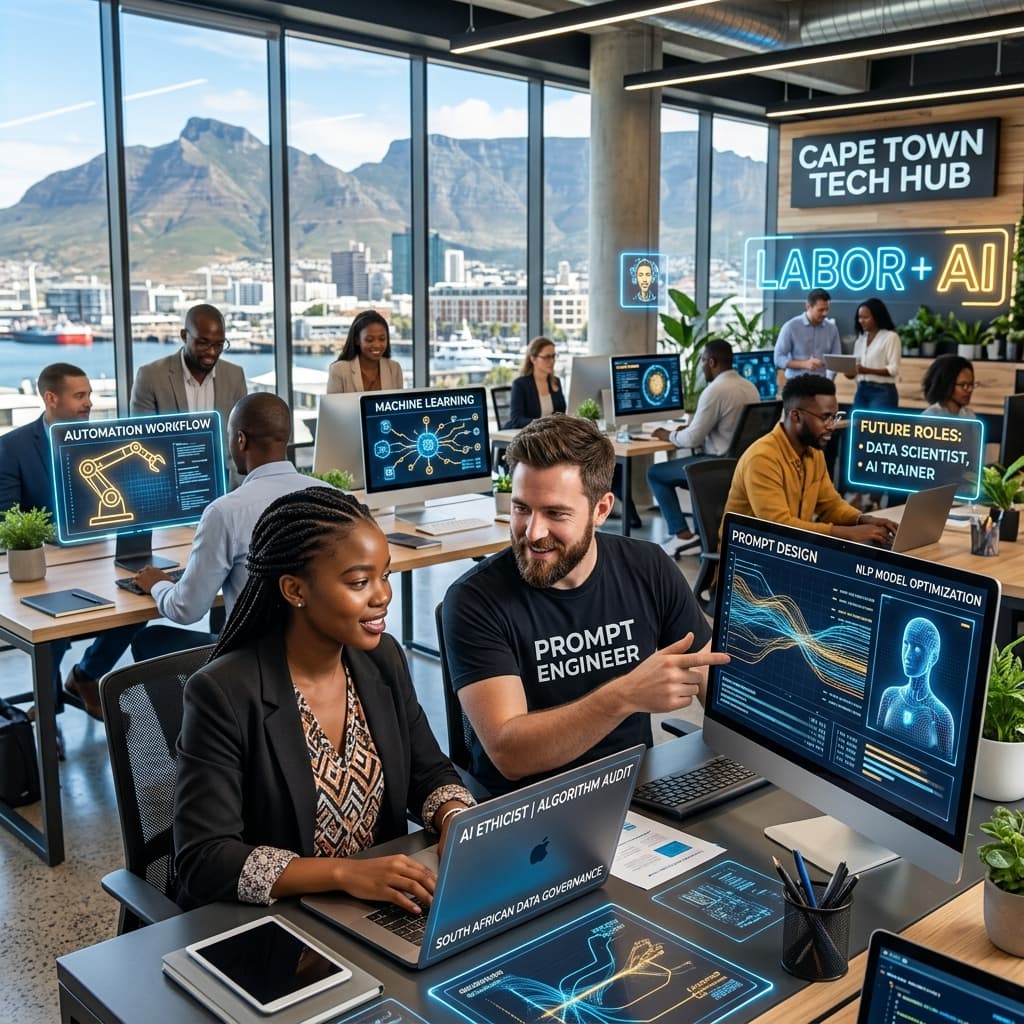
2. Prompt Engineers and AI Coordinators
The ability to "speak" to AI—to craft precise instructions that produce high-quality results—is becoming a vital skill. Companies will need "AI coordinators" who can look at a business problem and decide which AI tools are best suited to solve it.
3. Data Curators and Machine Learning Trainers
AI models are only as good as the data they are trained on. We need professionals who can curate high-quality South African data, including our indigenous languages and local cultural contexts, to ensure AI tools are relevant to our citizens.
The Importance of Digital Skills and "Human-Centric" Abilities
To prepare for this future, the South African education system must pivot. We need to move beyond teaching learners "what to think" and start teaching them "how to think" alongside machines.
1. Information Literacy
Learners must become experts at identifying misinformation. Since AI can generate convincing but false information (hallucinations), the ability to fact-check and verify data is a critical survival skill.
2. Computational Thinking
Understanding the logic behind how computers solve problems is more important than memorizing specific software. This is why programming and logic are such important additions to our school curriculum.
3. Soft Skills: The "Human Advantage"
As AI takes over technical and routine tasks, the value of uniquely human traits increases. AI cannot replicate:
- Deep Empathy: Critical in healthcare and education.
- Complex Creativity: The ability to create something entirely new and culturally resonant.
- Ethical Judgment: Making difficult decisions based on values rather than just data.
Challenges Specific to South Africa
We must acknowledge that the "AI divide" could exacerbate our existing digital divide. Learners in well-resourced schools are already using AI to enhance their studies, while those in rural schools without reliable internet or hardware risk being left behind.
Bridging this gap is not just a technological challenge; it is a moral imperative. Government initiatives like the Presidential Commission on 4IR are a start, but we need massive investment in affordable data and school infrastructure to ensure that every South African learner has a seat at the table of the future workforce.
Conclusion: Embrace the Change
The impact of AI on jobs in South Africa is not a distant prophecy; it is happening now. However, rather than viewing AI as a threat, we should see it as a powerful tool that can help us solve some of our most persistent challenges.
At SA Teachers, we are committed to ensuring that educators are the first to master these tools. When teachers are AI-literate, they can effectively prepare their learners for a world where AI is a constant companion. The future of work in South Africa belongs to the curious, the adaptable, and the digitally brave. By starting today, we can ensure that our learners are ready for whatever roles the 2030s and 2040s throw at them.
Trust Molai is the Founder of SA Teachers. He is an expert in digital transformation and is dedicated to preparing South African youth for the challenges of the future economy.
Trust Molai
Founder of SA Teachers. Passionate about educational technology, programming, and empowering the next generation of South African learners.